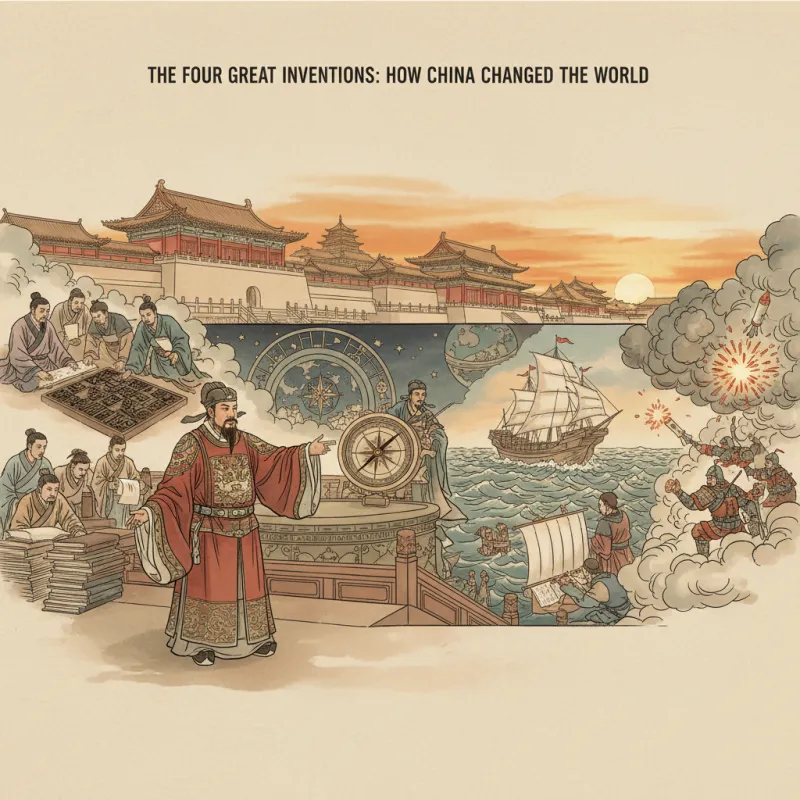
Picture a world where every book costs as much as a house. Where knowledge is literally weighed in gold, and a single letter requires a team of oxen to transport. That was reality before 105 CE, when a Chinese court official named Cai Lun (蔡伦, Cài Lún) presented Emperor He of Han with sheets of a revolutionary new material made from tree bark, hemp, old rags, and fishing nets. He called it paper.
The invention seems almost mundane to us now — we throw away more paper in a week than most ancient scholars saw in a lifetime. But paper was the internet of its age, a technology so transformative that it's hard to overstate its impact. Before paper, Chinese scribes wrote on bamboo strips or expensive silk. A single copy of the Confucian classics required several cartloads of bamboo. After paper, those same texts could fit in a shoulder bag.
The Material That Made Bureaucracy Possible
China's imperial bureaucracy — the most sophisticated administrative system the ancient world had ever seen — would have been impossible without paper. By the Tang Dynasty (618-907 CE), the government was consuming paper by the ton: official documents, tax records, census data, examination papers for the civil service, imperial edicts. The Chinese examination system that selected officials based on merit rather than birth? That only worked because paper made it affordable to print study materials and test millions of candidates.
But here's what's fascinating: Cai Lun didn't actually invent paper from nothing. Archaeological evidence shows that crude paper existed in China as early as the 2nd century BCE. What Cai Lun did was systematize and perfect the process, creating a reliable method that could be taught and scaled. He was less inventor and more industrial engineer — and that's exactly what China needed.
The recipe spread slowly at first. Papermaking remained a closely guarded Chinese secret for centuries, protected the way nuclear technology is today. When Tang forces clashed with the Abbasid Caliphate at the Battle of Talas in 751 CE, captured Chinese papermakers revealed the technique to their captors. From there, paper traveled to Baghdad, then Cairo, then Europe. By the time it reached Europe in the 12th century, China had been using it for over a thousand years.
Printing: The First Information Revolution
Paper was revolutionary, but printing was explosive. The earliest form was woodblock printing (雕版印刷, diāobǎn yìnshuā), where artisans carved entire pages in reverse onto wooden blocks, inked them, and pressed paper against them. The oldest surviving printed book is the Diamond Sutra, a Buddhist text printed in 868 CE during the Tang Dynasty. It's not just old — it's stunningly beautiful, with intricate illustrations and crisp text that would impress modern printers.
But woodblock printing had a problem: every page required a new carved block. Change one character, and you had to carve the whole block again. Enter Bi Sheng (毕昇, Bì Shēng), a commoner and artisan who around 1040 CE invented movable type using clay characters. Each character was a separate piece that could be arranged, used, then rearranged for the next page. It was the Lego principle applied to printing, and it was brilliant.
Here's the twist that surprises most people: movable type never fully replaced woodblock printing in China. Why? The Chinese writing system has thousands of characters, not a 26-letter alphabet. Setting up a print shop required organizing and storing thousands of individual pieces. For many applications, especially books that would be reprinted many times, carving a woodblock was actually more efficient. The technology that revolutionized Europe when Gutenberg "invented" it in 1450 was less revolutionary in its homeland — a reminder that the same technology can have radically different impacts in different contexts.
Still, printing transformed Chinese society. Buddhist monasteries printed sutras by the thousands. The government printed paper money (another Chinese first). Merchants printed contracts and receipts. By the Song Dynasty (960-1279 CE), China had a print culture that wouldn't appear in Europe for another four centuries.
Gunpowder: The End of Knights and Castles
Gunpowder (火药, huǒyào — literally "fire medicine") started as a mistake. Tang Dynasty alchemists searching for an elixir of immortality instead discovered a mixture that, when ignited, produced a violent explosion. The irony is almost too perfect: seeking eternal life, they created history's most effective killing tool.
The earliest reference to gunpowder appears in a 9th-century Taoist text that warns alchemists not to mix certain ingredients because "smoke and flames result, burning hands and faces, and even the whole house burns down." By the 10th century, military engineers had weaponized it. The Song Dynasty faced constant pressure from northern nomadic peoples — the Khitan, the Jurchen, later the Mongols — and gunpowder weapons offered an edge against cavalry charges.
Early gunpowder weapons were crude: fire lances (essentially flamethrowers), explosive grenades, and rockets. But they evolved rapidly. By the 13th century, the Chinese had developed the fire lance into the first true guns — metal tubes that used gunpowder to propel projectiles. The oldest surviving gun, discovered in Manchuria, dates to 1288.
The Mongols, after conquering China, spread gunpowder technology across their vast empire. By the 14th century, gunpowder weapons had reached Europe, where they would transform warfare completely. Medieval castles, designed to withstand arrows and siege towers, crumbled before cannon fire. Armored knights, the elite warriors of feudal Europe, became obsolete when a peasant with a gun could kill them from a hundred yards away. The entire social structure of medieval Europe — built on the military supremacy of mounted, armored nobility — collapsed. Gunpowder was the great equalizer, and it came from China.
The Compass: Opening the Oceans
The compass (指南针, zhǐnánzhēn — "south-pointing needle") emerged from another unexpected source: feng shui. Ancient Chinese geomancers used naturally magnetic lodestone to align buildings and graves with cosmic forces. Someone noticed that a magnetized needle, when allowed to rotate freely, always pointed north-south. By the Song Dynasty, Chinese sailors were using magnetic compasses for navigation.
Before the compass, sailors hugged coastlines, navigating by landmarks and the stars. Open ocean was terrifying — lose sight of land, and you were lost. The compass changed everything. Chinese ships began making direct crossings of the South China Sea and Indian Ocean. The massive treasure fleets of Admiral Zheng He (郑和, Zhèng Hé), which sailed as far as East Africa in the early 15th century, relied on compass navigation. These weren't small boats — Zheng He's treasure ships were over 400 feet long, larger than anything Europe would build for another century.
The compass reached Europe by the 12th century, probably through Arab intermediaries. Its impact was immediate. European sailors, previously confined to the Mediterranean and coastal waters, began venturing into the Atlantic. Columbus, Magellan, da Gama — none of their voyages would have been possible without the compass. The Age of Exploration, which reshaped the entire world, was enabled by a Chinese invention originally used to arrange furniture.
Why China? And Why Then?
Here's the question that haunts historians: why did all four of these world-changing inventions emerge from China? And why during the Tang and Song dynasties specifically?
Part of the answer is economic. The Song Dynasty, despite constant military pressure from the north, was phenomenally wealthy. It had a commercialized economy, extensive trade networks, and a large literate class. Innovation thrives in such conditions. The government also played a role — Chinese emperors funded research, rewarded inventors, and quickly adopted useful technologies for military and administrative purposes.
But there's a deeper pattern. All four inventions emerged from practical problem-solving, not abstract theorizing. Paper solved the problem of expensive writing materials. Printing addressed the need to reproduce texts quickly. Gunpowder came from alchemical experiments. The compass emerged from geomancy. Chinese innovation was empirical, experimental, and focused on what worked. This was both a strength and, eventually, a limitation — Chinese science excelled at practical technology but developed less theoretical framework than later European science.
The Great Divergence
Here's the uncomfortable question: if China invented these world-changing technologies centuries before Europe, why did Europe, not China, dominate the modern world? This is the "Great Divergence" debate that obsesses historians.
The answer is complex and contested, but part of it involves how technologies were used. In Europe, printing fueled the Protestant Reformation and the Scientific Revolution — movements that challenged authority and traditional knowledge. In China, printing reinforced Confucian orthodoxy by making classical texts more available. Gunpowder helped European states centralize power and fund exploration through conquest. In China, it was used defensively, to protect against nomadic invasions.
Technology alone doesn't determine outcomes. Context, culture, and institutions matter just as much. The same inventions that helped Europe expand globally were used differently in China, with different results. That's not a judgment about Chinese culture — it's a reminder that technology is never neutral. Its impact depends on the society that wields it.
Legacy: The Inventions That Made Modernity
Francis Bacon, writing in 1620, identified printing, gunpowder, and the compass (he didn't mention paper separately) as the three inventions that "have changed the whole face and state of things throughout the world." He didn't know they were all Chinese — that knowledge came later. But he was right about their impact.
These four inventions didn't just change technology. They changed what was possible. Paper and printing made knowledge cheap and portable, enabling mass literacy and education. Gunpowder ended the military dominance of armored cavalry and made centralized nation-states possible. The compass opened the oceans, connecting continents and creating the first truly global economy.
The modern world — with its books, guns, and global trade — was built on foundations laid in Tang and Song Dynasty China. That's not nationalist mythology. It's simply historical fact. And it raises a question we're still grappling with: in a world where technology spreads globally, who gets credit for innovation, and what does that credit mean?
The Four Great Inventions remind us that innovation is often a long, collaborative process spanning centuries and continents. Cai Lun improved paper, but he didn't invent it from nothing. Bi Sheng created movable type, but Gutenberg perfected it for alphabetic languages. Chinese alchemists discovered gunpowder, but European engineers developed modern firearms. The compass emerged from Chinese geomancy but enabled European exploration.
Perhaps that's the real lesson: great inventions belong to humanity, not to nations. They emerge from specific contexts but transform the world. And the fact that four of history's most consequential technologies originated in China is a testament to the creativity, ingenuity, and problem-solving capacity of Chinese civilization at its height — a reminder that innovation can come from anywhere, and that the future, like the past, will be shaped by ideas that cross borders and transform societies in ways their inventors never imagined.
Related Reading
- Porcelain: The Art That Named a Nation
- Unveiling Ancient Chinese Innovations: A Journey Through Dynasties and Culture
- Traditional Chinese Medicine: 5,000 Years of Healing
- Innovations of Ancient China: How Dynasties Shaped World-Changing Inventions
- Chinese Inventions the World Forgot: Beyond Paper, Printing, Gunpowder, and the Compass
- The Terracotta Army: 8,000 Soldiers Guarding an Emperor's Tomb
- How Buddhism, Islam, and Christianity Traveled the Silk Road
- Delving into Ancient China: A Journey Through Dynasties, Emperors, and Cultural Treasures