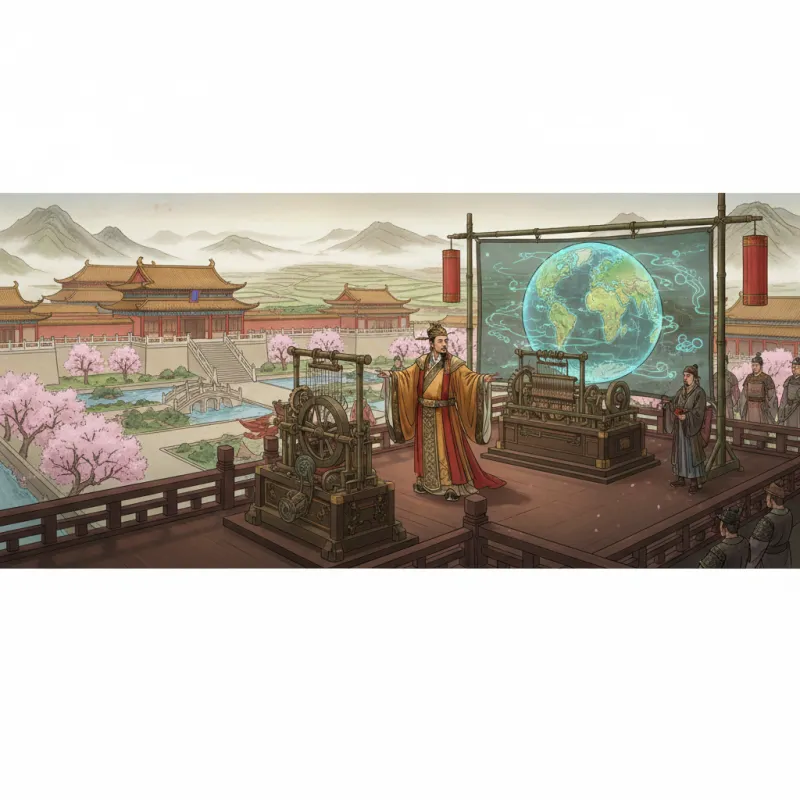
When Zhang Heng's bronze dragons dropped their balls in 132 CE, nobody in the capital believed him. The device — a massive urn ringed with eight dragon heads, each clutching a bronze sphere above a waiting toad — had just indicated an earthquake to the west. But the ground in Luoyang hadn't moved. Court officials mocked the contraption. Then, days later, a messenger arrived: a devastating quake had struck Gansu, hundreds of miles away. Zhang Heng's seismoscope had detected it before any human could feel it. The 四大发明 (sì dà fāmíng, Four Great Inventions) — paper, printing, gunpowder, and the compass — dominate every discussion of Chinese innovation. But they're just the opening act. Behind them stands a catalog of inventions so advanced, so unexpected, that the world simply forgot China made them first.
The Seismoscope That Detected Earthquakes 1,700 Years Before the West
Zhang Heng (张衡, 78–139 CE) wasn't just an inventor. He was a Han Dynasty (汉朝, Hàn Cháo) polymath who calculated pi to five decimal places, mapped 2,500 stars, and wrote poetry that's still studied today. His seismoscope — the 候风地动仪 (hòufēng dìdòng yí, instrument for measuring seasonal winds and earth movements) — was a bronze vessel about six feet in diameter. Eight dragon heads faced the cardinal and ordinal directions. When seismic waves reached the device, an internal pendulum mechanism would trigger one dragon to drop its ball into a bronze toad's mouth below, indicating the earthquake's direction.
The Western world wouldn't develop a comparable seismograph until 1848, when Italian physicist Luigi Palmieri created his electromagnetic seismometer. That's a 1,716-year gap. Zhang Heng's device wasn't just decorative — it was functional enough that the Han court used it for disaster response, dispatching aid before reports arrived by messenger. The original was lost centuries ago, but modern reconstructions based on historical texts have proven the design works.
Porcelain: The Technology That Took Europe 1,000 Years to Crack
The Chinese were making true porcelain — 瓷器 (cíqì) — by the Eastern Han Dynasty (25–220 CE), possibly earlier. This wasn't pottery. Porcelain requires kaolin clay fired at temperatures exceeding 1,200°C (2,192°F), creating a material that's translucent, resonant when struck, and completely non-porous. The Tang Dynasty (唐朝, Táng Cháo, 618–907 CE) perfected it. The Song Dynasty (宋朝, Sòng Cháo, 960–1279 CE) turned it into art.
Europeans called it "white gold" and spent centuries trying to reverse-engineer it. They failed repeatedly. Italian potters created majolica. The Dutch made delftware. Both were tin-glazed earthenware — impressive, but not porcelain. The secret wasn't cracked until 1708, when German alchemist Johann Friedrich Böttger, imprisoned and forced to make gold for Augustus the Strong, accidentally created European porcelain instead. By then, China had been exporting the real thing for over a millennium.
The economic impact was staggering. Chinese porcelain dominated global luxury markets for centuries, creating trade imbalances that European powers tried desperately to correct. The British East India Company's solution? Flood China with opium. The Opium Wars were, in part, a consequence of Europe's inability to match Chinese ceramic technology.
The Mechanical Clock: Not European, Not First
Everyone "knows" mechanical clocks are a European medieval invention. Everyone is wrong. Yi Xing (一行, 683–727 CE), a Tang Dynasty Buddhist monk and astronomer, built an astronomical clock tower in 725 CE that used an escapement mechanism — the key innovation that makes mechanical clocks possible. His water-powered device tracked celestial movements with remarkable precision.
But the real showstopper came during the Song Dynasty. Su Song (苏颂, 1020–1101 CE) constructed a 30-foot-tall astronomical clock tower in 1088 CE that was essentially a medieval computer. The 水运仪象台 (shuǐyùn yíxiàng tái, water-driven astronomical clock tower) used a sophisticated escapement mechanism, an endless power-transmitting chain drive, and a complex system of gears and wheels. It displayed celestial phenomena, tracked time, and even had mechanized puppets that rang bells and struck gongs to mark the hours.
European mechanical clocks didn't appear until the late 13th century — roughly 200 years after Su Song's masterpiece. The first European clock with an escapement mechanism dates to around 1280. Whether this represents independent invention or knowledge transfer along the Silk Road remains debated, but the chronology is clear: China got there first.
Cast Iron: A 1,700-Year Head Start
The Chinese were casting iron by the 5th century BCE. Europe didn't figure it out until the 12th century CE. That's not a typo. China had a 1,700-year monopoly on cast iron production.
The difference came down to furnace technology. Chinese blast furnaces could reach temperatures of 1,130°C (2,066°F), hot enough to melt iron completely and pour it into molds. European furnaces couldn't get hot enough, so they were stuck with wrought iron — laboriously hammered and shaped — until the High Middle Ages. The Chinese were mass-producing iron plowshares, tools, and weapons while Europeans were still in the Bronze Age mindset.
This wasn't just about tools. Cast iron enabled the construction of massive projects. The Iron Pagoda (铁塔, Tiě Tǎ) in Kaifeng, built in 1049 CE, isn't actually iron — it's brick — but the name reflects how common iron construction had become. The real iron pagodas, like the one in Dangyang built in 1061 CE, demonstrate casting techniques Europe wouldn't match for centuries.
The Stirrup: The Invention That Created Medieval Warfare
The stirrup seems simple. It's just a loop for your foot. But it revolutionized warfare, and China invented it first. Stirrups appeared in China by the 4th century CE, possibly earlier. They reached Europe by the 8th century, probably through the Avars or other Central Asian peoples.
The military implications were enormous. Stirrups transformed cavalry from mobile archers who had to slow down to shoot accurately into shock troops who could charge with lances while remaining stable in the saddle. The medieval knight — the armored, lance-wielding warrior who dominated European battlefields for centuries — was only possible because of the stirrup. Some historians argue that feudalism itself emerged as a social system to support this new, expensive form of warfare.
China, meanwhile, had already moved on. By the time European knights were perfecting the cavalry charge, Chinese armies were experimenting with gunpowder weapons and crossbow formations that could stop cavalry cold.
The Toothbrush: Yes, Really
In 1498, during the Ming Dynasty (明朝, Míng Cháo), someone in China — history didn't record their name — attached boar bristles to a bamboo handle and created the first toothbrush. Before this, people cleaned their teeth with twigs, cloths, or their fingers. The Chinese innovation was using bristles set perpendicular to the handle, the same basic design we use today.
The toothbrush didn't reach Europe until the 17th century, and even then, Europeans often substituted horsehair for boar bristles (softer, but less effective). Mass production didn't begin until 1780, when William Addis started manufacturing them in England. Nylon bristles — the modern standard — weren't invented until 1938.
This seems trivial compared to seismoscopes and cast iron, but it's emblematic of a larger pattern: China was innovating in every direction simultaneously, from the cosmic to the mundane, from astronomical instruments to personal hygiene.
The Umbrella: Not Just for Rain
Umbrellas existed in many ancient cultures, but the collapsible umbrella — the kind you can actually carry around — was a Chinese innovation from around the 21st century BCE, during the Wei Dynasty (魏朝, Wèi Cháo). These weren't rain protection. They were status symbols, used to shade nobility from the sun. The character 伞 (sǎn, umbrella) appears in texts from the Zhou Dynasty (周朝, Zhōu Cháo, 1046–256 BCE), and archaeological evidence confirms their use.
The waterproof umbrella came later, during the Song Dynasty, when craftsmen began waxing paper umbrellas to repel rain. The collapsible mechanism — using sliding joints to fold the ribs — was refined during the Ming Dynasty. Europe didn't adopt umbrellas widely until the 18th century, and even then, they were initially controversial. Jonas Hanway, an English traveler, was mocked for carrying one in London in the 1750s. The British considered umbrellas effeminate. The Chinese had been using them for 3,700 years.
Why Did the World Forget?
The question isn't why China invented so much. The question is why the West forgot, or never knew, that China invented so much. Part of the answer is timing. Many Chinese innovations reached Europe through intermediaries — Arab traders, Mongol conquerors, Silk Road merchants — which obscured their origins. Part of it is documentation. Chinese historical records are extensive, but they weren't translated into European languages until relatively recently. And part of it is bias. The 19th and early 20th centuries, when much of modern historical scholarship was established, were periods of European dominance and Chinese decline. It was easy to assume that innovation flowed one direction.
But the archaeological and textual evidence is clear. China wasn't just contributing to global technology. For much of human history, China was leading it. The Four Great Inventions are famous because they're undeniable — their impact was too large to ignore or misattribute. But they're not exceptional. They're representative. Behind them stands a civilization that was systematically innovating across every field of human endeavor, from seismology to dentistry, from metallurgy to timekeeping.
The inventions the world forgot aren't forgotten because they were unimportant. They're forgotten because remembering them requires acknowledging just how advanced Chinese civilization was, for how long, and how much of what we consider "universal" human progress was actually invented in one place, by one culture, and then spread outward to the rest of the world. The dragons dropped their balls. The world just wasn't paying attention.
Related Reading
- Porcelain: The Art That Named a Nation
- Traditional Chinese Medicine: 5,000 Years of Healing
- The Four Great Inventions: How China Changed the World
- Traditional Chinese Medicine: 3,000 Years of Healing Philosophy
- Forgotten Chinese Inventions That Changed the World Before the West Noticed
- Unraveling the Economic Tapestry of Ancient Chinese Dynasties
- Diplomacy and Cultural Exchange in Chinese Ancient Dynasties
- Zhuge Liang: The Sleeping Dragon Who Became China's Greatest Strategist