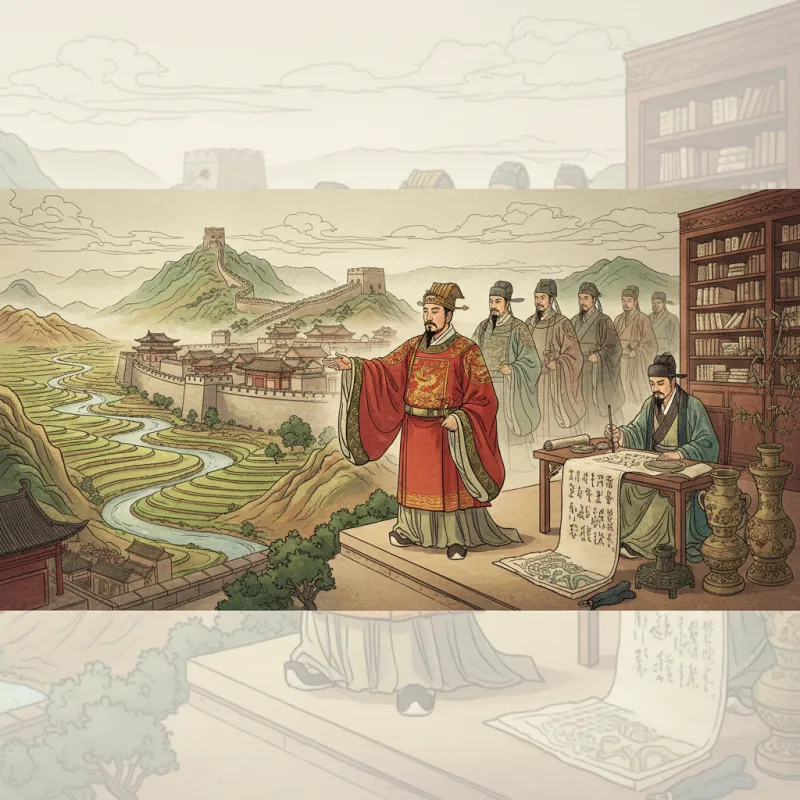
The bronze ritual vessels gleam in museum cases today, but three thousand years ago, they held wine for ancestral spirits while Zhou Dynasty nobles plotted the overthrow of their Shang overlords. That successful rebellion in 1046 BCE wasn't just a change of management—it introduced the Mandate of Heaven (天命, tiānmìng), a political philosophy so powerful it would justify every dynastic transition for the next three millennia. Ancient China wasn't a monolithic empire frozen in time; it was a churning cauldron of competing kingdoms, revolutionary ideas, and cultural innovations that would eventually influence half the world.
The Mythical Foundations and Archaeological Realities
The Xia Dynasty (夏朝, Xià Cháo, circa 2070-1600 BCE) occupies an uncomfortable space between legend and history. Traditional accounts credit Yu the Great (大禹, Dà Yǔ) with founding it after taming catastrophic floods through engineering rather than ritual—a telling detail about early Chinese pragmatism. For centuries, scholars dismissed the Xia as pure mythology, but archaeological discoveries at Erlitou in Henan Province have revealed a sophisticated Bronze Age culture that matches the traditional timeline. Whether these ruins represent the actual Xia or simply an advanced contemporary culture remains hotly debated, but the site's palace foundations and bronze workshops prove that complex civilization existed in China far earlier than skeptics once believed.
The Shang Dynasty (商朝, Shāng Cháo, circa 1600-1046 BCE) steps from shadow into sunlight thanks to oracle bones—turtle shells and ox scapulae inscribed with the earliest confirmed Chinese writing. These weren't literary works but divination records, questions posed to ancestors about everything from military campaigns to toothaches. The Shang kings ruled from successive capitals, with Yin (near modern Anyang) serving as their final seat of power. Their bronze casting technology was unmatched anywhere in the ancient world, producing ritual vessels of such complexity that modern metallurgists still marvel at the craftsmanship. But the Shang also practiced human sacrifice on a scale that makes them uncomfortable ancestors—royal tombs contained hundreds of retainers buried alive to serve their masters in death.
The Zhou and the Birth of Chinese Philosophy
When King Wu of Zhou (周武王, Zhōu Wǔ Wáng) defeated the last Shang king in 1046 BCE, he faced a legitimacy problem: how do you justify rebellion against the established order? His solution was brilliant—the Mandate of Heaven declared that heaven granted authority to virtuous rulers and withdrew it from corrupt ones. The Shang fell not because the Zhou were stronger, but because they had lost heaven's favor through tyranny and excess. This concept would echo through every subsequent dynasty, giving Chinese political philosophy a moral dimension that Western divine right of kings never quite achieved.
The Zhou Dynasty (周朝, Zhōu Cháo, 1046-256 BCE) lasted longer than any other Chinese dynasty, but that longevity came at a cost. After 771 BCE, the Zhou kings became ceremonial figureheads while real power fragmented among competing states. The Spring and Autumn Period (春秋, Chūnqiū, 770-476 BCE) saw over a hundred small states jockeying for position, while the subsequent Warring States Period (战国, Zhànguó, 475-221 BCE) narrowed the field to seven major powers locked in existential struggle. This chaos proved remarkably fertile for Chinese thought—Confucius (孔子, Kǒngzǐ), Laozi (老子, Lǎozǐ), Mozi (墨子, Mòzǐ), and dozens of other philosophers developed competing visions for restoring order. The philosophical flowering of this era would define Chinese intellectual life for millennia.
The Qin: Brutal Efficiency and Lasting Legacy
Qin Shi Huang (秦始皇, Qín Shǐ Huáng, 259-210 BCE) doesn't get enough credit for being history's most successful control freak. In just eleven years (221-210 BCE), he conquered the six remaining Warring States, abolished feudalism, standardized writing, currency, and axle widths, connected defensive walls into what would become the Great Wall, and built a tomb guarded by eight thousand terracotta soldiers. He also burned books, buried scholars alive, and created a surveillance state that would make Orwell wince. The Qin Dynasty (秦朝, Qín Cháo, 221-206 BCE) collapsed almost immediately after his death, but its administrative innovations—centralized bureaucracy, standardized measurements, direct imperial control over provinces—became the template for every subsequent Chinese government.
The First Emperor's megalomania left tangible monuments. His terracotta army, discovered in 1974, reveals an obsession with control extending beyond death. Each soldier has individual features, suggesting they were modeled on actual troops. The tomb complex itself remains largely unexcavated—ancient accounts describe rivers of mercury and crossbow traps, and modern testing has detected mercury levels in the soil hundreds of times higher than normal. Whether from paranoia or genuine belief, Qin Shi Huang prepared for an afterlife as regimented as his earthly empire.
The Han: Consolidation and Cultural Flowering
The Han Dynasty (汉朝, Hàn Cháo, 206 BCE-220 CE) took the Qin's administrative skeleton and gave it Confucian flesh. Emperor Wu (汉武帝, Hàn Wǔ Dì, r. 141-87 BCE) established Confucianism as state ideology, creating an examination system that would, in later dynasties, allow talented commoners to enter government service based on merit rather than birth. This was revolutionary—imagine if medieval Europe had recruited administrators through competitive exams on Aristotle rather than hereditary privilege.
The Han also pushed Chinese power to its greatest extent yet. General Zhang Qian's (张骞, Zhāng Qiān) missions to Central Asia in the 130s BCE opened the Silk Road, connecting China to Persia, India, and eventually Rome. Chinese silk became so prized in Rome that senators complained about the drain of gold to the East. The Han military campaigns against the Xiongnu nomads secured the western frontier and established Chinese control over the Tarim Basin. These weren't just military victories—they were cultural exchanges that brought Buddhism to China and Chinese technology to the West.
Han cultural achievements matched its political success. Sima Qian (司马迁, Sīmǎ Qiān) wrote the Records of the Grand Historian (史记, Shǐjì), establishing the biographical format that would dominate Chinese historical writing. Paper was invented during the Han, though it wouldn't replace bamboo and silk for official documents until later. The technological innovations of this period laid groundwork for China's later scientific achievements.
The Age of Division and Cultural Synthesis
The Han's collapse in 220 CE ushered in nearly four centuries of division. The Three Kingdoms period (220-280 CE) became legendary through the Romance of the Three Kingdoms, but the reality was grimmer—constant warfare, population collapse, and economic devastation. Yet this chaos proved culturally productive. Buddhism, which had trickled into China during the Han, now flooded in as traumatized people sought spiritual solace. The Northern and Southern Dynasties (420-589 CE) saw Buddhist monasteries become centers of learning, art, and even banking.
The Sui Dynasty (隋朝, Suí Cháo, 581-618 CE) reunified China but burned itself out through overambition. The Grand Canal, connecting the Yellow and Yangtze Rivers, was an engineering marvel that cost hundreds of thousands of lives and bankrupted the state. Three disastrous campaigns against Korea finished the job. The Sui lasted only thirty-seven years, but like the Qin, its infrastructure projects outlived it by centuries.
The Tang: Cosmopolitan Confidence
The Tang Dynasty (唐朝, Táng Cháo, 618-907 CE) represents Chinese civilization at its most confident and cosmopolitan. Chang'an, the capital, was the world's largest city, home to over a million people including Persian merchants, Arab traders, Indian monks, and Korean students. The Tang legal code influenced Japanese and Korean law. Tang poetry—Li Bai's (李白, Lǐ Bái) romantic wanderings, Du Fu's (杜甫, Dù Fǔ) social realism—set standards that later poets could only imitate.
The dynasty's only female emperor, Wu Zetian (武则天, Wǔ Zétiān, r. 690-705), remains controversial. Traditional historians condemned her as a usurper who murdered her way to power, but modern scholars note she was a capable administrator who expanded the examination system and patronized Buddhism. Her reign suggests that Chinese political culture, despite its Confucian patriarchy, could accommodate female power when backed by sufficient ruthlessness and competence.
The Song: Inward Turn and Innovation
The Song Dynasty (宋朝, Sòng Cháo, 960-1279) lost territory to northern nomads but compensated through economic and cultural sophistication. The Song invented paper money, developed gunpowder weapons, and created a market economy that wouldn't be matched in Europe until the Industrial Revolution. Neo-Confucianism, synthesized by Zhu Xi (朱熹, Zhū Xī), became the orthodox philosophy, emphasizing moral cultivation and social hierarchy.
Song landscape painting reached heights of subtlety that make Western medieval art look crude by comparison. Artists like Fan Kuan (范宽, Fàn Kuān) captured not just mountains and rivers but philosophical concepts—the relationship between humanity and nature, the insignificance of individual existence against cosmic vastness. These weren't decorative works but visual philosophy, as intellectually serious as any written text.
The Mongol conquest in 1279 ended the Song but couldn't erase its cultural legacy. The Yuan Dynasty (元朝, Yuán Cháo, 1271-1368) ruled China as foreign conquerors, but within a century, the Ming Dynasty (明朝, Míng Cháo, 1368-1644) restored native rule. The Ming built the Forbidden City, sent Zheng He's (郑和, Zhèng Hé) treasure fleets across the Indian Ocean, and then, fatefully, turned inward. When the Qing Dynasty (清朝, Qīng Cháo, 1644-1912) conquered China, they were the last dynasty in a three-thousand-year tradition—a tradition that ended not with foreign conquest but with internal revolution in 1911.
Ancient China's legacy isn't just monuments and artifacts. It's a continuous civilization that adapted foreign ideas—Buddhism, Mongol administration, Manchu military organization—while maintaining cultural continuity. The examination system, the bureaucratic state, the written language, the philosophical traditions—these survived dynasty after dynasty because they worked. Modern China may have rejected imperial rule, but it still grapples with questions the ancient dynasties faced: how to balance central authority with local autonomy, how to maintain cultural identity while engaging the world, how to justify political power. The bronze vessels in museums aren't just art—they're evidence of a civilization that solved problems we're still working on.
Related Reading
- Unveiling the Splendor of Ancient Chinese Architecture Across Dynasties
- Wu Zetian: China's Only Female Emperor
- Zheng He's Voyages: When China Ruled the Seas