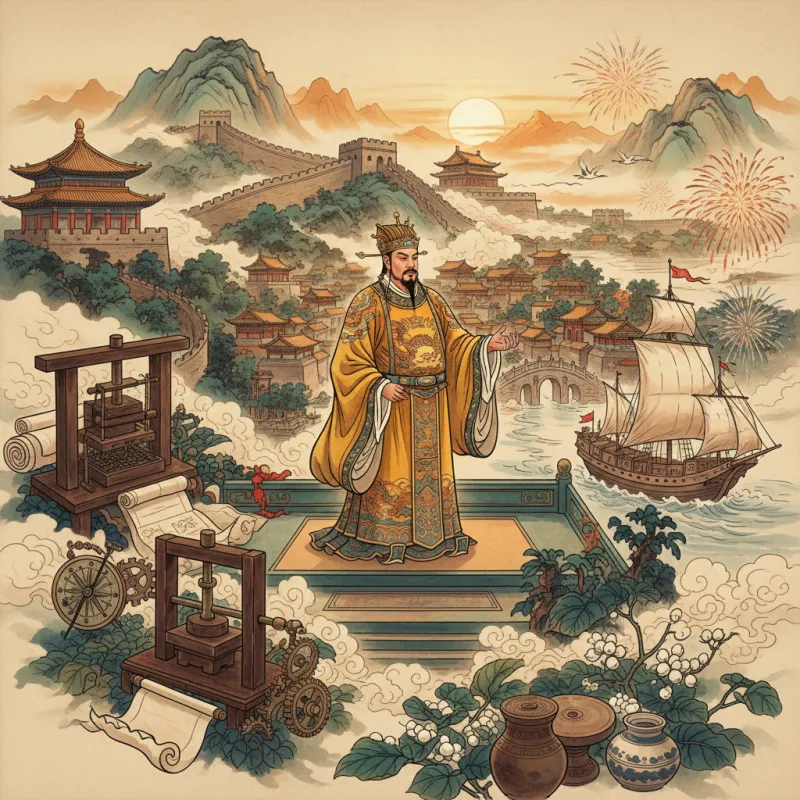
Paper wasn't just invented—it was weaponized. When Cai Lun (蔡伦, Cài Lún) presented his refined papermaking technique to Emperor He of Han in 105 CE, he couldn't have known he was handing future dynasties the ultimate tool for bureaucratic control. Suddenly, imperial edicts could reach the furthest provinces, tax records could be meticulously kept, and Confucian classics could be copied en masse. The invention that started with mulberry bark and fishing nets would eventually topple empires halfway across the world when it reached Europe over a millennium later.
The Han Dynasty: When Innovation Met Imperial Ambition
The Han Dynasty (206 BCE – 220 CE) didn't just inherit the Qin's centralized state—it perfected it through technology. While Confucian scholars debated the classics in Chang'an, craftsmen in government workshops were quietly revolutionizing warfare, agriculture, and administration. The seismoscope invented by Zhang Heng (张衡, Zhāng Héng) in 132 CE exemplifies this era's blend of scientific curiosity and practical governance. This bronze vessel, adorned with eight dragon heads holding bronze balls, could detect earthquakes hundreds of miles away—crucial intelligence for an empire constantly worried about natural disasters as omens of lost heavenly mandate.
But the Han's most transformative innovation was paper. Before Cai Lun's breakthrough, official documents were inscribed on heavy bamboo slips or expensive silk. His process—mashing tree bark, hemp, old rags, and fishing nets into pulp—democratized information storage. By the Later Han period, paper had become standard in government offices. The Four Great Inventions would later include this achievement, though calling them "four" severely undersells China's innovative output.
The Han also perfected the blast furnace, achieving temperatures high enough to produce cast iron on an industrial scale. While European blacksmiths wouldn't master this technique until the 15th century, Han foundries were already casting iron plowshares, cooking vessels, and weapons by the ton. The government monopolized salt and iron production—not just for revenue, but because controlling these industries meant controlling the empire's agricultural and military capacity.
The Tang Dynasty: Gunpowder and the Accidental Revolution
Taoist alchemists seeking the elixir of immortality instead discovered the formula for death on a massive scale. Sometime during the Tang Dynasty (618-907 CE), these experimenters mixing sulfur, charcoal, and saltpeter—what they called "fire medicine" (火药, huǒyào)—noticed their concoction had explosive properties. The irony is almost too perfect: the quest for eternal life produced history's most efficient killing tool.
Early applications were surprisingly mundane. Tang military manuals describe "fire arrows" and "fire lances"—essentially fireworks strapped to projectiles meant more to terrify than kill. The psychological warfare worked. Imagine facing an army that could summon thunder and lightning at will. But the Tang's real genius lay in their printing technology, specifically woodblock printing. The Diamond Sutra, printed in 868 CE, is the world's oldest dated printed book—predating Gutenberg by nearly 600 years.
The Tang's cosmopolitan capital, Chang'an, became a crucible for cross-cultural innovation. Persian merchants, Indian monks, and Central Asian traders brought foreign techniques that Chinese craftsmen adapted and improved. This wasn't cultural appropriation—it was sophisticated technological synthesis. The Tang took the best ideas from the Silk Road and made them distinctly Chinese.
The Song Dynasty: The Medieval Industrial Revolution
If you could time-travel to one Chinese dynasty, make it the Song (960-1279 CE). This era witnessed what historians now call a "medieval economic revolution"—urbanization, commercialization, and technological advancement on a scale Europe wouldn't match until the 18th century. The population exploded past 100 million. Cities like Kaifeng and Hangzhou dwarfed anything in medieval Europe, with sophisticated infrastructure including paved streets, fire departments, and even a form of paper money.
The Song perfected movable type printing, invented by Bi Sheng (毕昇, Bì Shēng) around 1040 CE using ceramic characters. While less practical for Chinese than for alphabetic languages, it represented a conceptual leap: text as modular, reusable components. Song publishers churned out books on agriculture, medicine, mathematics, and military strategy. Knowledge became a commodity, and literacy rates soared among the merchant class.
But the Song's most consequential innovation was weaponizing gunpowder properly. By the 11th century, Song military engineers had developed true guns—metal-barreled weapons that used explosive force to propel projectiles. The "fire lance" evolved into hand cannons, bombs, rockets, and even primitive grenades. When Mongol armies besieged Song cities, they faced walls defended by gunpowder weapons. The Mongols, quick learners, would carry this technology westward, fundamentally altering warfare across Eurasia.
The Song also revolutionized navigation with the magnetic compass. Chinese sailors had used lodestones for divination, but Song navigators realized these "south-pointing fish" (指南鱼, zhǐnán yú) could guide ships across open ocean. This wasn't just about trade—it was about projecting power. Song merchant vessels reached Southeast Asia, India, and East Africa, establishing trade networks that prefigured the later treasure voyages of the Ming Dynasty.
The Yuan Dynasty: Mongol Pragmatism Meets Chinese Innovation
The Mongol conquest could have been a technological dark age. Instead, the Yuan Dynasty (1271-1368 CE) became an unexpected period of cross-pollination. Kublai Khan, despite being a foreign conqueror, recognized that Chinese administrative and technological systems were superior to anything the Mongols possessed. He kept Chinese engineers, promoted Chinese scholars, and most importantly, facilitated the transfer of Chinese innovations westward.
This is when gunpowder weapons reached Europe, carried by Mongol armies and traders along the Silk Road. The compass, too, made its way to European sailors via Arab intermediaries. Even playing cards—a Yuan innovation—traveled westward, eventually evolving into the tarot and modern card decks. The Yuan's greatest contribution wasn't invention but dissemination, turning Chinese innovations into world-changing technologies.
The Ming Dynasty: Refinement and Retrenchment
The Ming Dynasty (1368-1644 CE) inherited a technological toolkit unmatched anywhere on Earth. Yet this era is marked by both spectacular achievement and puzzling conservatism. Admiral Zheng He's (郑和, Zhèng Hé) treasure voyages (1405-1433 CE) showcased Chinese maritime supremacy—massive fleets with ships dwarfing anything Europe could build, navigating by compass and detailed charts to Southeast Asia, India, Arabia, and East Africa.
Then, abruptly, the voyages stopped. The Ming court, influenced by Confucian scholars who viewed commerce as vulgar, turned inward. This wasn't technological regression—Ming craftsmen continued producing exquisite porcelain, sophisticated clocks, and advanced agricultural tools. But the innovative spirit that characterized earlier dynasties calcified into refinement of existing techniques rather than pursuit of new frontiers.
The Ming did perfect one crucial technology: the printing press. By the 16th century, China had a thriving publishing industry producing everything from novels to encyclopedias. The famous Yongle Encyclopedia, commissioned in 1403, comprised 11,095 volumes—the largest encyclopedia in history. Yet this information remained largely within China's borders, while European printers were disseminating knowledge that would fuel the Scientific Revolution.
Legacy: Why Chinese Innovations Mattered
The standard narrative claims Europe "caught up" to China during the Renaissance. This misses the point entirely. European advancement was built on Chinese foundations—paper, printing, gunpowder, and the compass. Without these technologies, there's no Gutenberg Bible, no Age of Exploration, no gunpowder empires. The Scientific Revolution itself depended on paper for disseminating ideas and printing for standardizing knowledge.
What's remarkable isn't that China invented these technologies first—it's that Chinese civilization sustained innovation across multiple dynasties, each building on previous achievements. The Han's paper enabled the Tang's printing revolution. The Tang's early gunpowder experiments led to the Song's military innovations. The Song's maritime technology made the Ming's treasure voyages possible.
The real question isn't why China fell behind in the 19th century, but why it dominated for so long. The answer lies in the dynastic system itself. Despite political upheavals, Chinese civilization maintained institutional continuity. Imperial workshops preserved techniques across generations. The examination system, whatever its flaws, created a literate bureaucratic class that valued learning and innovation. And Confucian emphasis on practical knowledge—agriculture, engineering, administration—channeled intellectual energy toward tangible improvements rather than abstract philosophy.
Modern China's technological ambitions aren't new—they're a return to form. For most of recorded history, China was the world's innovation engine. The dynasties that shaped these world-changing inventions understood something contemporary societies often forget: technological advancement requires not just individual genius but institutional support, cultural values that prize practical knowledge, and the patience to build on previous generations' achievements. The blast furnaces of the Han, the printing presses of the Song, and the treasure ships of the Ming weren't accidents—they were the products of a civilization that made innovation a dynastic priority.
Related Reading
- Traditional Chinese Medicine: 5,000 Years of Healing
- Unveiling Ancient Chinese Innovations: A Journey Through Dynasties and Culture
- Ancient Chinese Inventions the West Forgot to Credit
- The Four Great Inventions: How China Changed the World
- Forgotten Chinese Inventions That Changed the World Before the West Noticed
- Unveiling the Splendor of Ancient Chinese Architecture Across Dynasties
- The Empress Who Ruled China: Wu Zetian's Impossible Rise
- The Kangxi Emperor: China's Longest-Reigning and Greatest Ruler