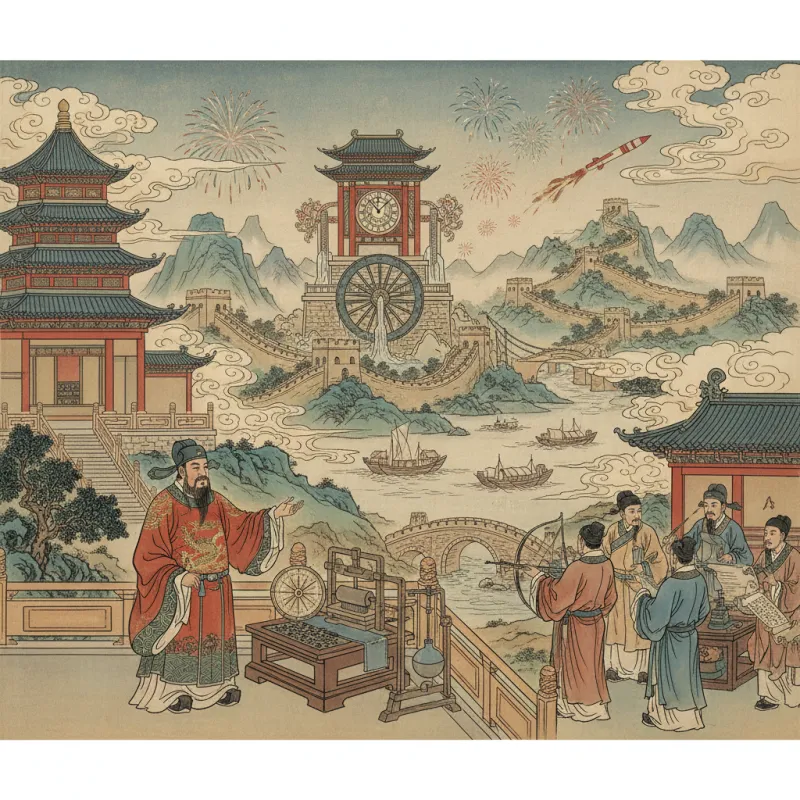
The bronze dragon opened its mouth and dropped a ball. In 138 CE, officials in Luoyang (洛阳) watched skeptically as Zhang Heng's strange contraption indicated an earthquake to the west—yet no one in the capital had felt a tremor. Days later, a messenger arrived with news: a massive earthquake had struck Longxi, over 400 miles away. The world's first seismograph had worked perfectly, and it would be another 1,500 years before Europe developed anything comparable.
We love our tidy narratives. China gave us paper, printing, gunpowder, and the compass—the Four Great Inventions that changed civilization. But this convenient shorthand has become a cage, trapping Chinese innovation in four neat boxes while dozens of other breakthroughs gather dust in the historical record. The real story is far more interesting, and far more uncomfortable for Western triumphalism.
The Earthquake Detector That Shouldn't Have Worked
Zhang Heng (张衡, Zhāng Héng) wasn't just an inventor—he was a polymath who wrote poetry, studied astronomy, and served as Chief Astronomer under Emperor Shun. His seismoscope (地动仪, dìdòngyí, literally "earth movement instrument") was a bronze vessel about six feet in diameter, decorated with eight dragon heads facing the eight cardinal directions. Inside, a mechanism we still don't fully understand used a pendulum system to detect seismic waves.
When tremors reached the device, one dragon would release its ball into the mouth of a bronze toad below, producing a loud clang and indicating the earthquake's direction. The mechanism was sensitive enough to detect earthquakes hundreds of miles away—earthquakes that couldn't be felt in Luoyang itself.
Modern attempts to reconstruct Zhang Heng's seismoscope have struggled. We know it worked because historical records document its successful predictions, but the exact internal mechanism remains debated. Some scholars suggest an inverted pendulum, others a suspended pendulum with a complex release mechanism. What's undisputed: Zhang Heng built a functional seismograph in 132 CE, while Europe wouldn't develop one until 1703.
Deep Drilling: Going Down 3,000 Feet
In Sichuan (四川) province, workers were drilling wells over 3,000 feet deep—using bamboo cables and iron drill bits—during the Han Dynasty. These weren't simple water wells. They were drilling for brine and natural gas, which they transported through bamboo pipelines and burned for heat to evaporate the brine and extract salt.
The technology was called "percussion drilling" (顿钻, dùnzuān), and it was astonishingly sophisticated. Workers would raise and drop a heavy drill bit repeatedly, pulverizing rock. They used bamboo tubes as casing to prevent cave-ins. When they hit natural gas, they captured it in bamboo pipelines sealed with mud and transported it to evaporation facilities. Some wells took decades to complete and were passed down through generations of drilling families.
Europe wouldn't develop comparable deep-drilling technology until the 19th century—roughly 1,800 years later. When Western oil companies began drilling in the 1800s, they were essentially reinventing techniques the Chinese had perfected during the Han Dynasty. The Sichuan salt industry, powered by this drilling technology, was one of the most advanced industrial operations in the ancient world, employing thousands of workers in a complex production chain that would look familiar to modern industrial engineers.
The Mechanical Clock Nobody Remembers
Su Song (苏颂, Sū Sòng) built a 30-foot-tall astronomical clock tower in 1092 CE that was arguably the most sophisticated machine in the world at that time. The clock used a water-driven escapement mechanism—the same basic principle that would later power European mechanical clocks, except Su Song built his three centuries earlier.
The clock tower wasn't just a timepiece. It was an astronomical observatory, a mechanical planetarium, and a automated armillary sphere all in one. Bronze mannequins emerged from doors to ring bells and strike gongs at regular intervals. The mechanism tracked the positions of stars and planets with remarkable accuracy. The entire structure was powered by a waterwheel with a sophisticated escapement that regulated the flow of water, ensuring consistent timekeeping.
When the Jin Dynasty conquered Kaifeng in 1127, they dismantled Su Song's clock and tried to rebuild it in Beijing. They failed—the mechanism was too complex, and the knowledge had already been lost. Europe would develop similar escapement mechanisms in the 14th century, but by then, Su Song's masterpiece had been forgotten for 200 years. Today, most people have never heard of it, while European clockmakers like Giovanni Dondi get credit for "inventing" mechanical astronomical clocks.
Cast Iron: A 2,000-Year Head Start
China was producing cast iron by the 5th century BCE. Europe wouldn't figure it out until the 14th century CE—a gap of nearly 2,000 years. This wasn't a minor technical detail; it was a fundamental technological advantage that shaped everything from agriculture to warfare.
Cast iron requires temperatures around 1,150°C, which Chinese blast furnaces achieved using efficient bellows systems and carefully selected fuel. The Chinese used cast iron for everything: plowshares that revolutionized agriculture, cooking vessels, tools, weapons, and even pagoda construction. The iron plows that enabled Chinese farmers to cultivate harder soils and increase yields were a direct result of this metallurgical advantage.
European bloomery furnaces produced wrought iron, which is more malleable but much more labor-intensive to produce and less suitable for many applications. When Europeans finally developed blast furnaces in the 14th century, they were playing catch-up to a technology China had mastered 1,900 years earlier. The economic and military implications were enormous—China's agricultural productivity and manufacturing capacity were partly built on this metallurgical foundation.
The Stirrup: Changing Warfare Forever
The stirrup seems simple—just a loop for your foot. But it transformed cavalry warfare, and China invented it. The earliest clear evidence of stirrups comes from Jin Dynasty (265-420 CE) China, though the technology may have developed slightly earlier among nomadic peoples on China's northern borders.
Before stirrups, cavalry were primarily mounted archers or light skirmishers. You can't deliver a powerful lance charge or swing a heavy sword effectively while gripping a horse with just your thighs. The stirrup gave riders a stable platform, enabling the development of heavy cavalry that could charge with lances, fight with swords, and dominate medieval battlefields.
The technology spread west along the Silk Road, reaching the Byzantine Empire by the 6th century and Western Europe by the 8th century. The medieval knight—that iconic figure of European warfare—was only possible because of a Chinese innovation. Yet most Western histories of medieval warfare never mention the stirrup's Chinese origins, treating it as if it simply appeared spontaneously in Europe.
The Blast Furnace and Bessemer Process
In the 2nd century BCE, Chinese metallurgists were using blast furnaces with water-powered bellows to produce cast iron on an industrial scale. By the 11th century CE, they had developed a process for converting cast iron into steel by blowing air through molten iron—essentially the same principle as the Bessemer process, which wouldn't be "invented" in Europe until 1856.
The Song Dynasty (960-1279 CE) was producing around 125,000 tons of iron per year—a level of production Europe wouldn't match until the 18th century. This wasn't primitive smelting; it was genuine industrial-scale production with sophisticated quality control and specialized facilities. The technological achievements of the Song Dynasty are often overshadowed by the more famous Tang Dynasty, but in terms of industrial capacity, the Song was arguably more advanced.
Why the Amnesia?
The selective memory about Chinese innovation isn't accidental. The narrative of Western technological superiority required minimizing or ignoring inconvenient facts. When European scholars in the 18th and 19th centuries were constructing the story of "progress," they needed Europe to be the protagonist. Chinese achievements were either unknown, dismissed as primitive, or quietly absorbed into the Western narrative without attribution.
Joseph Needham's monumental "Science and Civilisation in China" series, published starting in 1954, began correcting this historical amnesia, but the damage was done. Generations had already learned a version of history where meaningful innovation essentially began in ancient Greece, went dormant during the "Dark Ages," and resumed in Renaissance Europe. China appeared as a static, unchanging civilization that happened to invent a few useful things but never developed "real" science.
This narrative is demonstrably false. Chinese innovation was continuous, sophisticated, and often centuries ahead of European developments. The seismograph, deep drilling, mechanical clocks, cast iron, stirrups, and industrial-scale steel production aren't footnotes—they're major technological achievements that shaped world history. It's time we remembered them.
Related Reading
- Traditional Chinese Medicine: 3,000 Years of Healing Philosophy
- Innovations of Ancient China: How Dynasties Shaped World-Changing Inventions
- Chinese Inventions the World Forgot: Beyond Paper, Printing, Gunpowder, and the Compass
- The Silk Road: The Ancient Highway That Connected East and West
- Porcelain: The Art That Named a Nation
- Ancient Chinese Dynasties and Emperors: Legal Systems, Battles, and Cultural Legacy
- Liu Bei vs. Cao Cao: The Ultimate Rivalry in Chinese History
- China's Most Fascinating Emperors: The Brilliant, the Mad, and the Unexpected