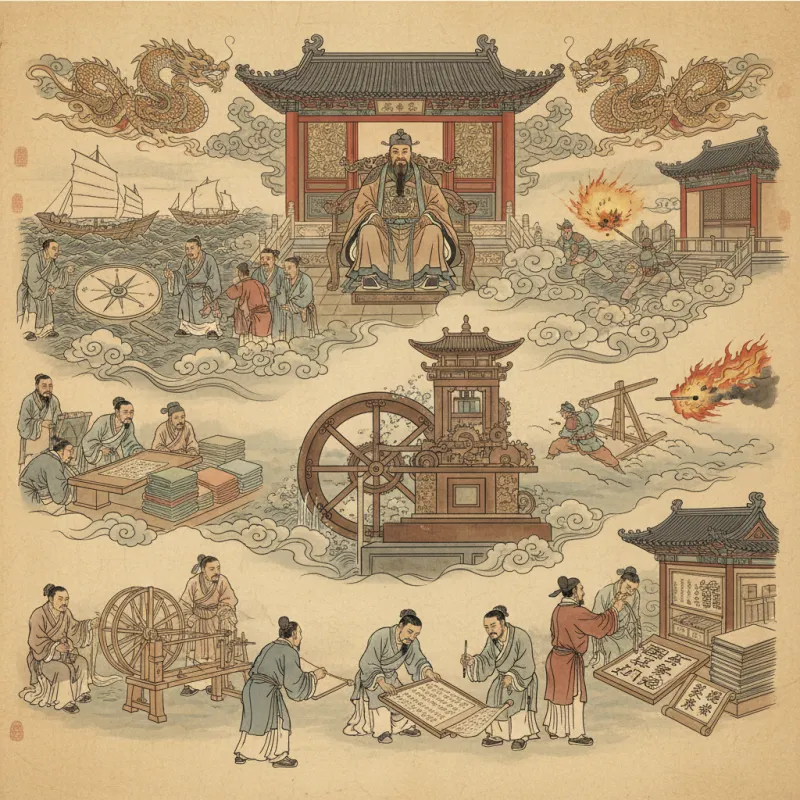
The bronze dragon opened its mouth and dropped a ball. In 138 CE, officials in Luoyang heard the metallic clang and checked Zhang Heng's strange device—one of eight toads had caught a ball from the western dragon. No one in the capital had felt anything. Days later, a messenger arrived: a massive earthquake had struck Longxi, 400 miles to the west. The court was stunned. How could a machine know what humans couldn't feel?
Zhang Heng's seismoscope wasn't magic—it was precision engineering seventeen centuries before the West built anything comparable. And it's just one of dozens of Chinese inventions that transformed the world while Europe was still figuring out the basics. Everyone knows about the Four Great Inventions, but the real story of Chinese innovation goes far deeper.
The Earthquake Detector That Shouldn't Have Worked
Zhang Heng (张衡, Zhāng Héng) was a polymath—astronomer, mathematician, poet, and inventor. In 132 CE, during the Eastern Han Dynasty, he presented Emperor Shun with the houfeng didong yi (候风地动仪, "instrument for measuring the seasonal winds and the movements of the earth").
The device was a bronze vessel about six feet in diameter, decorated with eight dragon heads facing the eight cardinal directions. Inside, a pendulum mechanism—the exact design is still debated—would swing during seismic waves. When triggered, one dragon would release its ball into the mouth of a bronze toad below, indicating the earthquake's direction.
What's remarkable isn't just that it worked, but that it worked at distance. The 138 CE Longxi earthquake demonstrated the device could detect tremors hundreds of miles away that humans in the capital couldn't perceive. Europe wouldn't develop a functional seismoscope until 1703, and even that was primitive compared to Zhang Heng's design. The first Western seismograph that could indicate direction didn't appear until 1848—over 1,700 years later.
Deep Drilling: Reaching for Fire and Salt
In the fourth century BCE, workers in Sichuan were drilling wells over 300 feet deep using bamboo cables and iron bits. By the Han Dynasty, they'd reached depths of 4,800 feet—nearly a mile underground. They weren't looking for oil; they were after natural gas and brine for salt production.
The technique, called chōngjī shì dùnjué (冲击式顿钻, percussion drilling), used a heavy bit attached to bamboo cables. Workers would rhythmically raise and drop the bit, pulverizing rock. Bamboo pipes brought the natural gas to the surface, where it was burned to evaporate brine and produce salt. Some wells burned continuously for decades.
The West didn't develop comparable drilling technology until the 1830s, when Americans began drilling for salt in the Appalachians—and they learned the technique from Chinese immigrants. The first commercial oil well in Pennsylvania (1859) used methods that Chinese engineers had perfected two thousand years earlier. When Western geologists finally visited Sichuan in the early 1900s, they found wells drilled in the Song Dynasty still producing gas.
The Mechanical Clock: Time Before Gears
In 725 CE, Buddhist monk and mathematician Yi Xing (一行, Yī Xíng) and engineer Liang Lingzan (梁令瓚, Liáng Lìngzàn) built the first mechanical clock. Their shuǐyùn hún tiān yí (水运浑天仪, "water-driven spherical bird's-eye-view map of the heavens") used a water-powered escapement mechanism—the key innovation that makes mechanical clocks possible.
An escapement regulates the release of energy, allowing a clock to tick at regular intervals. Yi Xing's device used water wheels and a complex system of gears to rotate an armillary sphere that tracked the positions of celestial bodies. It was accurate, automatic, and centuries ahead of its time.
The most famous Chinese clock came later: Su Song's (苏颂, Sū Sòng) astronomical clock tower of 1094, which stood 40 feet tall and featured an armillary sphere, a celestial globe, and mechanical puppets that announced the hours. The escapement mechanism was so sophisticated that when Joseph Needham studied it in the 20th century, he called it "the missing link" in the history of clockmaking.
Europe's first mechanical clocks appeared in the late 13th century—five hundred years after Yi Xing. Whether Chinese technology directly influenced European clockmakers remains debated, but the timeline is suggestive. What's certain is that China had working mechanical clocks when Europe was still using sundials and water clocks without escapements.
Cast Iron: The Foundation of Everything
China was producing cast iron by 500 BCE. Europe didn't figure it out until around 1380 CE—nearly two thousand years later. This isn't a minor detail; it's the foundation of technological civilization.
Cast iron requires temperatures above 1,150°C (2,100°F). Chinese metallurgists achieved this using blast furnaces with bellows, often water-powered, that could maintain the necessary heat. The result was a material that could be poured into molds to create everything from plowshares to weapons to architectural elements.
By the 11th century, during the Song Dynasty, China was producing around 125,000 tons of iron per year—a figure Europe wouldn't match until the 18th century during the Industrial Revolution. This iron built the infrastructure of Chinese civilization: bridges, buildings, tools, and weapons. The Iron Pagoda of Kaifeng (built 1049) still stands, its 50-meter height a testament to Song engineering.
When European blast furnaces finally appeared in the late 14th century, they produced iron of lower quality than what Chinese foundries had been making for centuries. The gap in metallurgical knowledge was so vast that some historians argue it delayed European technological development by half a millennium.
The Stirrup: How to Stay on a Horse
Sometime around the 4th century CE, Chinese cavalry adopted the stirrup. It seems like a simple invention—a loop for your foot—but it revolutionized warfare and transportation.
Before stirrups, mounted warriors had to grip with their legs and maintain balance while fighting. Stirrups provided stability, allowing riders to use weapons effectively, wear heavier armor, and stay mounted during combat. The military advantage was immediate and overwhelming.
Stirrups spread west along the Silk Road, reaching the Byzantine Empire by the 6th century and Western Europe by the 8th. Some historians argue that stirrups made medieval European feudalism possible—knights in heavy armor charging with lances required stirrups to stay mounted. The entire social and military structure of medieval Europe rested on a Chinese innovation.
The Frankish cavalry that stopped the Umayyad advance at Tours in 732 CE used stirrups. The Norman knights who conquered England in 1066 used stirrups. Every mounted warrior from the Middle Ages through the early modern period depended on this Chinese invention.
The Wheelbarrow: Moving the World
The wheelbarrow appears in Chinese sources from the 2nd century CE, possibly invented by the legendary general Zhuge Liang (诸葛亮, Zhūgě Liàng) during the Three Kingdoms period. Chinese wheelbarrows placed the wheel in the center, directly under the load, allowing a single person to transport heavy weights efficiently.
These weren't the clumsy garden wheelbarrows familiar in the West. Chinese designs could carry loads of 400 pounds or more, and they were used for everything from military logistics to construction to agriculture. Marco Polo saw them in the 13th century and was impressed enough to mention them in his writings.
The wheelbarrow didn't appear in Europe until around 1170—nearly a thousand years after Chinese use. Even then, European designs placed the wheel at the front, making them less efficient and harder to balance. The superior Chinese design didn't become common in the West until much later.
Why We Forgot
These inventions—and dozens more like them—demonstrate that Chinese technological innovation wasn't limited to the Famous Four. So why don't we learn about them?
Part of the answer is timing. Many Chinese inventions reached their peak during periods when Europe was technologically backward. By the time Europe began its rapid technological development in the Renaissance and Industrial Revolution, China's innovative momentum had slowed. The inventions that mattered to European progress—the ones that arrived at the right moment—got remembered. The ones that came too early were forgotten or attributed to later European inventors.
Another factor is documentation. Chinese historical records are extensive, but they weren't always translated or studied by Western historians until relatively recently. Joseph Needham's monumental Science and Civilisation in China (begun in 1954) did more than any other work to reveal the depth of Chinese technological achievement, but it came late.
The result is a distorted picture where China gets credit for four famous inventions while dozens of others—equally important, often earlier—remain obscure. Zhang Heng's seismoscope, Yi Xing's mechanical clock, and the blast furnaces of the Han Dynasty deserve to be as famous as paper and gunpowder. They changed the world just as profoundly, even if the world took centuries to notice.
Related Reading
- Porcelain: The Art That Named a Nation
- Ancient Chinese Inventions the West Forgot to Credit
- Unveiling Ancient Chinese Innovations: A Journey Through Dynasties and Culture
- Traditional Chinese Medicine: 5,000 Years of Healing
- Traditional Chinese Medicine: 3,000 Years of Healing Philosophy
- Ancient Chinese Medicine: A Look into Dynasties and Healing Practices
- The Role of Trade in Shaping Ancient Chinese Dynasties and Culture
- The Silk Road: A Complete Beginner's Guide