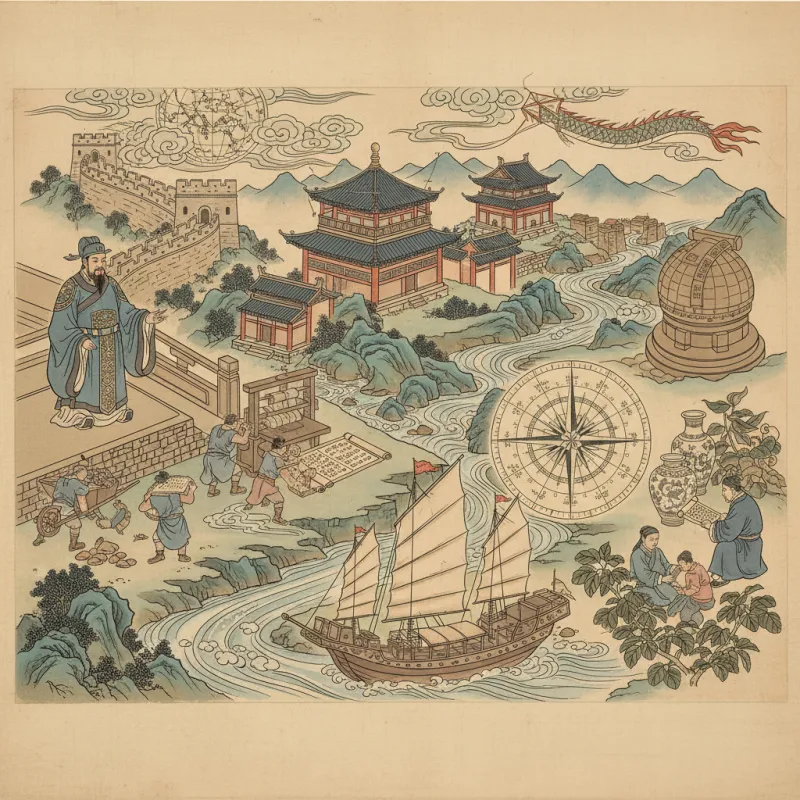
The year is 105 CE, and in the Eastern Han court, a eunuch named Cai Lun (蔡伦, Cài Lún) is about to change human civilization forever. He's not wielding a sword or commanding armies—he's pulping tree bark, hemp, and old fishing nets into a thin, flexible sheet that will make knowledge accessible to millions. This moment, recorded in the Book of Later Han, represents just one thread in the vast tapestry of Chinese innovation that stretches back millennia. While the West often credits the Renaissance with technological awakening, China's dynasties were already engineering marvels that would reshape warfare, navigation, communication, and daily life centuries—sometimes over a millennium—earlier.
Paper: The Democratic Revolution in Knowledge
Before Cai Lun's breakthrough, writing in China meant carving into bamboo strips or silk—expensive, heavy, and impractical for mass communication. The Hou Han Shu (後漢書, Book of Later Han) credits Cai Lun with systematizing paper production, though archaeological evidence suggests earlier primitive forms existed. What made his innovation revolutionary wasn't just the material itself, but the process: accessible raw materials, reproducible techniques, and a final product light enough to transport across the Silk Road.
By the Tang Dynasty (618–907 CE), paper had become so ubiquitous that it fueled an explosion in poetry, bureaucratic record-keeping, and the world's first paper money during the Song Dynasty (960–1279 CE). The technology reached the Islamic world by the 8th century after the Battle of Talas in 751 CE, when Chinese papermakers were captured by Abbasid forces. Europe wouldn't see paper mills until the 12th century—a thousand-year lag that speaks volumes about the pace of technological diffusion in the pre-modern world.
Gunpowder: From Immortality Elixirs to Imperial Warfare
Here's the irony: Taoist alchemists searching for the elixir of immortality during the Tang Dynasty accidentally created humanity's most destructive invention. The earliest reference to gunpowder (火藥, huǒyào, literally "fire medicine") appears in a 9th-century text warning alchemists that mixing saltpeter, sulfur, and charcoal could cause dangerous explosions and burns. They were trying to extend life, not end it.
By the Song Dynasty, military engineers had weaponized these accidental discoveries into fire lances, primitive grenades, and eventually true guns and cannons. The Wujing Zongyao (武經總要, Complete Essentials for the Military Classics), compiled in 1044 CE, contains the world's oldest known gunpowder recipes and detailed illustrations of incendiary weapons. When Mongol forces conquered China, they carried this technology westward, fundamentally altering medieval European warfare. The walls of Constantinople, which had stood for a millennium, would eventually fall to Ottoman cannons—a direct descendant of Chinese innovation. For more on how military technology shaped dynastic power, see The Evolution of Chinese Warfare Tactics.
The Compass: Navigating by Heaven's Mandate
The Chinese weren't trying to sail to distant continents when they invented the compass—they were trying to align their buildings with cosmic forces. The earliest magnetic devices, called sinan (司南, sīnán, "south-governor"), appeared during the Han Dynasty (206 BCE–220 CE) as geomantic tools for feng shui practitioners. These spoon-shaped lodestones balanced on bronze plates helped determine auspicious directions for temples, tombs, and palaces.
The transition from mystical tool to navigational instrument occurred gradually during the Song Dynasty. By the 11th century, Chinese sailors were using magnetic needles floating in water bowls to navigate coastal waters. The Pingzhou Table Talks (萍洲可談, Píngzhōu Kětán), written in 1119 CE, contains the first clear reference to maritime compass use. This technology enabled Zheng He's (鄭和, Zhèng Hé) legendary treasure voyages during the Ming Dynasty (1368–1644 CE), when massive fleets reached East Africa decades before European explorers rounded the Cape of Good Hope. The compass didn't just enable navigation—it enabled empire.
Printing: Multiplying Knowledge, Standardizing Culture
Woodblock printing emerged during the Tang Dynasty, but it was the Song Dynasty's invention of movable type that truly revolutionized information dissemination. Bi Sheng (畢昇, Bì Shēng), a commoner whose biography appears in Shen Kuo's (沈括, Shěn Kuò) Dream Pool Essays (1088 CE), created individual clay characters that could be rearranged and reused—predating Gutenberg by four centuries.
Why didn't movable type transform China as dramatically as it did Europe? The answer lies in language: Chinese requires thousands of characters, making woodblock printing often more practical for full texts. Yet the impact was still profound. The Song government printed paper money, standardized texts for the imperial examination system, and mass-produced Buddhist sutras. The Diamond Sutra, printed in 868 CE and discovered in the Mogao Caves, remains the world's oldest dated printed book—a full 587 years before the Gutenberg Bible.
Beyond the Famous Four: Hidden Innovations
Focusing solely on the "Four Great Inventions" obscures countless other breakthroughs. The Han Dynasty invented the seismoscope (地動儀, dìdòngyí) in 132 CE—Zhang Heng's (張衡, Zhāng Héng) bronze vessel could detect earthquakes hundreds of miles away. The Song Dynasty pioneered inoculation against smallpox by blowing powdered scabs into patients' nostrils, a technique that wouldn't reach Europe until the 18th century. Chinese metallurgists were casting iron a full millennium before Europe, enabling everything from agricultural tools to the massive iron lions that still guard Beijing's Forbidden City.
The mechanical clock, often attributed to medieval Europe, actually originated in Tang Dynasty China. The Buddhist monk Yi Xing (一行, Yī Xíng) and engineer Liang Lingzan (梁令瓚, Liáng Lìngzàn) built an astronomical clock tower in 725 CE, centuries before European clockmakers. Su Song's (蘇頌, Sū Sòng) even more sophisticated clock tower, completed in 1092 CE, stood over 30 feet tall and used a complex escapement mechanism—the same principle that would later drive European mechanical clocks. For insights into how astronomical observations influenced Chinese culture, explore Ancient Chinese Astronomy and Imperial Power.
The Paradox of Innovation: Why China Didn't Industrialize First
Here's the question that haunts historians: if China was so technologically advanced, why didn't it experience an industrial revolution? Joseph Needham spent decades exploring this "Needham Question," and the answers are complex. Some point to Confucian values that prioritized scholarship over commerce, others to the examination system that channeled talent into bureaucracy rather than entrepreneurship. The Ming Dynasty's decision to halt Zheng He's voyages and turn inward represents a pivotal moment—a conscious choice to prioritize stability over expansion.
But perhaps we're asking the wrong question. Chinese innovations weren't designed to maximize profit or conquer markets—they served different purposes: maintaining cosmic harmony, strengthening imperial administration, preserving cultural continuity. The compass aligned buildings with heaven's will before it guided ships. Paper served bureaucratic record-keeping before it enabled mass literacy. These weren't failures of imagination but reflections of different civilizational priorities.
The Legacy: Ancient Innovations in Modern Life
Walk through any modern city and you're surrounded by descendants of Chinese innovation. The paper in books, the gunpowder in fireworks, the magnetic sensors in smartphones, the printing on every surface—all trace their lineage back to Chinese workshops, laboratories, and imperial courts. Even technologies China didn't invent, like the internet, rely on paper-based bureaucratic systems and printing presses that owe their existence to Chinese breakthroughs.
The story of Chinese innovation isn't just about specific inventions—it's about a civilization that consistently transformed observations into practical applications, that valued both cosmic philosophy and material improvement, that built institutions capable of preserving and transmitting knowledge across centuries. When Cai Lun pulped that first batch of tree bark in 105 CE, he wasn't just making paper—he was creating the medium through which Chinese culture would preserve itself, spread across continents, and ultimately shape the modern world. The dynasties rose and fell, but the innovations endured, proving that ideas, once released, become immortal in ways no alchemist's elixir could ever achieve.
Related Reading
- The Silk Road: The Ancient Highway That Connected East and West
- Traditional Chinese Medicine: 5,000 Years of Healing
- Forgotten Chinese Inventions That Changed the World Before the West Noticed
- Ancient Chinese Inventions the West Forgot to Credit
- The Four Great Inventions: How China Changed the World
- Ancient Chinese Medicine: A Look into Dynasties and Healing Practices
- The Dynasties of China: A Quick Guide to 4,000 Years of History
- Qin Shi Huang: The First Emperor Who Created China