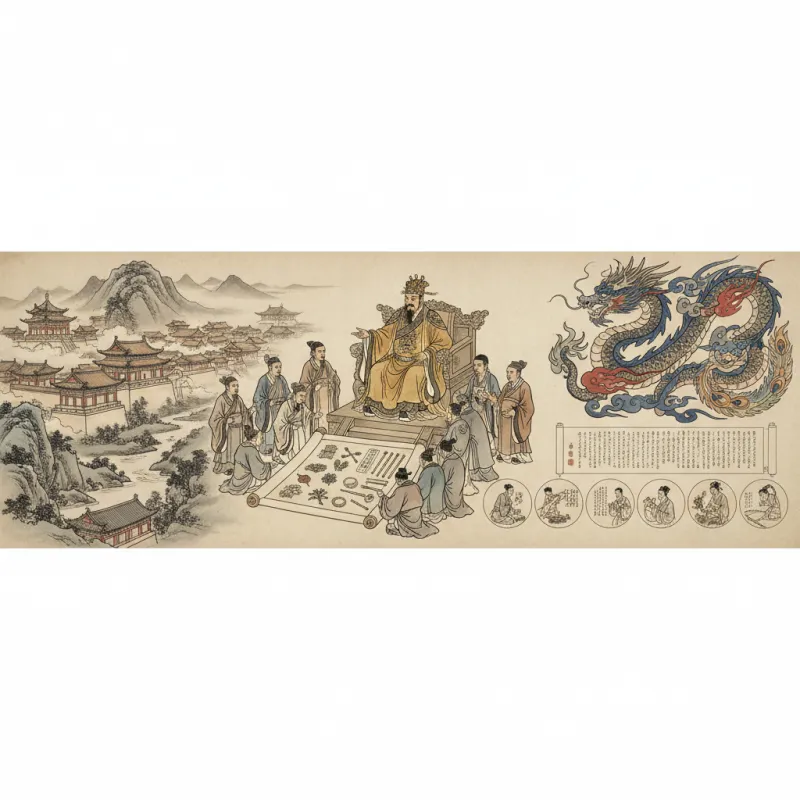
A physician in 168 BCE carefully unrolls silk manuscripts inside a tomb at Mawangdui, documenting prescriptions for ailments that won't have Latin names for another two millennia. These weren't primitive folk remedies scribbled by shamans—they were systematic medical texts describing circulation theories, herbal formulas, and diagnostic techniques that would form the backbone of a healing tradition outlasting the Roman Empire, the Byzantine Empire, and every European monarchy combined. Traditional Chinese Medicine (TCM, 中医 zhōngyī) didn't just survive 5,000 years; it evolved into a sophisticated system that today treats over a billion people and increasingly intrigues Western medical researchers who can't quite explain why it works.
The Philosophical Foundation: More Than Just Needles and Herbs
Western medicine asks "what's broken?" TCM asks "what's out of balance?" This fundamental difference traces back to concepts that predate Hippocrates by centuries. The theory of Yin and Yang (阴阳 yīnyáng)—those complementary opposites symbolized by the familiar black-and-white circle—emerged during the Western Zhou Dynasty (1046-771 BCE) as a way to explain natural phenomena. Cold is yin, heat is yang. Rest is yin, activity is yang. Disease occurs when these forces fall out of harmony.
Then there's Qi (气 qì), that notoriously difficult-to-translate concept often rendered as "vital energy" or "life force." Ancient Chinese physicians observed that something invisible yet essential flowed through the body along specific pathways called meridians (经络 jīngluò). Block the flow, and you get pain, illness, dysfunction. Restore it, and health returns. Skeptics dismiss Qi as mysticism, but acupuncture's documented effects on pain management and nausea have forced even conservative medical institutions to take notice.
The Five Elements theory (五行 wǔxíng)—Wood, Fire, Earth, Metal, and Water—added another layer of complexity. Each element corresponded to organs, seasons, emotions, and flavors. A skilled TCM practitioner could diagnose liver problems by observing a patient's irritability and preference for sour foods, both associated with the Wood element. This holistic approach, viewing the body as an interconnected ecosystem rather than a collection of parts, remains TCM's most distinctive feature.
The Classical Texts: Ancient Wisdom That Still Guides Modern Practice
The Yellow Emperor's Inner Classic (黄帝内经 Huángdì Nèijīng), compiled during the Warring States period and Han Dynasty (475 BCE - 220 CE), stands as TCM's foundational text. Structured as dialogues between the legendary Yellow Emperor and his physician Qi Bo, it covers everything from acupuncture points to seasonal health maintenance to the relationship between emotions and organ function. Remarkably, practitioners today still reference this 2,000-year-old text when diagnosing patients.
The Classic of Difficult Issues (难经 Nánjīng), attributed to the physician Bian Que around the 1st century CE, tackled 81 challenging medical questions the Inner Classic left unanswered. It refined pulse diagnosis into an art form—a skilled practitioner could allegedly detect pregnancy, predict death, and identify internal organ problems just by feeling the radial artery at three positions and three depths on each wrist.
During the Han Dynasty, Zhang Zhongjing wrote the Treatise on Cold Damage Disorders (伤寒论 Shānghán Lùn) around 220 CE, creating a systematic approach to treating infectious diseases using herbal formulas. Many of his prescriptions, like the formula for treating flu-like symptoms, remain in use today with minimal modifications. This continuity is staggering—imagine if Western doctors still prescribed Galen's remedies from the same era.
The Divine Farmer's Materia Medica (神农本草经 Shénnóng Běncǎo Jīng), compiled during the Eastern Han Dynasty, catalogued 365 medicinal substances, rating them by toxicity and therapeutic properties. Legend claims the Divine Farmer personally tasted hundreds of herbs, dying after sampling one too many poisonous plants in his quest for medical knowledge. While the legend is apocryphal, the text's systematic classification of herbs by their properties—warming or cooling, ascending or descending—created a framework still used in modern TCM pharmacology.
Diagnostic Arts: Reading the Body's Secret Language
TCM diagnosis relies on four examination methods: observation (望 wàng), listening and smelling (闻 wén), inquiry (问 wèn), and palpation (切 qiè). A TCM practitioner observes your tongue's color, coating, and shape with the intensity of a jeweler examining a diamond. A pale, swollen tongue with tooth marks suggests Spleen Qi deficiency. A red tongue with a yellow coating indicates internal heat. The tongue becomes a map of internal conditions.
Pulse diagnosis reaches levels of subtlety that seem almost supernatural. Practitioners distinguish 28 different pulse qualities—floating, sinking, slippery, choppy, wiry, tight, and so on. Each pulse type, felt at different positions corresponding to different organs, reveals specific imbalances. A "wiry" pulse suggests Liver Qi stagnation, often associated with stress and frustration. A "slippery" pulse might indicate phlegm accumulation or pregnancy.
The inquiry process covers not just symptoms but lifestyle details Western doctors rarely ask about: Do you prefer hot or cold drinks? What time of day do you feel worst? What's your emotional state? These seemingly tangential questions help identify pattern imbalances. Someone who craves cold drinks, feels worse in the afternoon, and experiences irritability might have Liver Fire rising—a specific syndrome with corresponding treatments.
Treatment Modalities: The Healing Arsenal
Acupuncture (针灸 zhēnjiǔ) gets the most attention in the West, but it's just one tool in TCM's extensive toolkit. The practice involves inserting hair-thin needles into specific points along meridians to regulate Qi flow. The World Health Organization now recognizes acupuncture's effectiveness for over 100 conditions, from chronic pain to chemotherapy-induced nausea. Modern research suggests it works by stimulating nerves, increasing blood flow, and triggering the release of natural painkillers—though this doesn't fully explain its effects.
Chinese herbal medicine (中药 zhōngyào) represents TCM's true powerhouse. Unlike Western medicine's single-compound drugs, TCM formulas combine multiple herbs in precise ratios, creating synergistic effects while minimizing side effects. A typical formula might contain 10-15 ingredients: some address the primary complaint, others harmonize the formula, and still others guide the medicine to specific organs. The anti-malarial drug artemisinin, which won Tu Youyou the 2015 Nobel Prize, came from the herb sweet wormwood (青蒿 qīnghāo), used in TCM for over 2,000 years to treat fevers.
Moxibustion (艾灸 àijiǔ) involves burning dried mugwort near acupuncture points to warm meridians and expel cold. Cupping therapy (拔罐 báguàn) creates suction on the skin to promote blood flow and release muscle tension—those circular bruises you've seen on Olympic athletes. Tui na (推拿 tuīná) massage manipulates soft tissue and acupuncture points. Dietary therapy prescribes foods based on their energetic properties rather than just nutritional content. Ginger is warming and disperses cold; watermelon is cooling and clears heat.
Evolution Through Dynasties: Innovation Within Tradition
The Tang Dynasty (618-907 CE) saw TCM's golden age. The government established medical schools, standardized education, and compiled comprehensive medical encyclopedias. Sun Simiao, known as the "King of Medicine," wrote Essential Prescriptions Worth a Thousand Gold (千金要方 Qiānjīn Yàofāng), emphasizing medical ethics and preventive care. His famous quote—"A great physician should treat disease before it arises"—captures TCM's preventive philosophy.
The Song Dynasty (960-1279 CE) brought technological advances. The government published illustrated herbals with woodblock prints, making medical knowledge more accessible. Forensic medicine developed, with texts describing autopsy procedures and death investigations that wouldn't appear in Europe for centuries. The practice of variolation—inoculating people against smallpox by exposing them to weakened virus—emerged during this period, predating Edward Jenner's vaccine by 500 years.
The Ming Dynasty (1368-1644 CE) produced Li Shizhen's monumental Compendium of Materia Medica (本草纲目 Běncǎo Gāngmù), cataloguing 1,892 medicinal substances with 11,096 prescriptions. This 27-year project corrected errors in earlier texts and added new discoveries. Charles Darwin reportedly kept a copy in his library, and it influenced early European pharmacology.
The Qing Dynasty (1644-1912 CE) saw the development of the Warm Disease School (温病学派 wēnbìng xuépài), which refined treatments for infectious diseases. This school's formulas proved remarkably effective during epidemics, saving countless lives when Western medicine had little to offer beyond quarantine.
Modern Challenges and Scientific Validation
The 20th century nearly destroyed TCM. During the Cultural Revolution (1966-1976), traditional practices were denounced as feudal superstition. Ironically, it was during this period that Chairman Mao, who privately preferred Western medicine, promoted TCM internationally as a uniquely Chinese contribution to world culture. The famous "barefoot doctors" program trained rural health workers in basic TCM and Western medicine, bringing healthcare to hundreds of millions.
Today, TCM faces the challenge of scientific validation. Double-blind, placebo-controlled trials—the gold standard of Western medicine—struggle to accommodate TCM's individualized treatments. How do you standardize a system that prescribes different formulas for the same Western diagnosis based on each patient's unique pattern? Some studies show promising results: acupuncture for chronic pain, certain herbs for specific conditions. Others find no effect beyond placebo.
The integration question remains contentious. Should TCM adapt to Western scientific frameworks, or does that fundamentally alter its nature? Chinese hospitals now commonly offer both Western and TCM departments, letting patients choose or combine approaches. This integration has produced interesting results—TCM herbs reducing chemotherapy side effects, acupuncture improving post-surgical recovery, herbal formulas managing chronic conditions where Western medicine offers only symptom control.
Quality control and safety concerns persist. Unlike pharmaceutical drugs, herbal products face minimal regulation in many countries. Contamination, misidentification, and adulteration pose real risks. Some traditional remedies contain toxic substances like mercury or lead, used historically but dangerous by modern standards. Responsible practitioners have abandoned these practices, but the reputation damage lingers.
The Global Future: Ancient Wisdom Meets Modern Science
TCM's influence extends far beyond China's borders. The World Health Organization's 2019 inclusion of TCM in its International Classification of Diseases marked a controversial milestone. Critics worry about legitimizing unproven treatments; supporters argue for recognizing a system serving billions of people. Over 100 countries now regulate acupuncture, and TCM colleges operate worldwide.
The pharmaceutical industry increasingly mines TCM for drug leads. Beyond artemisinin, researchers are investigating traditional formulas for cancer, diabetes, and neurodegenerative diseases. The herb thunder god vine (雷公藤 léigōngténg) shows promise for autoimmune conditions. Ginseng's effects on cognitive function and energy are being rigorously studied. This "reverse pharmacology" approach—starting with traditional uses and working backward to identify active compounds—has proven more efficient than random screening.
Perhaps TCM's greatest contribution isn't any specific treatment but its holistic philosophy. As Western medicine grapples with chronic disease epidemics, the TCM emphasis on prevention, lifestyle, and treating the whole person rather than isolated symptoms offers valuable perspectives. The recognition that emotional health affects physical health, that diet matters beyond calories and nutrients, that rest and activity must balance—these insights, obvious to TCM practitioners for millennia, are finally gaining mainstream acceptance.
The 5,000-year journey of Traditional Chinese Medicine continues. It has survived dynastic collapses, foreign invasions, ideological purges, and scientific skepticism. Whether it will successfully integrate with modern medicine or remain a parallel system depends on practitioners' willingness to embrace rigorous research and researchers' willingness to accommodate TCM's complexity. One thing seems certain: a healing tradition that has served humanity for five millennia won't disappear anytime soon. The ancient texts still guide modern hands, the needles still find their points, and the herbs still brew their mysterious benefits—a living bridge between China's distant past and its innovative future.
Related Reading
- The Silk Road: The Ancient Highway That Connected East and West
- Innovations of Ancient China: How Dynasties Shaped World-Changing Inventions
- Unveiling Ancient Chinese Innovations: A Journey Through Dynasties and Culture
- Ancient Chinese Inventions the West Forgot to Credit
- Chinese Inventions the World Forgot: Beyond Paper, Printing, Gunpowder, and the Compass
- The Role of Trade in Shaping Ancient Chinese Dynasties and Culture
- The Influential Emperors of Ancient China: Dynasties, Battles, and Cultural Impact
- Chinese Architecture: Forbidden Cities, Pagodas, and Garden Design