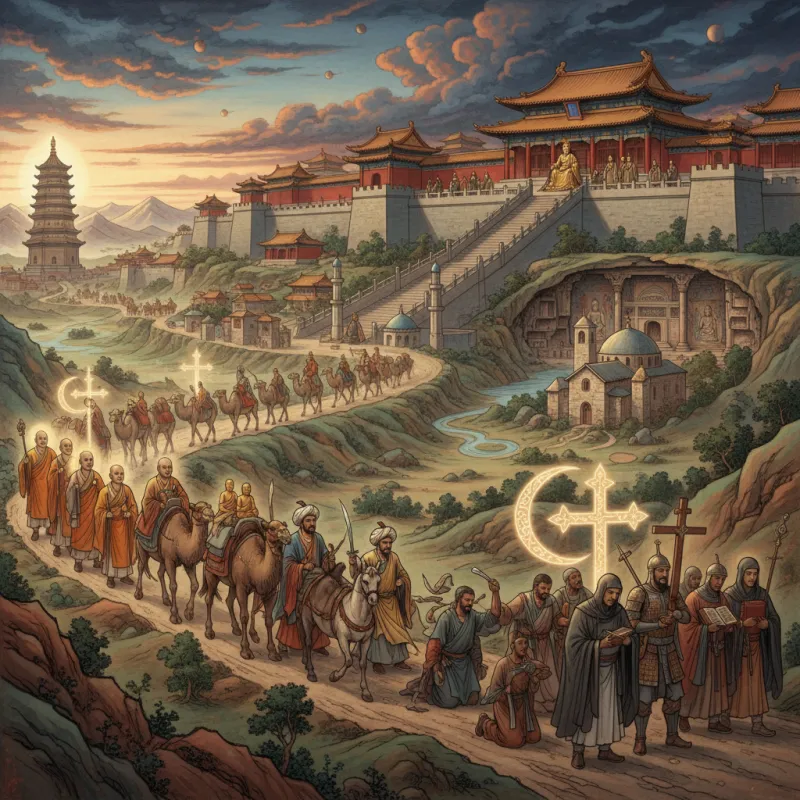
A monk walks into a desert oasis town in 65 CE, carrying nothing but a begging bowl and a rolled manuscript. Within three centuries, his religion will reshape Chinese philosophy, art, and governance. A millennium later, Muslim merchants will follow the same route, their call to prayer echoing where Buddhist chants once rang. This is the Silk Road's greatest paradox: a trade route built for profit became history's most effective missionary highway.
The Dharma Moves East: Buddhism's Transformation
Buddhism didn't arrive in China as a single, coherent package. It trickled in through multiple channels over several centuries, carried by Central Asian merchants, missionary monks, and Chinese pilgrims who risked their lives crossing the Taklamakan Desert. The traditional story credits Emperor Ming of Han (漢明帝, Hàn Míng Dì, r. 57-75 CE) with officially introducing Buddhism after dreaming of a golden deity, but archaeological evidence suggests Buddhist communities existed in China decades earlier.
The real breakthrough came during the political chaos following the Han Dynasty's collapse in 220 CE. As China fractured into warring kingdoms, Buddhism offered something Confucianism couldn't: consolation for suffering and a promise of salvation beyond this world. The religion that arrived, however, was already transformed by its journey. Central Asian kingdoms like Kucha and Khotan had created their own Buddhist traditions, blending Indian philosophy with local practices. When these reached China, they encountered yet another transformation.
The translation process itself changed Buddhism fundamentally. Chinese translators struggled with Sanskrit concepts that had no equivalents. Nirvana became 涅槃 (nièpán), dharma became 法 (fǎ) — a term already loaded with Daoist and Confucian meanings. The monk Kumārajīva (鳩摩羅什, Jiūmóluóshí, 344-413 CE), who translated over 300 volumes of Buddhist texts in Chang'an, famously compared translation to chewing food for someone else: "When I chew rice and give it to another, it is not only tasteless, but makes them vomit."
By the Tang Dynasty (618-907 CE), Chinese Buddhism had evolved into something distinctly Chinese. The monk Xuanzang (玄奘, Xuánzàng, 602-664 CE) made his legendary sixteen-year journey to India precisely because Chinese Buddhism had drifted so far from its origins. His journey, immortalized in the novel Journey to the West, brought back 657 Sanskrit texts — but even these would be filtered through Chinese sensibilities. The Silk Road didn't just transmit Buddhism; it transformed it into multiple regional variants, each adapted to local needs.
Islam's Rapid Advance: The Religion of the Merchants
Islam's arrival on the Silk Road was dramatically different from Buddhism's gradual infiltration. Within a century of Muhammad's death in 632 CE, Muslim armies had conquered Central Asia, and Muslim merchants dominated Silk Road trade. The Battle of Talas in 751 CE, where Arab forces defeated a Tang army, marked a turning point: Central Asia would become permanently Islamic, and the eastern Silk Road would be controlled by Muslim powers.
But Islam's spread wasn't primarily military. Muslim merchants were the Silk Road's most successful traders, and their religion came with practical advantages. Islamic law provided standardized contracts, credit systems, and commercial courts that worked across vast distances. The hawala system — an early form of banking that allowed merchants to transfer funds without moving physical currency — gave Muslim traders a competitive edge. Conversion to Islam meant joining a commercial network that stretched from Spain to Indonesia.
In China, Islam took root differently than Buddhism. Rather than seeking imperial patronage or converting the masses, Muslim communities remained distinct, centered around trading enclaves in cities like Chang'an, Guangzhou, and Quanzhou. The Tang Dynasty welcomed them — Emperor Gaozong (唐高宗, Táng Gāozōng, r. 649-683 CE) reportedly allowed the construction of China's first mosque in Chang'an around 651 CE, just nineteen years after Muhammad's death.
These communities developed a unique Chinese Islamic culture. They adopted Chinese names, architectural styles, and social customs while maintaining Islamic religious practices. The Hui people (回族, Huízú) emerged as a distinct ethnic group — Chinese in culture, Muslim in faith. Unlike Buddhism, which sought to transform Chinese civilization, Islam created parallel communities that could thrive within it. The maritime Silk Road further accelerated this process, as Muslim merchants dominated Indian Ocean trade.
Christianity's Multiple Arrivals and Failures
Christianity's Silk Road story is one of repeated arrivals and disappearances — a religion that never quite took root in Chinese soil. The first wave came with Nestorian Christianity, a branch declared heretical by the Byzantine Church in 431 CE. Fleeing persecution, Nestorian missionaries traveled east, establishing communities throughout Central Asia and reaching China by 635 CE during the Tang Dynasty.
The Nestorian monument erected in Chang'an in 781 CE — the 大秦景教流行中國碑 (Dàqín Jǐngjiào Liúxíng Zhōngguó Bēi) — tells their story in both Chinese and Syriac. They called their faith 景教 (Jǐngjiào), "the Luminous Religion," and presented it in Buddhist and Daoist terms to make it comprehensible. God became 天尊 (Tiānzūn), "Heavenly Venerable," a Daoist title. The Trinity was explained using Buddhist concepts of manifestation. This wasn't mere translation — it was theological adaptation.
Yet Nestorian Christianity never achieved Buddhism's success. It remained a foreign religion practiced mainly by foreign merchants and never developed a Chinese clergy or translated its core texts into vernacular Chinese. When Emperor Wuzong (唐武宗, Táng Wǔzōng, r. 840-846 CE) launched his anti-Buddhist persecution in 845 CE, Nestorian Christianity was swept up in the purge. It vanished from China almost completely.
Christianity's second major arrival came with the Mongol Empire. The Mongols themselves practiced religious tolerance, and many Mongol nobles had Nestorian Christian wives or advisors. Kublai Khan's mother was a Nestorian Christian, and he employed Christians in his administration. Catholic missionaries like John of Montecorvino arrived in the 1290s, establishing a Catholic archbishopric in Beijing. But when the Yuan Dynasty fell in 1368, Christianity again disappeared.
Why did Christianity repeatedly fail where Buddhism and Islam succeeded? The answer lies partly in exclusivity. Buddhism could coexist with ancestor worship and Confucian ethics; Islam allowed Muslims to participate in Chinese society while maintaining distinct practices. Christianity demanded exclusive loyalty and rejected core Chinese practices like ancestor veneration. It was a bridge too far for most Chinese.
The Marketplace of Faiths: Competition and Coexistence
The Silk Road wasn't just a highway for individual religions — it was a competitive marketplace where different faiths encountered each other, sometimes peacefully, sometimes violently. In Central Asian oasis cities like Dunhuang, Turfan, and Samarkand, Buddhist monasteries stood alongside Nestorian churches, Manichaean temples, Zoroastrian fire temples, and eventually mosques. Merchants and missionaries debated theology in caravanserais; rulers patronized multiple religions simultaneously.
This religious diversity created unexpected innovations. The Sogdians, an Iranian people who dominated Silk Road trade before the Islamic conquest, were religious chameleons. Sogdian merchants practiced Zoroastrianism at home, Buddhism in China, and Christianity in Central Asia — whatever facilitated business. They developed a commercial lingua franca and served as cultural intermediaries, translating Buddhist texts from Sanskrit to Chinese and Christian texts from Syriac to Sogdian.
The competition could be fierce. Buddhist and Daoist monks engaged in public debates at the Tang court, each trying to prove their religion superior. When Islam arrived, it often displaced Buddhism in Central Asia through a combination of political pressure and economic incentive. The destruction of Buddhist sites in Afghanistan and Central Asia — culminating in the Taliban's demolition of the Bamiyan Buddhas in 2001 — has medieval precedents in Islamic conquests along the Silk Road.
Yet coexistence was more common than conflict. The Mongol Empire's religious tolerance in the 13th-14th centuries created an unprecedented period of interfaith exchange. The Mongol postal system carried not just goods but ideas, allowing religious texts and missionaries to travel with unprecedented speed and safety. Marco Polo's account describes Kublai Khan celebrating Christian, Muslim, Buddhist, and Jewish holidays — not from personal belief, but from political pragmatism.
The Invisible Infrastructure: How Ideas Actually Moved
Religious transmission required more than just missionaries walking east. It needed infrastructure: translation bureaus, monasteries that served as hostels, merchant networks that carried texts alongside silk, and royal patronage that legitimized foreign faiths. The Tang Dynasty established official translation bureaus where teams of monks worked for decades rendering Sanskrit texts into Chinese. These weren't solo efforts but collaborative projects involving Indian monks who knew Sanskrit, Central Asian monks who knew both Sanskrit and Chinese, and Chinese scholars who could write elegant literary Chinese.
Monasteries along the Silk Road functioned as combination hotels, banks, and cultural centers. They provided lodging for travelers, stored merchants' goods, and served as nodes in information networks. A merchant traveling from Samarkand to Chang'an might stay in Buddhist monasteries the entire journey, each one providing not just shelter but news, contacts, and commercial intelligence. Religious institutions were economic institutions.
The economics of religious transmission mattered enormously. Buddhism succeeded partly because monasteries became wealthy landowners and moneylenders, creating economic incentives for elite patronage. Islam succeeded because Muslim merchants controlled lucrative trade routes. Christianity struggled partly because it never developed comparable economic power in China. Ideas need material support to spread, and religions that provided economic benefits spread faster than those that didn't.
Legacy: The Silk Road's Religious DNA
The Silk Road's religious exchanges left permanent marks on every civilization they touched. Chinese Buddhism is unrecognizable to an Indian Buddhist; it's been thoroughly sinicized, incorporating Confucian ethics, Daoist meditation practices, and Chinese aesthetic sensibilities. The Chan (禪, Chán) school — known as Zen in Japan — represents Buddhism's complete transformation into something distinctly East Asian.
Islam in China developed its own character, producing the Hui people and a tradition of Chinese Islamic scholarship that translated Islamic texts into Chinese and interpreted Islamic law through Confucian concepts. The great mosque of Xi'an, built in 742 CE and rebuilt in the Ming Dynasty, looks like a Chinese temple from the outside — only the Arabic calligraphy and the qibla orientation reveal its Islamic identity.
Even Christianity's failures left traces. The Nestorian monument in Xi'an remains one of the most important artifacts of early Christian history. The theological adaptations Nestorians made — explaining Christian concepts through Buddhist and Daoist terminology — influenced later Catholic missionaries in the 16th-17th centuries, who faced the same translation challenges.
The Silk Road proved that religions are never static. They adapt, hybridize, and transform in every new environment. The Buddhism that reached Japan via China and Korea was vastly different from the Buddhism that originated in India. The Islam practiced in western China differs from Arabian Islam. These aren't corruptions of pure originals — they're evidence that religions survive by adapting.
Today, as we debate globalization and cultural exchange, the Silk Road offers lessons. Ideas don't move in pure form; they're always translated, adapted, and transformed by the cultures that receive them. The most successful ideas aren't those that demand rigid adherence but those flexible enough to take new forms while maintaining core identity. The Silk Road's greatest legacy isn't the silk or spices it carried, but the proof that human cultures can exchange ideas across vast differences — and that both sides are transformed in the process.
Related Reading
- The Silk Road Was Not About Silk: What Actually Traveled Between China and the West
- Zheng He's Treasure Fleet: When China Ruled the Seas
- The Silk Road: A Complete Beginner's Guide
- The Silk Road Was Not a Road (And Other Things You Got Wrong)
- Exploring the Rich Tapestry of Ancient Chinese History and Culture
- Ancient Chinese Medicine: A Look into Dynasties and Healing Practices
- The Imperial Examination: The World's First Standardized Test