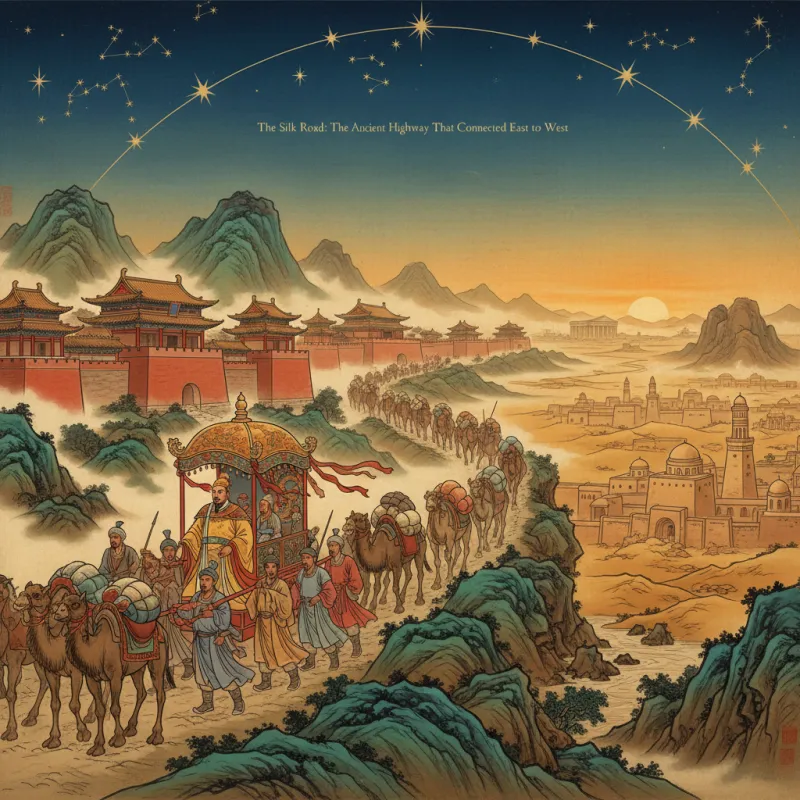
A Chinese diplomat named Zhang Qian (张骞, Zhāng Qiān) set out from Chang'an in 138 BCE with a hundred men. He was captured almost immediately by the Xiongnu, held prisoner for ten years, escaped, completed his mission anyway, got captured again on the return journey, and finally staggered back to the Han capital thirteen years after he left with only one companion surviving. Emperor Wu considered the expedition a complete success. Zhang Qian hadn't secured the military alliance he'd been sent to negotiate, but he'd discovered something far more valuable: a network of kingdoms, cities, and trade routes that would reshape world history.
The 丝绸之路 (Sīchóu zhī Lù, Silk Road) wasn't built by emperors or generals. It emerged organically from thousands of merchants, monks, diplomats, and adventurers who realized that the stuff people wanted in one place could be found in another — and that the journey between them, however brutal, was worth the profit or the enlightenment. The name itself is a 19th-century invention by German geographer Ferdinand von Richthofen, but the routes he described had been moving goods and ideas between China and the Mediterranean for over a millennium before anyone thought to call them a "road."
The Routes: Not One Road But Many
Calling it "the Silk Road" is like calling the internet "the cable" — technically accurate but wildly incomplete. The network comprised multiple routes that shifted with political winds, military conflicts, and the opening or closing of mountain passes. The main northern route ran from Chang'an (modern Xi'an) through the Hexi Corridor, skirting the Taklamakan Desert's northern edge through oasis cities like Dunhuang, Turpan, and Kashgar, then crossing the Pamir Mountains into Central Asia. A southern route hugged the desert's southern rim through Khotan and Yarkand. Maritime routes connected Chinese ports to Southeast Asia, India, and eventually the Persian Gulf and Red Sea.
The journey from Chang'an to Rome took roughly two years if everything went well — which it rarely did. Merchants didn't make the entire trip. Instead, goods passed through chains of middlemen, each controlling a segment of the route. A bolt of silk might change hands a dozen times between the weaver in Sichuan and the senator's wife in Rome who'd eventually wear it. This relay system meant that Chinese and Roman merchants rarely met face-to-face, despite their economies being intimately connected. The Parthian Empire, sitting between them, grew wealthy by controlling the middle sections and had zero interest in letting their customers meet directly.
The physical challenges were extraordinary. The Taklamakan Desert's name supposedly means "go in and you won't come out" in Uyghur. Summer temperatures reached 50°C; winter dropped to -20°C. Sandstorms could bury entire caravans. The Pamir Mountains, called the "Roof of the World," featured passes above 4,500 meters where altitude sickness killed the unprepared. Marco Polo claimed that fires wouldn't burn properly at those heights and that it took longer to cook food — one of the few things he got right.
What Actually Traveled: The Visible Cargo
Silk was the headline product, but calling it "the Silk Road" undersells the diversity of trade. From China westward went silk (obviously), porcelain, lacquerware, iron, bronze mirrors, and later tea and paper. The Romans were obsessed with Chinese silk — Pliny the Elder complained that Roman women's taste for silk was draining the empire's gold reserves. He wasn't entirely wrong; archaeologists have found Roman coins as far east as Vietnam.
Traveling eastward came horses — critically important for Chinese military power against steppe nomads. The Han Dynasty's obsession with the "heavenly horses" of Ferghana (in modern Uzbekistan) sparked military expeditions and diplomatic missions. Also moving east: grapes, walnuts, pomegranates, sesame, cucumbers, figs, and alfalfa — crops that transformed Chinese agriculture and cuisine. Glass from Rome and Persia amazed Chinese consumers who'd never seen the material. Precious stones, ivory, coral, amber, and exotic animals filled imperial menageries and aristocratic collections.
The economics were brutal but simple: luxury goods with high value-to-weight ratios justified the costs and risks. Nobody was shipping grain or lumber across the Taklamakan. A camel could carry about 200 kilograms; that load needed to be worth the animal's purchase price, feeding costs, the merchant's time, protection money paid to various authorities, and the risk of losing everything to bandits, weather, or disease. Silk, gems, and spices made the math work. Bulk goods didn't.
What Actually Traveled: The Invisible Cargo
The Silk Road's real revolution wasn't economic — it was cultural and technological. Buddhism entered China via these routes in the 1st century CE, carried by Central Asian monks and merchants. The religion transformed as it traveled, adapting to Chinese philosophical traditions and eventually spawning distinctly Chinese schools like Chan (Zen). The cave temples at Dunhuang, carved between the 4th and 14th centuries, preserve this cultural fusion in thousands of murals showing Indian Buddhist iconography rendered in Chinese artistic styles.
Papermaking technology, invented in China during the Han Dynasty, reached the Islamic world after the Battle of Talas in 751 CE, when Arab forces captured Chinese papermakers. Within decades, paper mills operated in Samarkand and Baghdad. By the 12th century, paper had reached Europe via Islamic Spain, revolutionizing record-keeping, scholarship, and eventually enabling the printing press. The modern information age traces directly back to Chinese prisoners of war sharing their craft.
Musical instruments migrated in both directions. The pipa (琵琶), now quintessentially Chinese, originated in Persia. The erhu (二胡) has Central Asian ancestors. Chinese musical scales influenced Central Asian traditions and vice versa. Artistic motifs blended: Persian and Hellenistic designs appeared in Chinese textiles and metalwork; Chinese dragons showed up in Central Asian art.
Agricultural knowledge moved along with crops. Chinese irrigation techniques influenced Central Asian farming. The Persian qanat system of underground channels for water transport was studied and sometimes adapted by Chinese engineers. Fermentation techniques, metallurgy innovations, and medical knowledge all traveled the routes, usually embedded in the minds of craftsmen and scholars rather than written down.
The Dark Side: Disease and Destruction
The Silk Road connected populations that had evolved separately for millennia, and their immune systems paid the price. The Antonine Plague (165-180 CE), possibly smallpox or measles, likely reached the Roman Empire via Silk Road trade routes, killing an estimated five million people. The Plague of Justinian (541-549 CE) may have originated in Central Asia before devastating the Byzantine Empire. The Black Death (1347-1353) definitely traveled from Central Asia to Europe along Silk Road networks, killing perhaps half of Europe's population.
These weren't accidents of geography — they were direct consequences of connectivity. Diseases that had been endemic in one region became pandemic when trade routes gave them access to immunologically naive populations. The same caravans that carried silk and spices also carried fleas, rats, and infected travelers. The Silk Road's greatest achievement — connecting distant civilizations — was also its deadliest feature.
Military technology spread along these routes too, not always peacefully. Gunpowder, invented in Tang Dynasty China, reached the Islamic world by the 13th century and Europe by the 14th. The Mongol conquests of the 13th century, which briefly unified most of the Silk Road under one empire, accelerated this transfer. Ironically, the Mongols' facilitation of trade and communication helped spread the very technologies that would eventually make their style of cavalry warfare obsolete.
The Mongol Century: Peak Connectivity
The Mongol Empire (1206-1368) created what historians call the Pax Mongolica — a period of relative stability and safety across Eurasia. Love them or hate them (and there are good reasons for both), the Mongols were excellent for business. They established the 驿站 (yìzhàn) system of relay stations, guaranteed safe passage for merchants, standardized weights and measures across their territory, and generally treated commerce as a strategic priority.
This is when the Silk Road reached its maximum efficiency. Marco Polo's journey (1271-1295) was possible because Mongol control meant he could travel from Venice to Kublai Khan's court in Khanbaliq (Beijing) with relative safety. His account, however embellished, reflects a period when transcontinental travel was more feasible than it had been before or would be again for centuries.
The Mongol postal system was legendarily fast. A message could travel from Beijing to the Black Sea in weeks rather than months. Merchants could obtain passports (paiza) that guaranteed protection and assistance throughout the empire. The Mongols even experimented with paper currency that was theoretically valid across their entire territory — an early attempt at international monetary policy that mostly failed but showed remarkable ambition.
The Decline: Why the Road Closed
The Silk Road didn't end with a bang but with a slow fade across the 15th and 16th centuries. Multiple factors converged. The Ming Dynasty (1368-1644), after overthrowing the Mongols, turned inward, emphasizing agricultural stability over foreign trade. The maritime routes pioneered by European explorers offered faster, cheaper transport for bulk goods. The Ottoman Empire's control of western Silk Road terminals and their conflicts with European powers disrupted traditional trade patterns.
But the real killer was technological: oceangoing ships could carry vastly more cargo than camel caravans, and once Europeans figured out how to sail around Africa to reach Asia directly, the overland routes couldn't compete economically. Why spend two years crossing deserts and mountains when you could ship goods by sea in six months? The romance of the Silk Road died when someone did the math on shipping costs per ton-kilometer.
The final blow came from political fragmentation. The Silk Road worked best when large empires controlled long stretches of route, providing security and infrastructure. As Central Asia fractured into smaller khanates and the Safavid, Mughal, and Ottoman empires focused on their own internal affairs, the coordination required for transcontinental trade became impossible. The oasis cities that had thrived as trading hubs declined into provincial backwaters.
The Legacy: We're All Living on the Silk Road Now
The modern world is the Silk Road's direct descendant. Global supply chains, international trade networks, cultural exchange programs, the internet — all of these are just the Silk Road with better technology. The fundamental insight remains the same: connecting distant places creates value, spreads ideas, and changes everyone involved.
China's modern Belt and Road Initiative explicitly invokes Silk Road imagery, proposing to rebuild transcontinental trade infrastructure through Central Asia. Whether it succeeds or fails, the symbolism is telling: the Silk Road represents an era when China was the world's most advanced economy and the center of global trade networks. That's a powerful historical memory to tap into.
The cultural legacy is everywhere if you know where to look. Buddhist temples in China, Islamic architecture incorporating Chinese motifs, Persian words in Chinese, Chinese words in Persian, the global spread of noodles (which may or may not have traveled from China to Italy via the Silk Road — the evidence is disputed), and the fundamental idea that distant civilizations can trade and communicate without one conquering the other.
The Silk Road proved that you don't need a common language, religion, or political system to do business. You just need something the other person wants and a willingness to make the journey. Zhang Qian figured that out in 138 BCE, and we're still living with the consequences.
Related Reading
- Porcelain: The Art That Named a Nation
- Forgotten Chinese Inventions That Changed the World Before the West Noticed
- Chinese Inventions the World Forgot: Beyond Paper, Printing, Gunpowder, and the Compass
- Traditional Chinese Medicine: 5,000 Years of Healing
- The Four Great Inventions: How China Changed the World
- The Empress Who Ruled China: Wu Zetian's Impossible Rise
- The Porcelain Trade: How Chinese Pottery Conquered the World
- Delving into Ancient China: A Journey Through Dynasties, Emperors, and Cultural Treasures