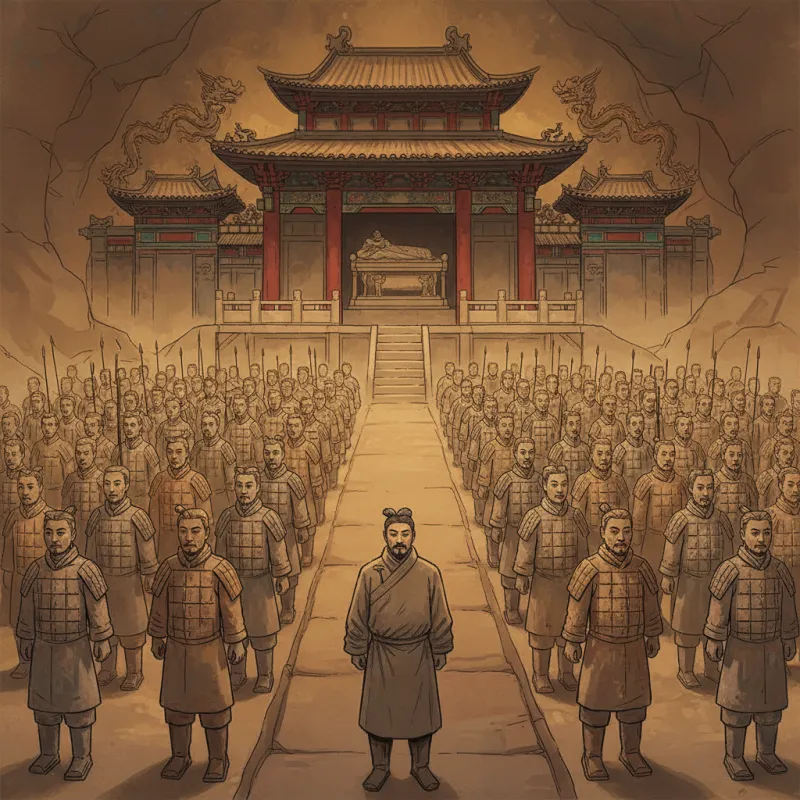
The Terracotta Army: Qin Shi Huang's Eternal Guard
Introduction: An Army Frozen in Time
In March 1974, farmers digging a well near Xi'an in Shaanxi Province stumbled upon one of the most extraordinary archaeological discoveries of the 20th century. What they unearthed was not just fragments of ancient pottery, but the vanguard of an entire army—thousands of life-sized terracotta warriors standing in battle formation, silent sentinels guarding their emperor for over two millennia. This was the legendary Terracotta Army (兵马俑, bīngmǎyǒng), the eternal military force of China's first emperor, Qin Shi Huang (秦始皇, Qín Shǐhuáng).
The discovery revealed not merely an impressive collection of clay sculptures, but a window into the military might, artistic sophistication, and spiritual beliefs of the Qin Dynasty (秦朝, Qín Cháo, 221-206 BCE). This underground army represents one of history's most ambitious funerary projects, a testament to imperial power that continues to captivate scholars and visitors alike.
The First Emperor and His Vision of Immortality
To understand the Terracotta Army, we must first understand the man who commissioned it. Ying Zheng (嬴政, Yíng Zhèng) ascended to the throne of the state of Qin at age thirteen in 246 BCE. By 221 BCE, through a combination of military brilliance, diplomatic cunning, and ruthless determination, he had conquered the six rival states of the Warring States Period (战国时代, Zhànguó Shídài), unifying China for the first time under a centralized imperial system.
Taking the title Qin Shi Huang—literally "First Emperor of Qin"—he set about transforming Chinese civilization. He standardized weights, measures, currency, and even the written script. He connected and extended defensive walls into what would become the Great Wall. Yet despite these monumental achievements, the emperor was haunted by mortality. Historical records, particularly Sima Qian's (司马迁, Sīmǎ Qiān) Records of the Grand Historian (史记, Shǐjì), describe his obsessive quest for immortality, sending expeditions to find the legendary elixir of eternal life.
When immortality in the physical world proved elusive, Qin Shi Huang turned his attention to the afterlife. Construction of his mausoleum complex began shortly after he took the Qin throne, eventually involving over 700,000 laborers over nearly four decades. The Terracotta Army was not merely a burial accessory—it was a fully equipped military force designed to protect and serve the emperor in the afterlife, reflecting the ancient Chinese belief in a spirit world that mirrored earthly existence.
The Archaeological Marvel: Scale and Scope
The Terracotta Army complex covers approximately 56 square kilometers, though only a fraction has been excavated. The main site consists of four major pits, with three containing warriors and one left unfinished—possibly due to the dynasty's abrupt collapse shortly after Qin Shi Huang's death in 210 BCE.
Pit One, the largest, measures 230 meters long and 62 meters wide, containing an estimated 6,000 warriors arranged in battle formation. The vanguard consists of three rows of crossbowmen, followed by the main infantry force organized into 38 columns. This pit represents the right flank of the army, positioned to face east—the direction from which threats to the Qin state historically emerged.
Pit Two, discovered in 1976, contains approximately 1,400 figures representing a more complex military unit. This L-shaped pit includes cavalry units with horses, war chariots (战车, zhànchē), archers in both standing and kneeling positions, and infantry. The arrangement suggests a highly mobile strike force, capable of rapid deployment and tactical flexibility.
Pit Three, the smallest, appears to be the command headquarters. It contains only 68 warriors and one war chariot, arranged around a central chamber. The figures here are believed to represent high-ranking officers, and the pit's layout suggests it served as the command post (指挥部, zhǐhuībù) for the entire terracotta force.
Pit Four was discovered but found empty, leading archaeologists to conclude that construction was interrupted by the political chaos following Qin Shi Huang's death and the subsequent fall of the Qin Dynasty.
Military Organization and Tactical Sophistication
The Terracotta Army is not a random collection of soldiers but a meticulously organized military force that reflects actual Qin military doctrine. The arrangement demonstrates the sophisticated tactical thinking that enabled Qin to conquer its rivals.
The infantry formations follow the principles outlined in ancient military treatises. The front ranks consist of lightly armored archers and crossbowmen, capable of delivering devastating volleys before enemy forces could close. Behind them stand heavily armored infantry wielding dagger-axes (戈, gē), spears (矛, máo), and swords (剑, jiàn). This layered defense allowed the Qin army to engage enemies at multiple ranges.
The cavalry units, though smaller in number, represent a crucial tactical innovation. During the Warring States Period, Chinese states increasingly adopted cavalry warfare, learning from northern nomadic peoples. The terracotta cavalry figures wear distinctive short armor and caps, designed for mobility rather than maximum protection—exactly what mounted warriors required.
The war chariots, each pulled by four terracotta horses and manned by a crew of three, represent an older but still prestigious military tradition. By the Qin period, chariots had evolved from frontline combat vehicles to command platforms and symbols of military authority. The presence of chariots in the terracotta army reflects both practical military organization and ceremonial significance.
Artistic Achievement and Individual Identity
What makes the Terracotta Army truly extraordinary is not just its scale but its artistry. Each warrior is a unique individual, with distinct facial features, expressions, and body types. This individualization represents an unprecedented achievement in ancient sculpture.
The figures range in height from 1.8 to 2 meters, with generals and officers being taller—possibly reflecting actual height differences or symbolic status. Facial features vary dramatically: some warriors have broad faces with wide-set eyes, others have narrow faces with sharp features. Some appear young and clean-shaven, others sport elaborate mustaches and beards. Hairstyles differ according to rank and regional origin, with some warriors wearing their hair in topknots, others in elaborate braids.
The level of detail extends to hands, with individually sculpted fingers positioned to grip weapons (most of which have long since decayed or been looted). Ears are carefully modeled, and even the soles of shoes show tread patterns. This attention to detail suggests that the sculptors worked from life, possibly using actual soldiers as models.
The manufacturing process was remarkably sophisticated. Bodies were constructed using coil pottery techniques (盘条法, pántiáo fǎ), with legs made as solid columns, hollow torsos, and separately crafted arms and heads. After assembly, the figures were fired in kilns at temperatures exceeding 1,000 degrees Celsius. They were then painted in bright colors—reds, blues, greens, purples, and yellows—using mineral and organic pigments. Tragically, exposure to air causes these pigments to deteriorate within minutes of excavation, though modern preservation techniques are improving.
Armor, Weapons, and Military Technology
The Terracotta Army provides invaluable evidence about Qin military technology and equipment. The warriors wear various types of armor, from simple tunics to elaborate lamellar armor (札甲, zhájǐa) consisting of small rectangular plates laced together. Officers wear more ornate armor with decorative elements, while generals sport distinctive double-layered robes and elaborate headgear.
Though most original weapons have been looted or deteriorated, archaeologists have recovered thousands of bronze weapons, including swords, spears, crossbow triggers, and arrowheads. These weapons reveal the Qin's advanced metallurgical capabilities. The bronze swords, some over 90 centimeters long, remain sharp after 2,200 years, showing minimal corrosion. Analysis reveals they were treated with chromium compounds, a rust-prevention technique not rediscovered in the West until the 20th century.
The crossbow mechanisms are particularly sophisticated, featuring precisely calibrated bronze triggers with interchangeable parts—evidence of standardized manufacturing that predates the European Industrial Revolution by two millennia. The effective range of Qin crossbows exceeded 200 meters, giving them a decisive advantage over enemies armed with traditional bows.
The Horses: Companions in Eternity
The Terracotta Army includes approximately 600 terracotta horses, each as meticulously crafted as the warriors. These horses represent the sturdy, compact breeds used by the Qin military, standing about 1.5 meters at the shoulder. They are depicted with alert expressions, flared nostrils, and carefully detailed musculature.
The horses are equipped with elaborate tack, including bridles, reins, and saddles (though stirrups had not yet been invented in China). Cavalry horses wear simpler equipment than chariot horses, reflecting their different tactical roles. The attention to equine anatomy and equipment demonstrates the crucial importance of horses in Qin military success.
In 1980, archaeologists discovered two bronze chariots buried near the main mausoleum, each pulled by four bronze horses. These half-scale models are masterpieces of bronze casting, featuring over 3,000 separate components assembled with gold and silver fittings. They likely represent the emperor's ceremonial vehicles, providing transportation for his spirit in the afterlife.
Spiritual Beliefs and Afterlife Concepts
The Terracotta Army embodies ancient Chinese beliefs about death and the afterlife. Unlike Egyptian pharaohs who were mummified for physical resurrection, Chinese emperors prepared for a spiritual existence that paralleled earthly life. The tomb complex was designed as an underground palace, complete with rivers of mercury (according to historical accounts), celestial ceiling decorations, and all the accoutrements of imperial power.
The practice of creating mingqi (明器, míngqì)—"spirit objects" or "grave goods"—dates back millennia in Chinese culture. However, earlier periods often practiced human sacrifice, with servants and soldiers killed to accompany rulers in death. The Terracotta Army represents a more humane evolution of this tradition, substituting clay figures for living victims. This shift reflects both practical considerations and evolving ethical sensibilities during the Warring States Period.
The army's positioning—facing outward from the tomb—suggests a defensive purpose, protecting the emperor from spiritual threats. Yet it also symbolizes the emperor's continued authority, his ability to command forces even in death. This dual function reflects the complex Chinese understanding of the afterlife as both a continuation of earthly existence and a separate spiritual realm.
Legacy and Ongoing Discoveries
The Terracotta Army has fundamentally transformed our understanding of ancient Chinese civilization. It provides concrete evidence of military organization, artistic capabilities, technological sophistication, and spiritual beliefs that previously existed only in fragmentary historical texts.
Excavation and research continue, with new discoveries emerging regularly. In recent years, archaeologists have found acrobats, musicians, and civil officials, suggesting the tomb complex includes not just military forces but an entire imperial court. The main burial mound itself remains unexcavated, partly due to technical challenges and partly from respect for the site's integrity.
Modern technology is revolutionizing research. 3D scanning creates detailed digital records, while chemical analysis reveals manufacturing techniques and trade networks. DNA analysis of human remains found at the site provides information about the workers who built this marvel. Ground-penetrating radar and other non-invasive techniques map unexcavated areas, revealing the complex's full scope without disturbing it.
Conclusion: Eternal Guardians of China's First Empire
The Terracotta Army stands as one of humanity's most remarkable achievements, a fusion of artistic vision, technical skill, military precision, and spiritual devotion. These silent warriors, frozen in eternal vigilance, guard not just an emperor's tomb but the memory of a pivotal moment in Chinese history—the birth of a unified empire that would shape East Asian civilization for millennia.
For visitors who stand before these ranks of clay soldiers, the experience is profound. Here is tangible evidence of human ambition, creativity, and the universal desire to transcend mortality. The warriors' individual faces remind us that behind every great historical achievement stand countless individuals—the artisans who sculpted each figure, the soldiers who served as models, the laborers who constructed this underground marvel.
Qin Shi Huang's quest for immortality failed in the physical sense—he died at age 49, possibly from mercury poisoning caused by the very elixirs meant to grant eternal life. Yet through the Terracotta Army, he achieved a different kind of immortality. More than two millennia after his death, millions visit his eternal guards each year, ensuring that the First Emperor's name and legacy endure. In this sense, the clay warriors have fulfilled their mission perfectly, standing watch not just over their emperor's tomb, but over his place in human memory—an eternal guard indeed.