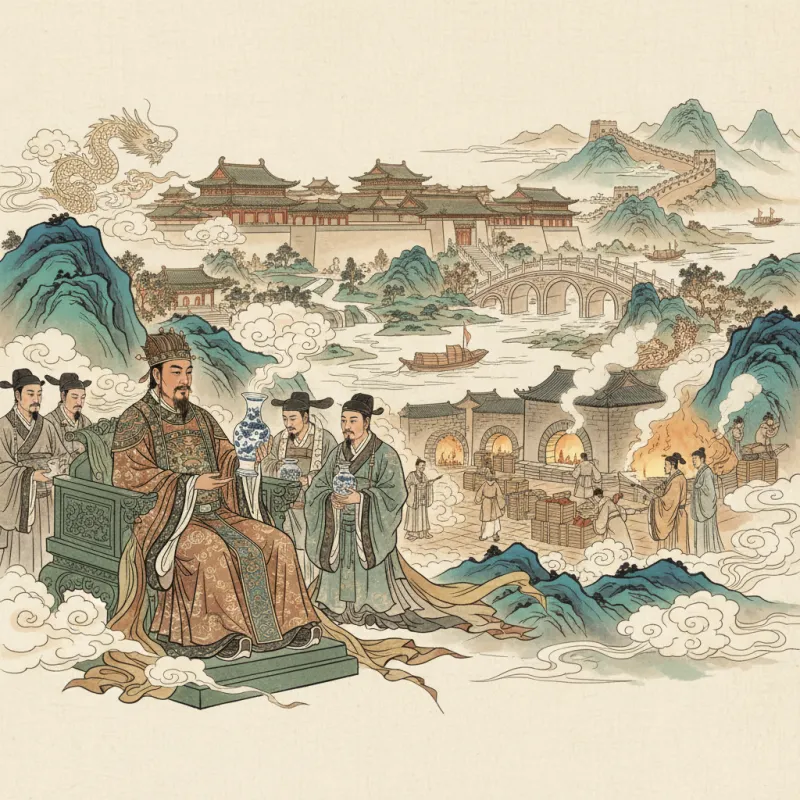
A single bowl could buy a house. In 16th-century Europe, Chinese porcelain commanded prices that rivaled gold, and monarchs bankrupted their treasuries trying to unlock its secrets. The Medici family attempted to replicate it. Augustus the Strong of Saxony traded an entire regiment of soldiers—600 men—for 48 porcelain vases. What made this "white gold" so intoxicating that it literally named a nation in Western languages? The answer lies in a millennium of obsessive refinement, jealously guarded secrets, and an alchemical process that transformed humble clay into objects of transcendent beauty.
The Alchemical Origins: More Than Just Clay
The Chinese didn't stumble upon porcelain—they engineered it through centuries of systematic experimentation. The breakthrough came during the Tang Dynasty (618–907 AD), when potters in Jingdezhen discovered that combining kaolin clay (高岭土, gāolǐng tǔ)—named after the Gaoling mountain where it was mined—with petuntse (瓷石, cí shí), a feldspathic rock, and firing the mixture at temperatures exceeding 1,300°C produced something unprecedented: a ceramic body that was white, translucent, and rang like a bell when struck.
This wasn't mere pottery. The molecular transformation that occurred in those dragon kilns created a vitrified, non-porous material that could hold liquids without glazing, resist thermal shock, and maintain its integrity for centuries. European potters, working with earthenware and stoneware, couldn't approach these temperatures with their kiln technology. They didn't even have the right clay. For nearly a thousand years, China held an absolute monopoly on true porcelain production.
The Song Dynasty (960–1279 AD) elevated porcelain from technical achievement to high art. Five great kiln sites—Ding, Ru, Guan, Ge, and Jun—each developed distinctive styles that modern collectors still revere. Ru ware, produced for only twenty years during the Northern Song, achieved a celadon glaze of such ethereal beauty that surviving pieces now sell for tens of millions of dollars. Only 67 authenticated Ru pieces exist today.
Jingdezhen: The Porcelain Capital of the World
If porcelain had a Vatican, it would be Jingdezhen (景德镇, Jǐngdézhèn) in Jiangxi Province. By the Yuan Dynasty (1271–1368 AD), this city had become the undisputed center of Chinese porcelain production, a position it held for over 600 years. At its peak during the Ming Dynasty, Jingdezhen employed over a million workers in porcelain-related industries—in a city whose entire population was dedicated to a single craft.
The scale was industrial, but the process remained artisanal. A single piece of imperial porcelain might pass through seventy pairs of hands, each specialist responsible for one step: wedging the clay, throwing the form, trimming the foot, applying the first glaze layer, painting the decoration, applying the final glaze, loading the kiln. The division of labor was so refined that some workers spent their entire careers painting nothing but the scales on dragons.
The imperial kilns (御窑, yù yáo) operated under brutal standards. Pieces destined for the Forbidden City had to be flawless—a single bubble in the glaze, a microscopic crack, an imperfect brushstroke meant destruction. Thousands of pieces were smashed for every one that passed inspection. Archaeologists have excavated mountains of imperial kiln waste in Jingdezhen, a testament to the uncompromising perfectionism that defined Chinese porcelain at its zenith.
Blue and White: The Design That Conquered the World
When cobalt blue met white porcelain during the Yuan Dynasty, it created the most influential ceramic aesthetic in human history. Blue and white porcelain (青花瓷, qīnghuā cí) became China's signature export, the visual language that defined "Chinese" in the global imagination for centuries.
The cobalt itself came from Persia, imported along the Silk Road and known as "Muslim blue" (回青, huí qīng). Chinese potters discovered that this particular cobalt ore, when painted onto unfired porcelain and covered with transparent glaze, produced a brilliant blue that could withstand the intense kiln temperatures. The color was stable, vivid, and unlike anything European ceramics could achieve.
Ming Dynasty blue and white reached its artistic peak during the Xuande reign (1426–1435 AD). Xuande pieces combined technical perfection with artistic sophistication—the cobalt was applied in varying densities to create tonal depth, the designs balanced negative space with intricate detail, and the forms themselves achieved a harmony of proportion that seems effortless but required generations of refinement. A Xuande blue and white jar sold at Sotheby's in 2011 for over $10 million.
The global appetite for blue and white was insatiable. The Dutch East India Company alone shipped millions of pieces to Europe in the 17th century. Japanese potters at Arita began producing their own blue and white to meet demand. Even after Europeans finally cracked the porcelain formula, they continued to imitate Chinese blue and white designs—the willow pattern, chinoiserie scenes, the visual vocabulary of Chinese porcelain became embedded in Western decorative arts.
The Great Porcelain Secret: Europe's 200-Year Quest
European alchemists and potters spent two centuries trying to reverse-engineer Chinese porcelain, and they failed spectacularly. They produced soft-paste porcelain—a mixture of white clay and ground glass that could approximate porcelain's appearance but lacked its strength and translucency. The Medici porcelain of 1575 was an impressive fake, but it was still a fake.
The breakthrough came in 1708 when Johann Friedrich Böttger, an alchemist imprisoned by Augustus the Strong in Meissen, Germany, finally produced true hard-paste porcelain. The discovery was treated as a state secret—workers at the Meissen factory were forbidden to leave, and the formula was guarded with the same intensity as military intelligence. Augustus had his porcelain, and he didn't intend to share.
But secrets leak. By the mid-18th century, porcelain manufactories had sprung up across Europe—Sèvres in France, Chelsea in England, Capodimonte in Italy. Each developed distinctive styles, but they all owed their existence to the Chinese formula that Böttger had finally cracked. The irony is that by the time Europe mastered porcelain production, Chinese porcelain had already shaped European taste so thoroughly that European factories spent decades imitating Chinese designs.
The Silk Road of Ceramics: Porcelain as Global Currency
Chinese porcelain wasn't just an export commodity—it was a form of soft power that projected Chinese aesthetic values across three continents. Porcelain shards have been found in East African ports, Persian palaces, and Viking graves. The Silk Road carried silk, but it also carried ceramics, and in many markets, porcelain was more valuable.
The maritime trade was even more significant. By the Ming Dynasty, Chinese porcelain was being produced specifically for export markets, with designs tailored to foreign tastes. Potters created pieces with Islamic calligraphy for Middle Eastern buyers, armorial designs for European nobility, and hybrid styles that blended Chinese and foreign aesthetics. This wasn't cultural dilution—it was sophisticated market segmentation.
The economic impact was staggering. Porcelain exports generated enormous wealth for China, creating a trade imbalance that European powers struggled to correct. The British solution was opium, which led directly to the Opium Wars—a conflict that had its roots, in part, in Europe's insatiable appetite for Chinese porcelain and tea.
The Living Tradition: Porcelain in Modern China
Jingdezhen never stopped making porcelain. Even during the Cultural Revolution, when traditional crafts were denounced as feudal remnants, the kilns kept firing. Today, the city has experienced a renaissance, attracting artists and ceramicists from around the world who come to work with master craftsmen whose skills represent an unbroken lineage stretching back centuries.
Modern Chinese porcelain exists in tension between tradition and innovation. Some artists meticulously recreate Song Dynasty glazes using historical formulas. Others push the material in radical new directions, creating sculptural works that challenge porcelain's association with decorative arts. The technical knowledge accumulated over a millennium provides a foundation for experimentation that would be impossible without that deep historical grounding.
The global porcelain market has also shifted. Chinese collectors, newly wealthy, are repatriating pieces that left China centuries ago, paying record prices at international auctions. A Ming Dynasty chicken cup—a small wine cup decorated with a rooster and hen—sold for $36 million in 2014 to a Shanghai collector. The porcelain that once flowed out of China is flowing back, a circular journey that mirrors China's own economic transformation.
The Art That Named a Nation
In most European languages, the word for China and the word for porcelain are the same or closely related—china, Chine, porcellana. This linguistic fusion reveals something profound: for centuries, China was porcelain in the Western imagination. The nation's identity became inseparable from its most famous export.
This wasn't accidental. Chinese porcelain represented a level of technical sophistication and aesthetic refinement that Europe couldn't match for a millennium. It was tangible proof of Chinese civilization's advancement, a daily reminder in every European household that possessed a Chinese bowl or plate that the Middle Kingdom had mastered arts that the West was still struggling to understand.
The legacy endures. When we speak of "fine china," we're invoking a tradition that began in Tang Dynasty kilns and reached its apex in the imperial workshops of the Ming and Qing. Every porcelain piece, whether a priceless museum artifact or a modern dinner plate, carries within it the accumulated knowledge of generations of Chinese potters who transformed earth, water, and fire into objects of enduring beauty. They didn't just create an art form—they created an art form so distinctive, so superior, that it became synonymous with the civilization that produced it.
Related Reading
- The Four Great Inventions: How China Changed the World
- Unveiling Ancient Chinese Innovations: A Journey Through Dynasties and Culture
- Forgotten Chinese Inventions That Changed the World Before the West Noticed
- Innovations of Ancient China: How Dynasties Shaped World-Changing Inventions
- Traditional Chinese Medicine: 3,000 Years of Healing Philosophy
- Unveiling the Role of Women in Ancient Chinese Dynasties
- Three Kingdoms: The History That Became China's Greatest Story
- Diplomacy and Cultural Exchange in Chinese Ancient Dynasties