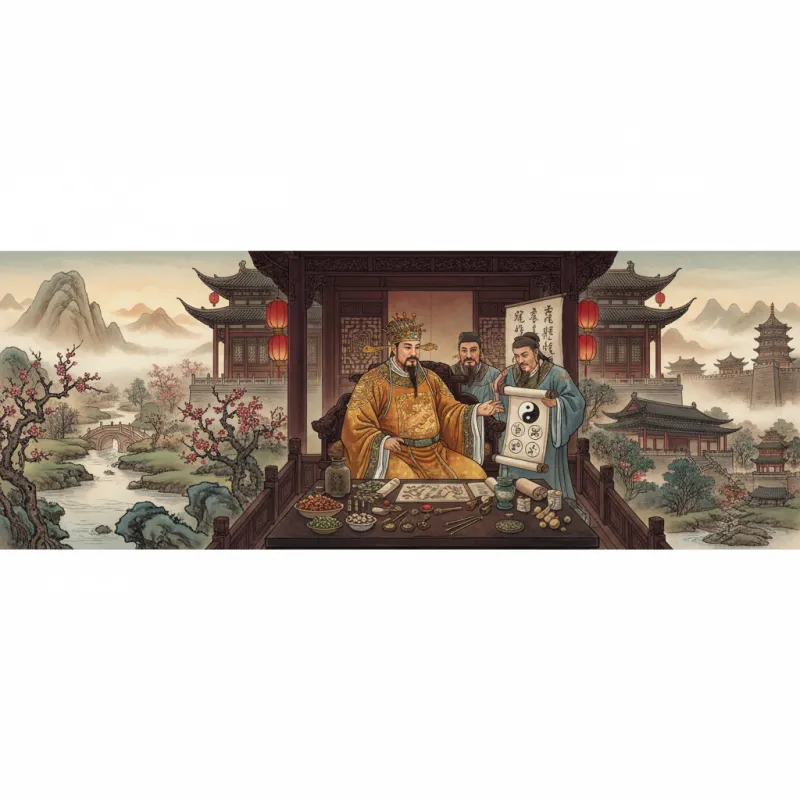
A physician in the Han dynasty court examines a patient not by drawing blood or ordering scans, but by placing three fingers on the wrist and closing his eyes. For the next several minutes, he feels for twenty-eight distinct pulse qualities — slippery, wiry, choppy, floating, sinking — each revealing the state of internal organs he will never see. This isn't mysticism. It's 脉诊 (màizhěn, pulse diagnosis), one pillar of a medical system that has treated billions of people across three millennia, and it operates on principles so foreign to Western biomedicine that the two traditions still struggle to speak the same language.
The Philosophical Foundation: Qi, Yin-Yang, and Five Phases
Traditional Chinese Medicine rests on a cosmological view where the human body mirrors the natural world. At its core lies 气 (qì), often translated as "vital energy" or "life force," though neither captures its full meaning. Qi is simultaneously the breath you take, the warmth in your limbs, the force that moves your blood, and the intangible something that distinguishes a living body from a corpse. When qi flows smoothly through the body's meridians (经络 jīngluò), health prevails. When it stagnates, rebels upward, or becomes deficient, disease follows.
This isn't metaphor — TCM practitioners diagnose and treat qi as concretely as Western doctors treat blood pressure. The 黄帝内经 (Huángdì Nèijīng, Yellow Emperor's Inner Canon), compiled around 100 BCE during the Han dynasty, established qi as the fundamental substance of life. The text presents medicine as a dialogue between the legendary Yellow Emperor and his physician Qi Bo, covering everything from acupuncture techniques to seasonal dietary recommendations. It remains required reading in Chinese medical schools today.
Overlaying the concept of qi is the yin-yang duality — not opposing forces but complementary aspects of a unified whole. Yin represents cold, interior, deficiency, and substance; yang represents heat, exterior, excess, and function. A fever might indicate excess yang or deficient yin (which fails to cool the body). Chronic fatigue could stem from yang deficiency or yin excess. The same symptom demands different treatments depending on the underlying pattern.
The Five Phases theory (五行 wǔxíng) adds another layer, correlating wood, fire, earth, metal, and water with organs, seasons, emotions, tastes, and colors in an intricate web of correspondences. The liver belongs to wood, governs anger, prefers sour flavors, and flourishes in spring. The heart belongs to fire, houses the spirit, and peaks in summer. These aren't arbitrary associations but systematic relationships observed and refined over centuries. A skilled TCM doctor reads these patterns like a Western physician reads lab results.
Diagnostic Arts: Reading the Body's Language
Where Western medicine relies on laboratory tests and imaging, TCM employs four diagnostic methods known as the "Four Examinations" (四诊 sìzhěn): looking, listening/smelling, asking, and touching. Each reveals different aspects of the body's internal state.
Tongue diagnosis (舌诊 shézhěn) deserves special mention. The tongue's color, coating, shape, and moisture reflect the condition of internal organs with surprising specificity. A pale, swollen tongue with tooth marks suggests spleen qi deficiency. A red tongue with a yellow coating indicates heat in the stomach. A purple tongue points to blood stasis. I've watched TCM doctors diagnose digestive issues, hormonal imbalances, and chronic pain conditions from a ten-second tongue examination, then confirm their assessment through pulse-taking.
The pulse diagnosis mentioned earlier isn't checking heart rate — it's assessing the quality of qi and blood flow through twelve positions on both wrists, each corresponding to different organs. A "slippery" pulse (滑脉 huámài) feels like pearls rolling under the fingers and often indicates phlegm accumulation or pregnancy. A "wiry" pulse (弦脉 xiánmài) feels taut like a guitar string and suggests liver qi stagnation, often accompanying stress and irritability. Master practitioners claim to distinguish twenty-eight pulse types, though even competent doctors reliably identify eight to twelve.
This diagnostic approach frustrates Western-trained physicians because it's irreproducible in the scientific sense — two TCM doctors might identify different patterns in the same patient. But TCM doesn't aim for standardization; it aims for individualized pattern recognition. The same disease might present as five different patterns requiring five different treatments, while five different diseases might share one pattern requiring one treatment.
The Herbal Pharmacy: 5,000 Medicinal Substances
The 本草纲目 (Běncǎo Gāngmù, Compendium of Materia Medica), compiled by physician Li Shizhen during the Ming dynasty and published in 1596, catalogs 1,892 medicinal substances with 11,096 prescriptions. This monumental work took Li thirty years to complete, drawing on every medical text available and his own clinical experience. It remains the foundation of Chinese herbal medicine, though the modern pharmacopeia has expanded to over 5,000 substances.
Chinese herbs aren't used individually like Western pharmaceuticals. They're combined in formulas (方剂 fāngjì) of four to twenty ingredients, each playing a specific role: the emperor herb addresses the primary pattern, minister herbs support the emperor, assistant herbs treat secondary symptoms or moderate harsh effects, and envoy herbs guide the formula to specific body regions. The classic formula 四物汤 (Sìwù Tāng, Four-Substance Decoction) for blood deficiency contains just four herbs, but their synergistic effect supposedly exceeds the sum of their parts.
Some formulas date back two thousand years. 麻黄汤 (Máhuáng Tāng, Ephedra Decoction) from the 伤寒论 (Shānghán Lùn, Treatise on Cold Damage), written by Zhang Zhongjing around 220 CE, treats exterior cold patterns with symptoms resembling the common cold. The formula remains in use today, though ephedra's stimulant properties have made it controversial in Western countries. This highlights a key difference: TCM uses ephedra in combination with other herbs that moderate its effects, not as an isolated compound.
The preparation matters as much as the ingredients. Herbs might be raw, dry-fried, honey-fried, wine-processed, or vinegar-processed, each method altering their properties and directing them to different organs. Ginger appears in dozens of formulas, but fresh ginger (生姜 shēngjiāng) warms the exterior and stops vomiting, while dried ginger (干姜 gānjiāng) warms the interior and treats diarrhea. This pharmaceutical sophistication rivals anything in Western medicine, though it operates on different principles.
Acupuncture: Needling the Meridians
If herbal medicine is TCM's internal therapy, acupuncture (针灸 zhēnjiǔ, literally "needle-moxibustion") is its external intervention. The practice involves inserting hair-thin needles into specific points along the body's meridian pathways to regulate qi flow. The meridian system maps twelve primary channels connecting the body's surface to internal organs, plus eight extraordinary vessels that act as reservoirs. Over 360 classical acupuncture points dot these pathways, each with specific therapeutic effects.
The earliest acupuncture needles, discovered in a tomb from the Han dynasty, were made of bronze and stone. Modern needles are stainless steel, disposable, and far more refined, but the point locations remain largely unchanged from those documented in the Yellow Emperor's Inner Canon. 合谷 (Hégǔ, Union Valley), located between the thumb and index finger, treats headaches, facial pain, and toothaches. 足三里 (Zúsānlǐ, Leg Three Miles), below the knee, strengthens digestion and boosts overall vitality — legend claims soldiers could march three more miles after needling this point.
Western medicine has struggled to explain acupuncture's mechanisms. Early dismissals as placebo have given way to research showing measurable effects on pain perception, inflammation, and nervous system function. The meridian system doesn't correspond to any known anatomical structure, yet functional MRI studies show that needling specific points activates corresponding brain regions. Acupuncture for chronic pain now receives qualified endorsement from organizations like the World Health Organization and the U.S. National Institutes of Health, though debates continue about whether it works through TCM's proposed mechanisms or through neurological pathways Western science is still mapping.
Moxibustion (灸 jiǔ), acupuncture's partner therapy, involves burning dried mugwort (艾草 àicǎo) near acupuncture points to warm the meridians and expel cold. The practice dates back at least 2,500 years and remains common in Chinese clinics, though it's less known in the West. The pungent smoke and risk of burns make it impractical for many modern settings, but practitioners insist certain conditions — particularly those involving cold and dampness — respond better to moxibustion than needles alone.
Historical Evolution: From Shamans to State Medicine
TCM didn't emerge fully formed. Its earliest roots lie in Shang dynasty (1600-1046 BCE) oracle bone inscriptions describing illnesses and healing rituals that mixed proto-medical observation with shamanic practices. The transition from supernatural to naturalistic medicine accelerated during the Warring States period (475-221 BCE) as philosophical schools like Daoism and Confucianism provided frameworks for understanding health and disease without invoking spirits.
The Han dynasty (206 BCE - 220 CE) marked TCM's classical period. The Yellow Emperor's Inner Canon established theoretical foundations, while Zhang Zhongjing's Treatise on Cold Damage provided clinical protocols still used today. The 神农本草经 (Shénnóng Běncǎo Jīng, Divine Farmer's Materia Medica), attributed to the legendary emperor Shennong but likely compiled during this period, classified 365 medicinal substances by their properties and therapeutic effects.
Subsequent dynasties added layers of sophistication. The Tang dynasty (618-907 CE) established the Imperial Medical Bureau, standardizing medical education and creating specialized departments for different branches of medicine. The Song dynasty (960-1279 CE) saw the first government-sponsored publication of medical texts and the establishment of public pharmacies. The Ming dynasty produced Li Shizhen's comprehensive materia medica and saw the rise of specialized schools focusing on specific aspects of TCM — the 温病学派 (wēnbìng xuépài, Warm Disease School) developed new approaches to infectious diseases that challenged classical cold damage theory.
The Qing dynasty (1644-1912 CE) brought TCM to its pre-modern peak, but also sowed seeds of its later crisis. As Western powers forced China open in the 19th century, Western medicine arrived with undeniable advantages: surgery, antiseptics, vaccines. Chinese intellectuals, desperate to modernize a nation humiliated by foreign powers, questioned everything traditional, including medicine. The early Republican period (1912-1949) saw serious proposals to abolish TCM entirely as unscientific superstition.
Modern Integration: Science, Politics, and Practice
TCM survived its near-death experience through an unlikely savior: the Communist Party. Mao Zedong, facing a massive healthcare crisis with insufficient Western-trained doctors, promoted TCM as a practical solution and a symbol of Chinese cultural pride. The famous "barefoot doctors" program trained rural health workers in basic TCM and Western medicine, bringing healthcare to hundreds of millions. Political expediency became cultural preservation.
The government established TCM universities, research institutes, and hospitals, attempting to systematize and scientize the tradition. This modernization brought gains and losses. TCM education became standardized, making it more accessible but potentially less individualized. Research attempted to validate TCM through Western scientific methods — isolating active compounds, conducting randomized trials — sometimes missing the point that TCM treats patterns, not diseases, and uses synergistic formulas, not isolated compounds.
The most famous success story is 青蒿素 (qīnghāosù, artemisinin), an antimalarial compound extracted from sweet wormwood (青蒿 qīnghāo) by scientist Tu Youyou, who won the 2015 Nobel Prize in Physiology or Medicine. Tu discovered artemisinin by studying ancient TCM texts, particularly Ge Hong's 4th-century 肘后备急方 (Zhǒuhòu Bèijí Fāng, Emergency Formulas to Keep Up One's Sleeve), which described sweet wormwood for treating intermittent fevers. This vindicated TCM's empirical knowledge while demonstrating the value of scientific investigation.
Today's TCM exists in multiple forms. In China, TCM hospitals operate alongside Western hospitals, and many patients use both systems — Western medicine for acute conditions and surgery, TCM for chronic diseases and prevention. The integration isn't always smooth. Western-trained doctors often dismiss TCM as pseudoscience, while TCM practitioners resent being forced into Western scientific frameworks that don't accommodate their diagnostic methods or theoretical models.
Global Spread and Contemporary Challenges
TCM has spread globally, though often in diluted or distorted forms. Acupuncture clinics proliferate in Western cities, but many practitioners learn simplified point protocols divorced from TCM theory. Chinese herbal formulas are sold as supplements with health claims that would make classical doctors cringe. The term "traditional Chinese medicine" itself is a 20th-century invention — classical doctors simply practiced "medicine" (医 yī).
Quality control remains a serious issue. Herbal products vary wildly in potency and purity. Some contain heavy metals or pharmaceutical adulterants. Others substitute cheaper herbs for expensive ones. The lack of standardization that allows TCM's individualized approach also enables fraud and inconsistency. Western regulatory agencies struggle to evaluate products designed for synergistic effects rather than isolated active ingredients.
The philosophical gap persists. Western medicine asks "What disease does this patient have?" TCM asks "What pattern is this patient manifesting?" Western medicine seeks universal protocols applicable to all patients with the same diagnosis. TCM insists that ten patients with the same disease might need ten different treatments. These aren't just different medical systems — they're different ways of understanding what bodies are and how healing works.
Yet integration continues. Research on acupuncture reveals measurable neurological effects. Studies of herbal formulas identify anti-inflammatory, immune-modulating, and neuroprotective compounds. The World Health Organization has included TCM in its International Classification of Diseases, legitimizing it while attempting to standardize it. Whether this represents TCM's triumph or its domestication remains debatable.
The Living Tradition
What makes TCM remarkable isn't its age but its continuity. This isn't a museum piece or a reconstructed tradition — it's a living medical system still evolving, still treating patients, still training new practitioners. Walk into a TCM clinic in Chengdu or Taipei, and you'll see doctors using diagnostic methods from the Han dynasty alongside modern equipment, prescribing classical formulas modified for contemporary patterns of disease.
The tradition faces genuine challenges. Climate change affects herb cultivation. Overharvesting threatens rare medicinal plants. Younger Chinese, raised on Western medicine, view TCM with skepticism or nostalgia rather than confidence. The pressure to validate TCM through Western scientific methods risks transforming it into something unrecognizable — Chinese-flavored biomedicine rather than an alternative medical paradigm.
Yet TCM persists because it addresses something Western medicine often misses: the patient's subjective experience of illness, the body as an integrated whole rather than a collection of systems, the importance of prevention and balance rather than just treating disease. Whether its theoretical framework represents profound wisdom or elaborate rationalization of empirical observations matters less than this: for three thousand years, it has helped people feel better. That's not nothing.
The dual pharmacy in Beijing — Western pills and Chinese herbs side by side — isn't a contradiction. It's a pragmatic acknowledgment that different medical systems excel at different things, and that healing is too important to be constrained by theoretical purity. The conversation between these traditions continues, sometimes contentious, sometimes productive, always revealing how much we still don't understand about bodies, health, and the mysterious process of healing.
Related Reading
- Innovations of Ancient China: How Dynasties Shaped World-Changing Inventions
- Forgotten Chinese Inventions That Changed the World Before the West Noticed
- Unveiling Ancient Chinese Innovations: A Journey Through Dynasties and Culture
- Traditional Chinese Medicine: 5,000 Years of Healing
- Ancient Chinese Inventions the West Forgot to Credit
- The Four Great Inventions: Paper, Printing, Gunpowder, and the Compass
- The Role of Trade in Shaping Ancient Chinese Dynasties and Culture
- Ancient Chinese Law: When Justice Was Personal and Punishment Was Public