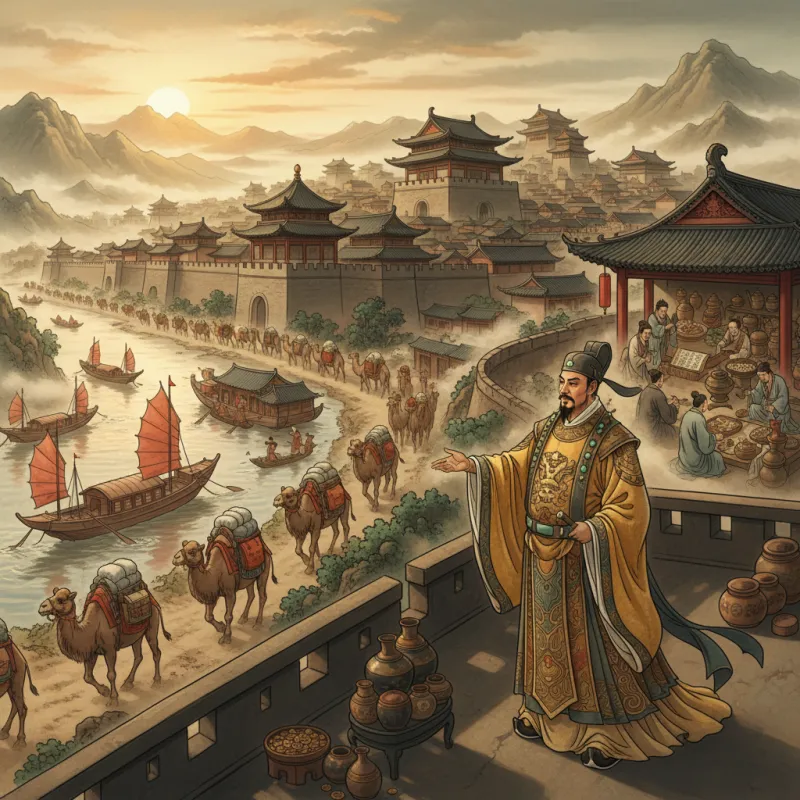
The bronze vessels gleamed in the firelight of a Shang Dynasty workshop, their intricate patterns telling stories that would travel thousands of miles along dusty caravan routes. These weren't just decorative objects—they were currency, diplomatic gifts, and proof of technological superiority that would reshape the political landscape of ancient China. Trade wasn't merely an economic activity for Chinese dynasties; it was the invisible hand that built empires, toppled kingdoms, and wove together the cultural fabric we recognize today as distinctly Chinese.
Bronze, Silk, and the Birth of Commercial Networks
The Shang Dynasty (商朝, Shāng Cháo, circa 1600-1046 BCE) didn't invent trade, but they perfected the art of using it as a tool of statecraft. Their bronze-working technology created a commodity so valuable that neighboring tribes would pledge allegiance just to access it. Archaeological evidence from Anyang reveals that Shang merchants traded as far as modern-day Xinjiang, exchanging bronze weapons, ritual vessels, and cowrie shells—the dynasty's preferred currency—for jade, tin, and exotic animal pelts.
What made Shang trade revolutionary wasn't the goods themselves but the infrastructure they built around commerce. Oracle bone inscriptions record detailed accounts of trade missions, tribute payments, and even early forms of taxation on merchant activities. The dynasty established what we might call "trade posts" at strategic locations, precursors to the caravanserais that would later dot the Silk Road. This wasn't accidental—the Shang rulers understood that controlling trade routes meant controlling power itself.
The Zhou Dynasty (周朝, Zhōu Cháo, 1046-256 BCE) inherited this commercial framework and expanded it dramatically during their Western Zhou period. They introduced standardized bronze coinage and established the "well-field system" (井田制, jǐngtián zhì), which, while primarily agricultural, created surplus production that fueled inter-regional trade. More importantly, Zhou rulers codified the concept of "tribute trade" (朝贡贸易, cháogòng màoyì), where vassal states would present valuable goods to the emperor in exchange for political legitimacy and access to Chinese markets.
The Silk Road: When Commerce Became Diplomacy
Emperor Wu of Han (汉武帝, Hàn Wǔdì, r. 141-87 BCE) didn't set out to create the world's most famous trade route—he was trying to find military allies against the Xiongnu nomads. When Zhang Qian (张骞, Zhāng Qiān) returned from his diplomatic mission to Central Asia in 126 BCE, he brought back something more valuable than treaties: detailed knowledge of Western markets hungry for Chinese silk. The Han court's decision to monopolize silk production and control its export transformed a luxury fabric into a geopolitical weapon.
The Silk Road's impact on Chinese culture was profound and often unexpected. Buddhist missionaries followed merchant caravans eastward, introducing concepts that would fundamentally alter Chinese philosophy and art. The introduction of Buddhism during the Later Han period came not through military conquest but through commercial exchange—monks traveled with merchants because the routes were safer and the audiences more receptive. By the Tang Dynasty, Chang'an had become the world's most cosmopolitan city, where Persian merchants, Indian monks, and Arab traders mingled in markets selling goods from three continents.
But here's what most accounts miss: the Silk Road wasn't actually about silk for most of its history. By the Tang Dynasty (唐朝, Táng Cháo, 618-907 CE), Chinese merchants were trading tea, porcelain, paper, and gunpowder—technologies that would reshape civilizations from Baghdad to London. The real commodity being traded was innovation itself. When a Persian merchant purchased Chinese paper in Samarkand, he wasn't just buying a product; he was acquiring a technology that would eventually make the European Renaissance possible.
Maritime Trade and the Southern Dynasties' Hidden Influence
While historians obsess over the Silk Road, the maritime trade routes developed during the Song Dynasty (宋朝, Sòng Cháo, 960-1279 CE) were arguably more transformative. Song merchants, barred from northern overland routes by hostile nomadic kingdoms, turned to the sea with remarkable results. The development of the magnetic compass, watertight bulkheads, and sophisticated navigation techniques allowed Chinese junks to reach as far as East Africa, establishing what historians now call the "Maritime Silk Road" (海上丝绸之路, hǎishàng sīchóu zhīlù).
The Song Dynasty's commercial revolution deserves more attention than it typically receives. The government issued the world's first paper money (交子, jiāozǐ) specifically to facilitate long-distance trade. They established maritime trade offices (市舶司, shìbó sī) in major ports like Quanzhou and Guangzhou, which collected customs duties that eventually accounted for up to 20% of government revenue. This wasn't just economic policy—it was a fundamental reimagining of how a state could generate wealth without relying solely on agricultural taxation.
The cultural impact was equally significant. Song-era Quanzhou became home to one of the world's largest Muslim communities, with mosques, Hindu temples, and Nestorian Christian churches standing alongside Buddhist monasteries. The city's cosmopolitan character influenced everything from cuisine to architecture, creating a hybrid culture that challenged traditional Confucian notions of Chinese identity. When Marco Polo visited Quanzhou in the 1290s, he called it "one of the two greatest havens in the world for commerce."
The Ming Treasure Voyages: Ambition and Retreat
Zheng He's (郑和, Zhèng Hé) seven voyages between 1405 and 1433 represent both the apex and the tragedy of Chinese maritime trade. His treasure ships—some reportedly over 400 feet long—dwarfed anything Europe would build for another century. These weren't trading missions in the conventional sense; they were demonstrations of Ming power designed to establish a tributary system that would funnel exotic goods and diplomatic recognition to the Yongle Emperor's court.
The voyages brought giraffes from Africa, which the Ming court interpreted as qilin (麒麟, qílín)—mythical creatures whose appearance signaled heaven's approval of the emperor's rule. They established Chinese communities throughout Southeast Asia that would become crucial nodes in regional trade networks for centuries. Yet within decades of Zheng He's death, the Ming court abandoned oceanic exploration entirely, focusing instead on defending against northern threats and maintaining the Grand Canal's inland trade routes.
This decision—often called China's "great retreat"—had profound consequences. While Chinese merchants continued trading privately throughout Southeast Asia, the lack of state support meant that when European powers arrived in the 16th century with armed merchant ships, China had no naval force capable of challenging them. The Ming Dynasty's choice to prioritize land-based defense over maritime commerce would ultimately contribute to the dynasty's vulnerability to both internal rebellion and external pressure.
Trade's Cultural Legacy: Beyond Economics
The most lasting impact of ancient Chinese trade wasn't economic—it was cultural. The constant flow of goods, people, and ideas along trade routes created what we might call a "cosmopolitan consciousness" in Chinese cities. Tang Dynasty poetry is filled with references to exotic Western goods: grape wine from Persia, dancing girls from Sogdiana, and glass vessels from Rome. This wasn't mere exoticism; it reflected a genuine cultural openness that challenged the Confucian ideal of Chinese cultural superiority.
Trade also transformed Chinese cuisine in ways we often overlook. Grapes, walnuts, pomegranates, and sesame all arrived via the Silk Road during the Han and Tang dynasties. The chili peppers that now define Sichuan cuisine came from the Americas via Manila galleons during the Ming Dynasty. Even tea—perhaps China's most iconic export—only became a mass-market commodity because of trade networks that distributed it from southern growing regions to northern cities and eventually to the world.
The social impact was equally significant. Merchant families, traditionally ranked below peasants in the Confucian social hierarchy, accumulated wealth and influence that challenged traditional power structures. By the late Ming Dynasty, wealthy merchants were commissioning novels, sponsoring theatrical performances, and even purchasing official titles—effectively buying their way into the gentry class. This commercialization of culture produced masterpieces like "The Plum in the Golden Vase" (金瓶梅, Jīn Píng Méi), which offers an unflinching look at merchant society's moral complexities.
The Paradox of Prosperity and Decline
Here's the uncomfortable truth that Chinese historians sometimes avoid: trade-driven prosperity often preceded dynastic decline. The Tang Dynasty's cosmopolitan golden age ended with the An Lushan Rebellion, partly triggered by tensions over control of lucrative trade routes. The Song Dynasty's commercial revolution couldn't save it from Mongol conquest. The Ming Dynasty's early maritime ambitions gave way to isolationism and eventual collapse.
The pattern suggests that trade created wealth and cultural dynamism but also generated social tensions, foreign entanglements, and economic dependencies that traditional Chinese political structures struggled to manage. The Confucian bureaucracy, designed to govern an agricultural society, often found itself at odds with merchant interests and the cosmopolitan values that trade encouraged. This tension between commercial dynamism and political conservatism would continue to shape Chinese history well into the modern era.
Yet trade also provided the resources and connections that allowed Chinese civilization to survive repeated invasions and political fragmentations. When the Mongols conquered China, they found a commercial infrastructure so sophisticated that they adopted it wholesale, creating the Yuan Dynasty's unprecedented integration of Eurasian trade networks. When the Qing Dynasty faced Western imperialism in the 19th century, it was Chinese merchants and their overseas networks who would eventually help finance reform movements and revolutionary change.
Lessons from the Caravan Routes
The story of trade in ancient Chinese dynasties isn't just historical curiosity—it's a reminder that economic exchange has always been inseparable from cultural identity, political power, and social transformation. The bronze vessels of the Shang, the silk of the Han, the porcelain of the Song, and the treasure ships of the Ming weren't merely commodities; they were vehicles for ideas, technologies, and values that shaped not just China but the entire world.
Modern China's Belt and Road Initiative explicitly invokes this historical legacy, positioning itself as a revival of ancient trade networks. Whether this comparison holds up to scrutiny is debatable, but it demonstrates how deeply trade remains embedded in Chinese conceptions of national identity and global engagement. The ancient dynasties understood something that remains true today: whoever controls the trade routes doesn't just move goods—they shape the future.
Related Reading
- The Terracotta Army: 8,000 Soldiers Guarding an Emperor's Tomb
- Women Who Changed Chinese History: Warriors, Empresses, and Rebels
- The Imperial Examination: Meritocracy in Ancient China