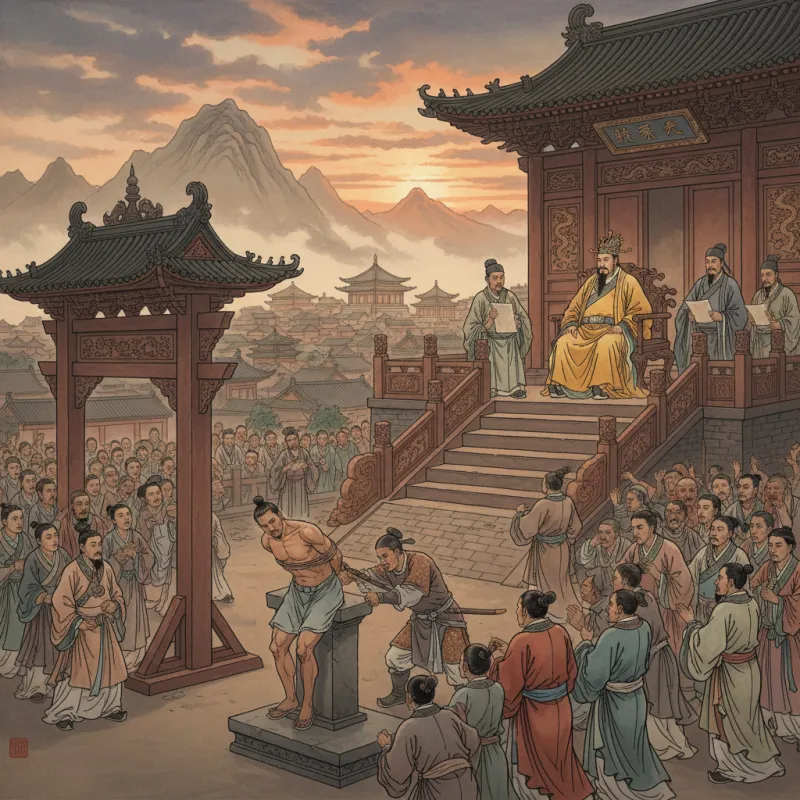
Picture this: A crowd gathers in the town square as drums thunder. A prisoner kneels before the magistrate's bench, not in some distant courthouse, but right here in the marketplace where everyone buys their rice and gossip. The magistrate—wearing his official robes and that distinctive black hat—reads the charges, hears the testimony, and pronounces sentence, all before lunch. By afternoon, if the crime warrants it, the punishment happens in the same square. Justice in imperial China wasn't hidden behind closed doors. It was a public spectacle, and everyone had front-row seats.
One Man, All the Power
The county magistrate (县令, xiànlìng) was judge, jury, prosecutor, detective, and local administrator rolled into one. He investigated crimes, interrogated suspects, weighed evidence, and handed down sentences—often on the same day. No defense attorneys argued on behalf of the accused. No jury of peers deliberated guilt or innocence. The magistrate's word was law, at least within his county's borders.
This concentration of power seems designed for corruption, and yes, corrupt magistrates existed. But the system had built-in safeguards that modern observers often miss. First, magistrates were always posted far from their home provinces—a Fujian native might govern a county in Shaanxi, ensuring he had no family connections or childhood friends to sway his judgment. Second, terms were limited, typically three years, preventing any magistrate from building a local power base. Third, and most importantly, every decision could be appealed up the bureaucratic ladder, all the way to the emperor himself if the case warranted it.
The magistrate's courtroom was usually part of the county yamen (衙门, yámén), the administrative compound that served as government office, courthouse, and residence. Locals would file complaints by submitting written petitions or, for the illiterate majority, having a scribe draft one. The magistrate held court sessions where plaintiffs and defendants presented their cases, often with witnesses. Torture was legal during interrogation—bamboo rods, finger presses, ankle crushers—though officially restricted to suspects, not witnesses, and only when other evidence suggested guilt.
The Legalist Blueprint
Chinese law didn't emerge from abstract principles of justice or divine commandment. It came from Legalism (法家, fǎjiā), a brutally pragmatic philosophy that dominated Qin Dynasty thinking and never really left the imperial bloodstream. Legalists like Han Feizi believed humans were fundamentally selfish and would only behave if the law was clear, punishments were severe, and enforcement was certain. Morality was irrelevant. What mattered was order.
The Qin Dynasty's legal code, discovered in 1975 in Shuihudi tomb excavations, reveals just how detailed and unforgiving Legalist law could be. Specific punishments for specific crimes, measured in strokes of the bamboo rod or years of hard labor. Collective punishment was standard—if one family member committed a crime, relatives could be punished too. The logic was simple: make everyone responsible for everyone else's behavior, and people will police themselves.
Later dynasties softened some of Legalism's harshest edges, blending it with Confucian values of benevolence and propriety. The Tang Code (唐律, Táng Lǜ), compiled in 653 CE, became the template for East Asian legal systems for centuries. It still prescribed severe punishments—death by strangulation or beheading, exile to distant frontiers, forced labor—but it also incorporated Confucian principles like showing leniency to the elderly and young, and distinguishing between intentional and accidental harm. The Confucian influence on governance meant that law was supposed to educate as much as punish.
Public Punishment as Theater
Executions weren't hidden away in prison yards. They happened in public markets, at crossroads, anywhere crowds naturally gathered. The condemned would be paraded through streets, sometimes in a wooden cangue (枷, jiā)—a heavy wooden board locked around the neck that forced the wearer to stand or kneel, unable to feed themselves. The message was unmistakable: this is what happens when you break the law.
The most severe punishment was lingchi (凌迟, língchí), often translated as "death by a thousand cuts" or "slow slicing." Reserved for the worst crimes—treason, patricide, rebellion—it involved systematically cutting pieces of flesh from the living body. The executioner's skill determined how long the condemned survived. Photographs from the late Qing Dynasty show crowds watching these executions with the same casual interest modern people bring to street performances. This wasn't cruelty for cruelty's sake. It was pedagogy through terror.
Lesser crimes brought public humiliation. Thieves might be tattooed on the face, permanently marking them as criminals. Adulterers could be paraded naked through town. The bamboo rod—applied to the buttocks or back—was administered in public, with the number of strokes precisely specified by law. Twenty strokes for minor theft. Forty for assault. The body became a text that the state wrote upon, and everyone could read.
The Appeal System Nobody Talks About
Here's what surprises people: you could appeal. If you believed the magistrate's judgment was unjust, you could take your case to the prefectural level, then to the provincial governor, then to the Ministry of Punishment in the capital. For capital cases, the emperor himself reviewed the sentence. During the Qing Dynasty, the Autumn Assizes (秋审, qiūshěn) brought all pending death sentences before the emperor for final review each year.
This wasn't just theoretical. Records show countless cases where higher courts overturned magistrate decisions, sometimes punishing the magistrate for incompetence or corruption. The system recognized that concentrated power needed oversight. The imperial examination system that selected magistrates emphasized Confucian classics and legal knowledge, but it couldn't guarantee wisdom or integrity. Appeals provided a safety valve.
Common people did use this system, though it required resources—time, money for travel and bribes, literacy or access to scribes. The poor and powerless often couldn't navigate the bureaucracy. But the mere existence of appeals meant magistrates couldn't act with complete impunity. A pattern of overturned decisions would end a career.
When Law Met Reality
Legal codes prescribed ideal punishments, but reality was messier. Magistrates had discretion, and they used it. A first-time thief might receive a warning instead of bamboo strokes. A respected family might negotiate a reduced sentence for their wayward son. Local customs sometimes trumped written law, especially in remote regions where the magistrate's authority was more theoretical than actual.
Confucian values created tension within the legal system. Filial piety (孝, xiào) was the supreme virtue, which meant a son who killed his father committed the worst possible crime. But what if the father was abusive? What if a daughter-in-law killed her mother-in-law in self-defense? The law said one thing, but Confucian ethics complicated the picture. Magistrates had to navigate these contradictions, and their decisions reveal the gap between legal theory and social reality.
Women faced particular challenges. They couldn't file legal complaints without a male relative's support. Their testimony carried less weight than men's. Yet court records show women using the legal system strategically—filing complaints about abusive husbands, demanding property rights, seeking justice for murdered daughters. The system was patriarchal, but not completely closed to female agency.
The Legacy in Modern Courts
When you walk into a Chinese courtroom today, you won't see magistrates in silk robes or public canings in the square. But echoes of the imperial system remain. Judges still hold enormous power, with less emphasis on adversarial proceedings than in Western courts. Confessions carry tremendous weight—a legacy of the imperial belief that the guilty should acknowledge their crimes. Public shaming, though no longer involving wooden cangues, happens through media exposure and social credit systems.
The imperial legal system wasn't primitive or barbaric by the standards of its time. It was sophisticated, bureaucratic, and surprisingly consistent across centuries and dynasties. It balanced centralized power with local administration, harsh punishments with appeal mechanisms, written law with Confucian ethics. It was also deeply unequal, favoring the educated and wealthy over the poor and illiterate, men over women, Han Chinese over ethnic minorities.
Understanding this system means recognizing that justice is always cultural. What seems obvious to us—trial by jury, presumption of innocence, separation of powers—would have seemed bizarre to a Tang Dynasty magistrate. And what seemed obvious to him—public punishment, collective responsibility, the magistrate's absolute authority—strikes us as unjust. The imperial legal system worked for the society that created it, maintaining order across a vast empire for over two thousand years. Whether it was just depends on whose justice you're measuring it against.
Related Reading
- Legalism: The Philosophy That Built an Empire
- Famous Trials That Changed Chinese Law
- Crime and Punishment in Imperial China
- The Magistrate System: How Justice Worked
- The Four Great Inventions: Paper, Printing, Gunpowder, and the Compass
- The Three Kingdoms: History, Fiction, and Why Everyone's Obsessed
- Unraveling the Economic Tapestry of Ancient Chinese Dynasties