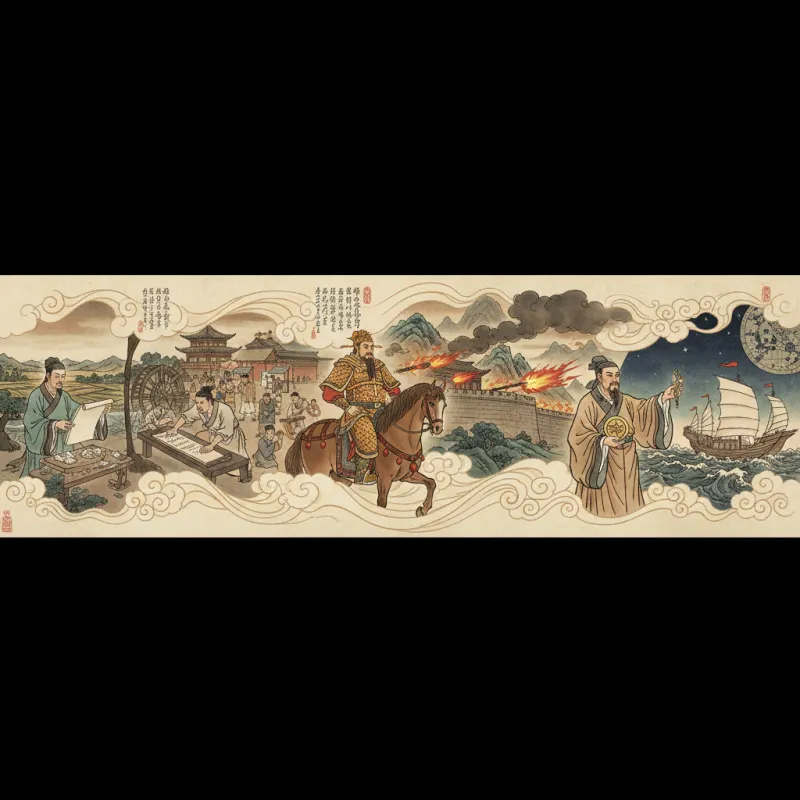
The eunuch Cai Lun (蔡伦) stood before Emperor He of Han in 105 CE, presenting sheets of a revolutionary new material. Smooth, lightweight, and remarkably cheap to produce, this substance would eventually carry the weight of human knowledge across continents and centuries. But Cai Lun didn't actually invent paper — he systematized and improved an existing technology, then took credit for it in the imperial court. This pattern of innovation, refinement, and strategic mythmaking repeats across all four of China's celebrated great inventions.
Paper: The Eunuch Who Perfected Someone Else's Idea
The 四大发明 (sì dà fāmíng) — Four Great Inventions — form the cornerstone of China's claim to technological preeminence in the pre-modern world. Paper, printing, gunpowder, and the compass: these innovations genuinely transformed human civilization. But the textbook version taught in Chinese schools glosses over the messy reality of how technologies actually develop.
Cai Lun, a 宦官 (huànguān, court eunuch) serving the Eastern Han Dynasty (东汉 Dōng Hàn, 25-220 CE), receives official credit for inventing paper in 105 CE. Archaeological evidence tells a different story. Paper fragments discovered in Gansu province date to the 2nd century BCE, two centuries before Cai Lun's supposed invention. What Cai Lun actually did was far more valuable than invention: he standardized the manufacturing process, experimented with different plant fibers, and created a product consistent enough for imperial bureaucratic use.
His formula combined tree bark, hemp waste, old rags, and fishing nets, all macerated into pulp and spread on screens to dry. The resulting sheets were smoother and more uniform than earlier attempts. More importantly, Cai Lun had the political connections to promote his improved paper throughout the imperial administration. By the 3rd century, paper had replaced bamboo slips and silk as the primary writing surface across China.
The technology spread slowly but inexorably. By the 8th century, Chinese papermakers captured during the Battle of Talas (751 CE) brought their knowledge to the Islamic world. Europeans didn't establish their first paper mill until 1276 in Italy, over a millennium after Cai Lun's refinements. The delay wasn't due to secrecy — it was cultural inertia. Europeans preferred parchment and vellum, despite their expense, because paper seemed foreign and untrustworthy for important documents.
Printing: From Buddhist Devotion to Mass Communication
The world's oldest surviving printed book is the Diamond Sutra (金刚经 Jīngāng Jīng), a Buddhist text printed in 868 CE during the Tang Dynasty (唐朝 Táng Cháo). The colophon states it was commissioned by Wang Jie "for universal free distribution" to honor his parents. This seven-sheet scroll, discovered in the Mogao Caves near Dunhuang, demonstrates sophisticated woodblock printing technology already mature by the 9th century.
But printing didn't begin with books. The earliest printed materials were Buddhist charms and images, mass-produced for devotional purposes. The logic was simple: if copying a sutra by hand generated spiritual merit, printing thousands of copies must generate exponentially more merit. This religious motivation drove the technology's development far more than any secular desire for knowledge dissemination.
Woodblock printing (雕版印刷 diāobǎn yìnshuā) required carving an entire page in reverse on a wooden block, inking it, and pressing paper against the surface. For texts that would be reprinted frequently — Buddhist sutras, Confucian classics, government announcements — the labor investment made sense. For unique documents or small print runs, hand copying remained more practical.
The real revolution came with Bi Sheng (毕昇) around 1040 CE during the Northern Song Dynasty (北宋 Běi Sòng). Bi Sheng, a commoner whose biography occupies barely a paragraph in historical records, invented movable type using baked clay characters. Each character could be arranged, printed, then rearranged for the next page. The polymath Shen Kuo (沈括) described the process in his 梦溪笔谈 (Mèngxī Bǐtán, Dream Pool Essays), our primary source for Bi Sheng's innovation.
Here's the complication: movable type never dominated Chinese printing the way it would later dominate European printing. The Chinese writing system, with thousands of characters rather than a small alphabet, made movable type less practical. Carving a single woodblock for an entire page often proved faster than selecting and arranging thousands of individual characters. Movable type existed in China for four centuries before Gutenberg, but it remained a specialized technique rather than the standard method.
Gunpowder: From Immortality Elixirs to Military Dominance
Daoist alchemists seeking the elixir of immortality instead discovered the formula for death on an industrial scale. The irony would be poetic if it weren't so bloody. By the 9th century, Tang Dynasty alchemists had identified the explosive properties of mixing saltpeter (硝石 xiāoshí), sulfur (硫磺 liúhuáng), and charcoal. A Daoist text from 850 CE explicitly warns against combining these ingredients, noting that some experimenters had "had their hands and faces burnt, and even the whole house where they were working burned down."
The warning came too late. Military engineers immediately recognized gunpowder's potential. By the 10th century, the Song Dynasty (宋朝 Sòng Cháo, 960-1279) was manufacturing 火箭 (huǒjiàn, fire arrows), 火炮 (huǒpào, fire cannons), and 火球 (huǒqiú, fire balls) — incendiary weapons that terrorized enemies and occasionally their own operators. The 武经总要 (Wǔjīng Zǒngyào, Complete Essentials for the Military Classics), compiled in 1044, contains detailed formulas for various gunpowder mixtures optimized for different weapons.
Early gunpowder weapons were primarily psychological weapons. The noise, smoke, and flames frightened horses and demoralized infantry, but their actual destructive power was limited. True explosive force required higher nitrate concentrations, which Chinese manufacturers achieved by the 13th century. The Mongol invasions paradoxically accelerated gunpowder technology — both sides desperately innovated to gain advantage, and the Mongols carried Chinese weapons and weapons-makers across Eurasia.
By the time gunpowder reached Europe in the 13th century, likely through Mongol intermediaries and Islamic scholars, European metallurgy was advanced enough to create more effective gun barrels than Chinese bronze casting could produce. Within two centuries, European firearms had surpassed Chinese designs. China invented gunpowder but didn't maintain its lead in firearms technology — a pattern that would repeat with other innovations as the Ming and Qing dynasties turned increasingly conservative and inward-looking.
The Compass: Navigating by Heaven's Magnet
Chinese fortune-tellers discovered magnetism before Chinese sailors did. The earliest magnetic devices were 司南 (sīnán, "south-pointing ladles"), spoon-shaped lodestones balanced on bronze plates, used for geomancy and divination during the Han Dynasty. The idea that certain stones naturally aligned with cosmic forces fit perfectly with Chinese cosmological thinking about the harmony between heaven and earth.
The transition from mystical tool to navigational instrument took centuries. By the Song Dynasty, sailors were using magnetic needles floating in water bowls to determine direction. Zhu Yu's (朱彧) 萍州可谈 (Píngzhōu Kětán, Pingzhou Table Talks), written around 1119, describes ship captains using compasses to navigate when stars weren't visible: "The ship's pilots are acquainted with the configuration of the coasts; at night they steer by the stars, and in the daytime by the sun. In dark weather they look at the south-pointing needle."
The Chinese compass pointed south rather than north — a trivial difference in practice but revealing of different cultural frameworks. Chinese cosmology emphasized the south as the direction of warmth, life, and imperial authority. The emperor sat facing south; his subjects faced north toward him. A south-pointing compass aligned with this symbolic geography.
Chinese maritime technology reached its apex during the early Ming Dynasty (明朝 Míng Cháo) with Admiral Zheng He's (郑和) treasure voyages (1405-1433). His massive fleet — some ships reportedly over 400 feet long — sailed to Southeast Asia, India, Arabia, and East Africa, demonstrating Chinese naval supremacy. Then, abruptly, the voyages stopped. The Ming court decided maritime expeditions were wasteful and potentially destabilizing, and China turned away from the seas just as European powers were beginning their age of exploration.
The compass technology that enabled Zheng He's voyages had reached European sailors by the 12th century, probably through Arab intermediaries. Unlike China, Europe's fragmented political landscape created intense competition for maritime trade routes. The same technology produced different outcomes in different contexts — a reminder that invention alone doesn't determine historical trajectories.
Why These Four? The Politics of Historical Memory
The "Four Great Inventions" framework isn't ancient Chinese wisdom — it's a modern construct. The British sinologist Joseph Needham popularized this grouping in his monumental Science and Civilisation in China series, begun in 1954. Chinese scholars and educators embraced the framework because it provided a concise, powerful counter-narrative to Western triumphalism about the Scientific Revolution and Industrial Revolution.
The selection is somewhat arbitrary. Why not include cast iron, developed in China centuries before Europe? Or the mechanical clock, or the seismograph, or porcelain, or the stirrup? Each of these innovations had profound historical impacts. The four chosen inventions share a common feature: they're technologies that clearly and demonstrably spread from China to the rest of the world, transforming societies as they went.
This matters because Chinese historical memory carries deep wounds from the "century of humiliation" (百年国耻 bǎinián guóchǐ) — the period from the First Opium War (1839) to the founding of the People's Republic (1949) when Western and Japanese powers dominated China militarily and economically. The Four Great Inventions narrative serves as a reminder that China was once the world's technological leader and can be again. It's history in service of national pride and future ambition.
The Paradox of Innovation Without Revolution
Here's the uncomfortable question the Four Great Inventions raise: if China developed these transformative technologies centuries before Europe, why didn't China experience an industrial revolution? Why did the technological lead reverse?
The answers are complex and contested, but several factors stand out. Chinese imperial bureaucracy, while sophisticated, was fundamentally conservative. The examination system (科举 kējǔ) that selected officials emphasized mastery of classical texts, not technical innovation. Merchants and artisans occupied low positions in the Confucian social hierarchy, below scholars and farmers. Technical knowledge was often treated as mere craft, unworthy of systematic study by educated elites.
China's size and relative self-sufficiency also reduced competitive pressure for innovation. European states, smaller and more numerous, competed intensely for military and economic advantage. A technological breakthrough in one state forced others to adopt or develop countermeasures. China, as the dominant power in East Asia for most of its history, faced less existential pressure to innovate.
The Ming and Qing dynasties' increasing conservatism and suspicion of foreign contact further stifled innovation. The same government that sponsored Zheng He's voyages later banned ocean-going ships. The Qing Dynasty's initial prosperity in the 18th century created complacency just as European powers were accelerating their technological development through the Scientific Revolution and early Industrial Revolution.
Legacy and Lessons
The Four Great Inventions remain genuine achievements worthy of recognition. Paper enabled the preservation and transmission of knowledge on an unprecedented scale. Printing democratized access to texts, though less dramatically in China than in Europe. Gunpowder transformed warfare and, eventually, mining and construction. The compass enabled global navigation and trade.
But the real lesson isn't about Chinese superiority or Western theft of Chinese innovations. It's about the complex relationship between invention, diffusion, and social transformation. Technologies don't automatically produce progress — they interact with existing social structures, values, and institutions in unpredictable ways. The same invention can strengthen tradition in one society and revolutionize another.
Modern China's emphasis on technological innovation and scientific development represents, in some ways, a return to the spirit that produced the Four Great Inventions. But it also reflects lessons learned from the centuries when China's early lead evaporated. Innovation requires not just clever individuals but social systems that reward experimentation, tolerate failure, and rapidly disseminate new knowledge.
The eunuch Cai Lun, the commoner Bi Sheng, the anonymous Daoist alchemists, and the fortune-tellers who first noticed magnetic stones — these weren't isolated geniuses. They were participants in a civilization that, for centuries, led the world in technical sophistication and practical innovation. Understanding why that lead was lost is as important as celebrating the achievements themselves. The Four Great Inventions are both a source of pride and a reminder that historical advantage is never permanent.
Related Reading
- Chinese Astronomy: Mapping the Stars for 4,000 Years
- Chinese Science and Technology: Inventions That Changed the World (Before Europe Noticed)
- Chinese Astronomy: Mapping the Stars for 4000 Years
- Traditional Chinese Medicine: 2,500 Years of Healing
- The Dynasties of China: A Quick Guide to 4,000 Years of History
- Battle of Fei River: When 80,000 Defeated 800,000
- Porcelain: The Art That Named a Nation