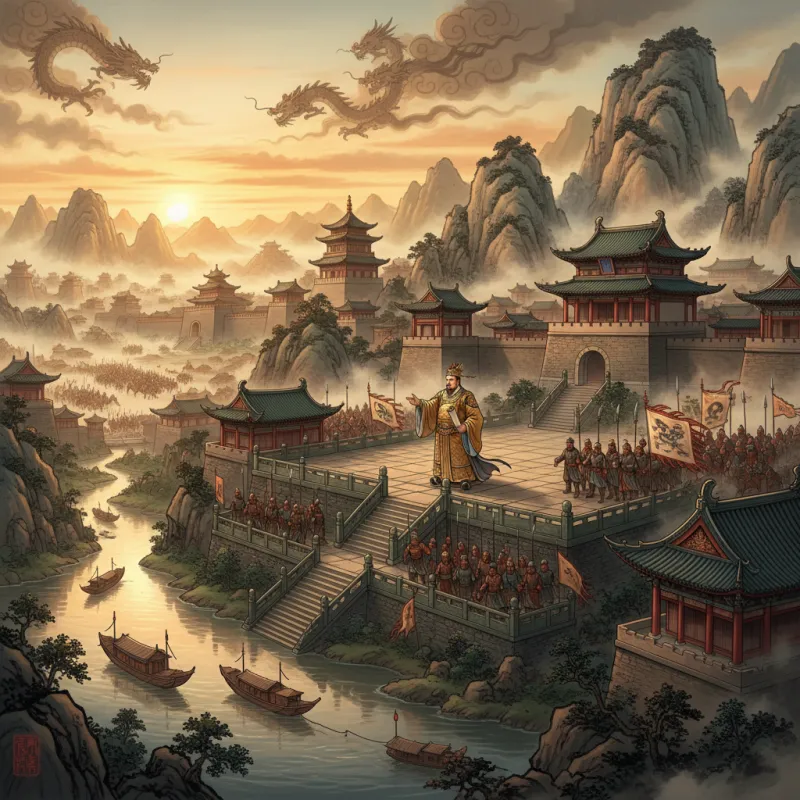
A warlord burns his own ships to prove he won't retreat. A strategist borrows 100,000 arrows in three days using nothing but fog and straw boats. A sworn brotherhood of three men becomes more famous than most imperial dynasties. The Three Kingdoms period lasted just sixty years — from 220 to 280 CE — yet it has dominated Chinese imagination for seventeen centuries. More people can name Zhuge Liang's stratagems than can list the emperors of the Tang Dynasty. Why does a brief, bloody interlude eclipse millennia of imperial grandeur?
The History That Refused to Stay History
The Three Kingdoms era began with the collapse of the Han Dynasty (汉朝, Hàn Cháo) in 220 CE and ended with reunification under the Jin in 280 CE. Sixty years. In that time, China fractured into three competing kingdoms: Wei (魏, Wèi) in the north under Cao Cao and his descendants, Shu Han (蜀汉, Shǔ Hàn) in the southwest under Liu Bei, and Wu (吴, Wú) in the southeast under Sun Quan.
The actual history is messy, morally ambiguous, and often disappointing. Cao Cao — portrayed as the villain in most retellings — was arguably the most capable administrator. Liu Bei, the supposed hero, spent most of his career fleeing from one defeat to another. The brilliant strategist Zhuge Liang never actually won a major campaign against Wei. The period ended not with a dramatic showdown but with Wei's general Sima Yan simply usurping the throne and mopping up the other kingdoms.
Yet within a century, storytellers had already begun transforming this chaos into legend. By the Yuan Dynasty (1271-1368), the stories had crystallized into the novel Romance of the Three Kingdoms (三国演义, Sānguó Yǎnyì) by Luo Guanzhong. The novel took historical figures and turned them into archetypes: Cao Cao became cunning incarnate, Liu Bei became righteousness personified, Zhuge Liang became wisdom itself.
The Questions China Cannot Stop Asking
The Three Kingdoms endures because it dramatizes the fundamental tensions in Chinese political philosophy. Is it better to be effective or righteous? Cao Cao wins battles through ruthless pragmatism — he massacres cities, betrays allies, and manipulates the emperor. Liu Bei loses battles but maintains his moral authority — he refuses to abandon his followers even when it costs him strategically.
Chinese culture has never resolved this tension. Confucian ideology demands that rulers be virtuous, yet Chinese history is full of effective tyrants and failed saints. The Three Kingdoms lets people argue both sides endlessly. Was Cao Cao a villain or a realist? Was Liu Bei genuinely righteous or just a skilled performer of righteousness? These debates have raged for centuries because they're really debates about what China values most.
The period also asks: What matters more, loyalty or competence? Zhuge Liang served Liu Bei and his son Liu Shan with absolute devotion, even though Liu Shan was manifestly incompetent. He could have seized power himself — he certainly had the ability and popular support. Instead, he worked himself to death trying to fulfill his promise to Liu Bei. Is this admirable or tragic? Chinese readers have been arguing about it since the Tang Dynasty.
Why These Characters Became Immortal
The Three Kingdoms produced more iconic characters than any other period because the era was perfectly positioned: late enough that records existed, early enough that legend could fill the gaps. We know enough about Cao Cao to make him feel real, but not so much that we can't project our interpretations onto him.
Consider Guan Yu (关羽, Guān Yǔ), Liu Bei's sworn brother. The historical Guan Yu was a capable general who made a catastrophic strategic error and got himself killed. The legendary Guan Yu became the God of War, literally worshipped in temples across China. His red face, long beard, and Green Dragon Crescent Blade are instantly recognizable. He represents loyalty so absolute it transcends death — he supposedly appeared as a ghost to help his sworn brothers even after being executed.
Or take Zhuge Liang (诸葛亮, Zhūgě Liàng), who evolved from a competent but not exceptional strategist into a supernatural genius. In Romance of the Three Kingdoms, he controls the weather, predicts the future, and defeats armies through pure intellect. The real Zhuge Liang failed to conquer Wei despite five major campaigns. The legendary Zhuge Liang became the embodiment of the scholar-official ideal: brilliant, loyal, and tragically constrained by circumstances beyond his control.
These transformations happened because the characters filled archetypal roles that Chinese culture needed. Every society needs heroes, but China specifically needed heroes who embodied Confucian virtues while operating in a world where those virtues often led to failure. The Three Kingdoms provided them. For more on how these rivalries shaped Chinese culture, see Liu Bei vs. Cao Cao: The Ultimate Rivalry in Chinese History.
The Novel That Ate History
Romance of the Three Kingdoms is one of the Four Great Classical Novels of Chinese literature, and it has done something remarkable: it has largely replaced the actual history in popular consciousness. Most Chinese people learn the Three Kingdoms story from the novel, not from historical records. The novel's version is what gets adapted into films, TV series, and video games.
This creates a strange situation where historical figures are judged by their fictional portrayals. Cao Cao has been rehabilitated somewhat in recent decades, with scholars pointing out that he was an effective administrator who stabilized northern China. But he still carries the stigma of being the novel's villain. Liu Bei is still praised for his virtue even though historical records suggest he was as opportunistic as any other warlord.
The novel's influence extends beyond China. In Japan, Korea, and Vietnam — all part of the Sinosphere — the Three Kingdoms story is equally famous. Japanese adaptations often make Cao Cao more sympathetic, reflecting different cultural values about pragmatism versus righteousness. Korean versions emphasize different strategic lessons. The story is flexible enough to be reinterpreted across cultures while maintaining its core appeal.
Why It Still Matters Today
Walk into any Chinese bookstore and you'll find dozens of Three Kingdoms adaptations: graphic novels, strategy guides, leadership manuals, children's books. The 2010 TV series Three Kingdoms had 95 episodes and was one of the most expensive productions in Chinese television history. Video games like Dynasty Warriors and Total War: Three Kingdoms have introduced the story to global audiences.
Business books in China regularly use Three Kingdoms examples to illustrate management principles. Zhuge Liang's strategies are taught in MBA programs. Cao Cao's ruthless efficiency is held up as a model for entrepreneurs. The period has become a repository of strategic wisdom, real or imagined.
Part of the enduring appeal is that the Three Kingdoms offers something for everyone. If you value loyalty, you have Guan Yu. If you value intelligence, you have Zhuge Liang. If you value effectiveness, you have Cao Cao. If you value charisma, you have Liu Bei. The story is complex enough that different readers can find different heroes depending on what they value most.
The Period That Defines Chinese Storytelling
The Three Kingdoms established templates that Chinese fiction has followed ever since. The sworn brotherhood between Liu Bei, Guan Yu, and Zhang Fei became the model for countless martial arts novels and films. The wise strategist advising a less capable lord became a stock character. The tragic hero who remains loyal despite knowing his cause is doomed became a recurring archetype.
Even the structure of Chinese historical epics owes much to Romance of the Three Kingdoms. The novel moves between multiple storylines, giving each faction its own narrative arc while building toward larger confrontations. It balances intimate character moments with massive battle scenes. It uses poetry and classical allusions to elevate the prose. Later historical novels, from Water Margin to modern works, follow this template.
The Three Kingdoms also established the idea that history is a stage for moral instruction. The novel's opening lines — "The empire, long divided, must unite; long united, must divide" — frame history as cyclical and inevitable, but also as a series of moral choices that determine which individuals will be remembered and how. This view of history as both determined and contingent, both tragic and instructive, has shaped how Chinese culture understands its past.
The Story That Never Ends
The Three Kingdoms period ended in 280 CE when the Jin Dynasty reunified China. But the story has never ended. New adaptations appear every year, each finding new angles, new interpretations, new relevance. The 1994 TV series emphasized traditional values. The 2010 version was darker and more morally ambiguous. Recent video games let players rewrite history entirely, creating alternate timelines where different kingdoms triumph.
This endless reinterpretation is possible because the Three Kingdoms story is fundamentally about questions rather than answers. Should you be pragmatic or principled? Is loyalty more important than success? Can intelligence overcome circumstance? These questions don't have definitive answers, which is why each generation returns to the Three Kingdoms to argue about them again.
China has had longer dynasties, more powerful emperors, greater territorial expansion, and more significant cultural achievements than anything that happened during those sixty chaotic years. But none of it has captured the imagination quite like three kingdoms fighting over the ruins of an empire. The Three Kingdoms isn't China's greatest history — it's China's greatest story, and that's why it will never be forgotten. For more insights into this transformative period, explore The Fall of the Han Dynasty.
Related Reading
- The Three Kingdoms: History, Fiction, and Why Everyone's Obsessed
- Zhuge Liang: The Sleeping Dragon Who Became China's Greatest Strategist
- The Three Kingdoms: Why China's Favorite Story Is About Failure
- Ancient Chinese Law: When Justice Was Personal and Punishment Was Public
- Ancient Chinese Dynasties and Emperors: Legal Systems, Battles, and Cultural Legacy
- The Imperial Examination: Meritocracy in Ancient China