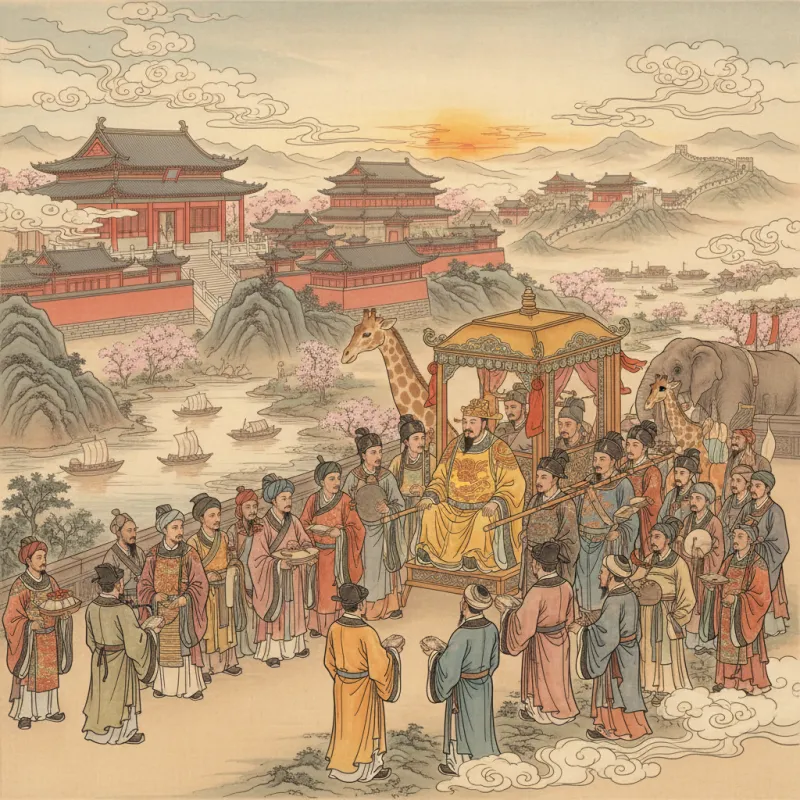
When Zhang Qian set out from Chang'an in 138 BCE, he carried more than just Emperor Wu's letter to the Yuezhi people—he carried the seeds of what would become the Silk Road, history's most ambitious diplomatic gambit. His thirteen-year odyssey through hostile territory, including a decade of captivity among the Xiongnu, would transform China from an isolated empire into the hub of a transcontinental network of trade, ideas, and cultural exchange. This wasn't diplomacy as we know it today, with embassies and treaties. This was something far more audacious: the deliberate construction of civilization-spanning relationships through gifts, marriages, and the calculated projection of cultural superiority.
The Tribute System: Diplomacy Through Hierarchy
The Chinese approach to foreign relations rested on a deceptively simple premise: China was the Middle Kingdom (中国, Zhōngguó), the center of civilization, and all other nations existed in concentric circles of barbarism radiating outward. This wasn't mere arrogance—it was a sophisticated diplomatic framework that allowed the empire to manage relationships with dozens of neighboring states without the administrative nightmare of treating them as equals.
The tribute system (朝贡体系, cháogòng tǐxì) worked like this: foreign rulers would send envoys bearing local products—horses from Central Asia, exotic birds from Southeast Asia, furs from the northern steppes. In return, the Chinese emperor would bestow gifts of far greater value: silk, porcelain, tea, and most importantly, legitimacy. By accepting tribute, the emperor acknowledged the foreign ruler's authority. By giving lavish gifts in return, he demonstrated China's wealth and generosity. Everyone saved face, trade flourished, and the empire maintained a buffer zone of friendly or at least non-hostile neighbors.
The genius of this system was its flexibility. The Han dynasty (206 BCE-220 CE) perfected it, but each dynasty adapted it to their circumstances. When China was strong, tribute missions came frequently and the gifts flowed generously. When China was weak, the system became more transactional, sometimes barely disguised trade. The Tang dynasty (618-907 CE) received tribute from over 300 states and tribes, while the Song (960-1279 CE), facing military pressure from the north, often paid what amounted to protection money disguised as "gifts" to the Liao and Jin dynasties.
The Silk Road: Commerce as Cultural Conduit
Zhang Qian's reports to Emperor Wu about the Western Regions opened Chinese eyes to a world they barely knew existed. The subsequent establishment of the Silk Road wasn't a single road at all, but a network of trade routes connecting China to Central Asia, India, Persia, and eventually Rome. Silk was the headline product—so precious that Romans believed it grew on trees—but the real cargo was culture.
Buddhist monks traveled east along these routes, bringing scriptures, artistic styles, and entirely new ways of thinking about existence and suffering. The first Buddhist texts reached China during the Han dynasty, but it was during the chaotic Period of Disunion (220-589 CE) that Buddhism truly took root, offering spiritual solace when Confucian order had collapsed. By the Tang dynasty, Chinese pilgrims like Xuanzang (玄奘) were making the reverse journey, traveling to India to study at the source. Xuanzang's sixteen-year journey (629-645 CE) brought back 657 Buddhist texts and inspired the classic novel "Journey to the West."
The exchange wasn't one-way. Chinese inventions—paper, printing, gunpowder, the compass—gradually made their way west, fundamentally altering the trajectory of world history. Persian and Arab merchants brought mathematics, astronomy, and medicine. The Tang capital of Chang'an became the most cosmopolitan city in the world, home to Nestorian Christians, Zoroastrians, Manichaeans, and Muslims, each with their own places of worship. This wasn't multiculturalism as modern policy—it was the organic result of empire-scale trade networks and diplomatic relationships.
Marriage Alliances: Princesses as Political Instruments
Few diplomatic tools were as effective—or as personally costly—as the marriage alliance (和亲, héqīn). When military solutions failed or proved too expensive, Chinese emperors would send princesses to marry foreign rulers, cementing alliances through kinship. The most famous of these diplomatic brides was Wang Zhaojun (王昭君), one of the Four Beauties of ancient China, who married the Xiongnu chanyu in 33 BCE.
The reality behind these romantic tales was often grim. Most "princesses" sent to foreign courts weren't actually imperial daughters but palace women or relatives given honorary titles. They left behind everything familiar—language, food, climate, culture—to live among people the Chinese considered barbarians. Yet their impact was profound. Princess Wencheng (文成公主), sent to marry the Tibetan king Songtsen Gampo in 641 CE, brought Buddhism, Chinese arts, and agricultural techniques to Tibet, fundamentally shaping Tibetan culture.
These marriages created complex webs of obligation and relationship. A foreign ruler married to a Chinese princess had a stake in maintaining good relations with his wife's homeland. The children of these unions embodied both cultures, sometimes serving as bridges, sometimes as sources of conflict. The practice continued for over a millennium, from the Han through the Qing dynasties, testament to its effectiveness despite—or perhaps because of—its human cost.
The Zheng He Expeditions: Diplomacy by Naval Power
When the Yongle Emperor dispatched Admiral Zheng He (郑和) on the first of seven massive naval expeditions in 1405, he was making a statement about Ming China's place in the world. These weren't exploratory voyages in the European sense—Zheng He wasn't looking for new lands to conquer or colonize. Instead, he commanded a "treasure fleet" of over 300 ships carrying 27,000 men, visiting Southeast Asia, India, the Persian Gulf, and the east coast of Africa.
The expeditions were diplomacy as spectacle. Zheng He's flagship was over 400 feet long—larger than any European vessel of the era. The fleet carried luxury goods, craftsmen, and scholars. At each port, Zheng He would present gifts from the emperor, receive tribute, and sometimes intervene in local conflicts on behalf of Chinese interests. He brought back exotic animals (including a giraffe that caused a sensation at court), rare goods, and envoys from dozens of kingdoms eager to establish relations with the Ming.
Then, abruptly, the voyages stopped. After Zheng He's death in 1433, the Ming court turned inward, eventually forbidding ocean-going vessels entirely. Historians still debate why—perhaps the expeditions were too expensive, perhaps Confucian officials opposed the eunuch admiral's influence, perhaps China simply decided it had nothing to gain from the outside world. Whatever the reason, the decision had world-historical consequences. Within decades, European ships would begin arriving in Asian waters, and the age of Western colonial expansion would begin. China's withdrawal from maritime diplomacy left a vacuum that others eagerly filled.
Cultural Exports: Soft Power Before the Term Existed
Long before Joseph Nye coined the term "soft power," Chinese dynasties understood that cultural influence could be as effective as military might. The Chinese writing system became the lingua franca of East Asia, adopted and adapted by Korea, Japan, and Vietnam. Confucian philosophy provided the ideological foundation for governance across the region. Chinese artistic styles—in painting, poetry, ceramics, architecture—set the standard that others emulated.
This cultural hegemony was both deliberate and organic. The Tang dynasty actively promoted Chinese culture abroad, establishing schools for foreign students in Chang'an. Thousands of Korean, Japanese, and Southeast Asian students studied in China, returning home to implement Chinese-style bureaucracies, legal codes, and educational systems. The Japanese even modeled their capital, Nara, on Chang'an's grid layout.
But cultural exchange is never purely one-directional. As Chinese culture spread outward, foreign influences flowed back. The Tang dynasty's openness to foreign ideas enriched Chinese art, music, and cuisine. The Mongol Yuan dynasty (1271-1368) brought Central Asian and Persian influences, while the Manchu Qing dynasty (1644-1912) created a hybrid culture blending Chinese and Manchu elements. Each wave of foreign influence was absorbed, sinicized, and integrated into the evolving tapestry of Chinese civilization.
The Limits of Cultural Diplomacy
For all its sophistication, Chinese diplomacy had blind spots that would prove costly. The assumption of cultural superiority made it difficult to recognize when other civilizations had developed advantages. The Qing court's dismissal of British diplomatic overtures in the late 18th century—famously, the Qianlong Emperor told King George III that China had no need for British goods—reflected a worldview that no longer matched reality.
When British warships arrived in 1839 to force open Chinese markets, the tribute system's inadequacy became painfully apparent. Diplomacy based on cultural prestige and gift exchange couldn't counter industrial-age military technology. The Opium Wars shattered the illusion of Chinese invincibility and forced a painful reckoning with the limits of traditional diplomatic approaches.
Yet the legacy of ancient Chinese diplomacy persists. Modern China's Belt and Road Initiative echoes the Silk Road's vision of prosperity through connectivity. The emphasis on "win-win cooperation" and "mutual respect" reflects Confucian diplomatic principles. Even the concept of "face" (面子, miànzi)—the need to maintain dignity and avoid public humiliation—remains central to Chinese diplomatic culture. Understanding these ancient roots is essential for anyone trying to make sense of China's role in today's world.
Lessons from the Long View
What can we learn from two millennia of Chinese diplomatic practice? First, that successful diplomacy requires understanding how others see themselves, not just how you see them. The tribute system worked because it allowed both sides to claim victory—China maintained its sense of centrality while foreign states gained trade access and legitimacy.
Second, that cultural exchange is more durable than military conquest. The Mongols conquered China but were ultimately absorbed by Chinese culture. Buddhism transformed China more profoundly than any army could have. Ideas, once planted, grow in unpredictable directions.
Third, that isolation is ultimately unsustainable. Each time China turned inward—after the Zheng He voyages, during the late Qing—it paid a price in lost opportunities and vulnerability to external shocks. The most dynamic periods of Chinese history were those most open to foreign influence and exchange.
Zhang Qian probably never imagined that his desperate mission to find allies against the Xiongnu would create a transcontinental network that would last for centuries. That's the nature of diplomacy—you plant seeds not knowing what will grow. The ancient Chinese understood this better than most, building relationships that outlasted dynasties and shaped the world we inhabit today.
Related Reading
- Unveiling the Role of Women in Ancient Chinese Dynasties
- Zheng He's Treasure Fleet: When China Ruled the Seas
- Ancient Chinese Medicine: A Look into Dynasties and Healing Practices