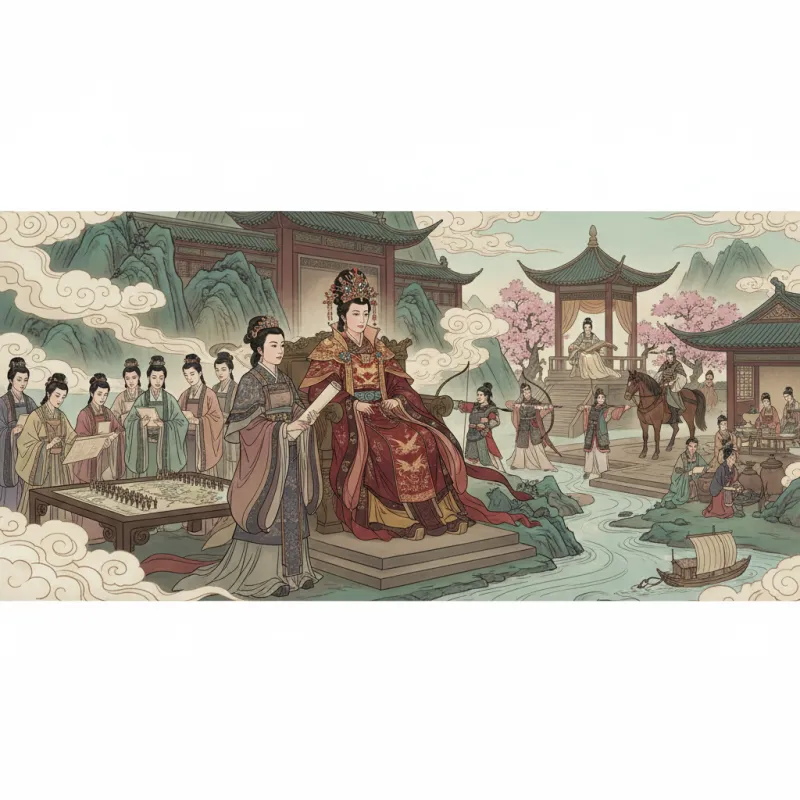
The oracle bones don't lie. When archaeologists deciphered the ancient inscriptions from the Shang Dynasty, they discovered something unexpected: women's names appearing as military commanders, ritual specialists, and political advisors. Fu Hao (婦好, Fù Hǎo), consort of King Wu Ding, led 13,000 troops into battle and presided over sacrificial ceremonies—her tomb, discovered intact in 1976, contained over 130 weapons alongside ritual bronze vessels. This wasn't an anomaly. It was a glimpse into a more complex reality that centuries of Confucian revisionism would later obscure.
The Matriarchal Echoes of Early China
Before Confucius codified the "three obediences" (三从, sān cóng) that would define women's subordinate status for millennia, ancient Chinese society operated under different rules. During the Shang Dynasty (c. 1600–1046 BCE), women participated actively in religious and political life. The oracle bone inscriptions—our most direct window into this period—record women performing divination rituals, managing agricultural estates, and yes, commanding armies.
Fu Hao wasn't just a warrior queen; she was a high priestess who conducted sacrifices to ancestors and natural deities. Her tomb contained nearly 500 bronze ritual vessels and 7,000 cowrie shells (the currency of the time), suggesting she controlled significant economic resources independently. The Shang didn't see this as contradictory. Power was power, regardless of gender.
The Zhou Dynasty (1046–256 BCE) introduced a shift. The concept of yin and yang (阴阳, yīn yáng) began associating women with passive, interior qualities while men embodied active, exterior forces. Yet even here, the Book of Songs (诗经, Shījīng) preserves women's voices—poems about courtship, marriage, and yes, complaints about neglectful husbands. These weren't silent, submissive figures. They were individuals navigating a changing social landscape.
The Confucian Cage and Its Cracks
When Confucianism became state ideology during the Han Dynasty (206 BCE–220 CE), women's legal and social status contracted dramatically. The Book of Rites (礼记, Lǐjì) prescribed that women should "obey their fathers before marriage, their husbands after marriage, and their sons in widowhood." The ideal woman was chaste, obedient, and confined to "inner quarters" (内室, nèishì).
But ideology and reality rarely align perfectly. Ban Zhao (班昭, Bān Zhāo, 45–116 CE), China's first known female historian, completed her brother's monumental Book of Han after his death. Her Lessons for Women (女诫, Nǚjiè) is often cited as evidence of women's oppression—and it is, in many ways, a manual for female subordination. Yet Ban Zhao herself was educated, influential at court, and tutored the empress and imperial concubines. She lived the contradiction: advocating for women's submission while exercising considerable intellectual authority.
The Tang Dynasty (618–907 CE) saw perhaps the most dramatic example of a woman shattering Confucian constraints: Wu Zetian (武则天, Wǔ Zétiān), China's only female emperor. Not empress—emperor. She took the male title deliberately, ruling in her own name from 690 to 705 CE. Wu Zetian promoted Buddhism over Confucianism (partly because Buddhist texts were less hostile to female authority), commissioned scholars to write biographies of famous women, and even created new Chinese characters, including one for her own name. Her reign was controversial, marked by political purges and accusations of ruthlessness. But she proved that a woman could hold supreme power—and the Confucian establishment never quite recovered from the shock.
The Economic Power Hidden in Plain Sight
Here's what the official histories miss: women controlled significant economic resources throughout Chinese history, particularly through textile production. Silk wasn't just a luxury export; it was currency, tax payment, and diplomatic gift. And women produced it.
Every peasant household depended on women's weaving to meet tax obligations. Elite women managed large textile workshops. The government even measured land taxes in bolts of silk and hemp cloth. This gave women—especially in the lower classes—a form of economic leverage that official Confucian texts ignored. A woman who could produce high-quality textiles contributed tangibly to household survival. Her labor wasn't decorative; it was essential.
During the Song Dynasty (960–1279 CE), women's property rights actually expanded in some ways. Widows could inherit property, and daughters received dowries that remained their personal property even after marriage. The rise of Neo-Confucianism during this period also brought the horrific practice of foot binding (缠足, chánzú), which physically restricted elite women's mobility. Yet simultaneously, literacy rates among upper-class women increased. Women poets like Li Qingzhao (李清照, Lǐ Qīngzhào, 1084–1155) achieved fame during their lifetimes. The Song Dynasty embodied this paradox: greater intellectual opportunities alongside greater physical constraints.
Empresses, Concubines, and the Politics of the Inner Court
The imperial harem (后宫, hòugōng) was never just a collection of beautiful women waiting passively for the emperor's attention. It was a political institution with its own hierarchies, factions, and power struggles. The empress and high-ranking concubines wielded influence through their sons (potential heirs), their natal families, and their personal relationships with the emperor.
Empress Dowager Cixi (慈禧太后, Cíxǐ Tàihòu, 1835–1908) of the Qing Dynasty ruled China for nearly half a century, first as regent for her son, then for her nephew. She was conservative, resistant to reform, and arguably contributed to the Qing Dynasty's collapse. But she was also a skilled political operator who navigated court factions, foreign invasions, and internal rebellions while maintaining power in a system designed to exclude women from formal authority.
The concubine system itself reveals something important about women's status: they were simultaneously commodified and empowered. A concubine had no choice in her selection, yet a favored concubine could influence policy, enrich her family, and secure her son's succession. It was a brutal system that some women nevertheless learned to manipulate to their advantage. For more on how women navigated these complex power structures, see Women's Education in Imperial China.
The Invisible Majority: Peasant Women's Lives
Most Chinese women throughout history weren't empresses or poets. They were peasants whose lives revolved around agricultural labor, textile production, and childcare. The sources are frustratingly silent about their experiences—official histories focused on elites, and peasant women were largely illiterate.
But we can piece together fragments. Legal cases reveal women suing for divorce (rare but possible under certain circumstances), managing family finances, and working in markets. Local gazetteers occasionally mention women who achieved local fame for filial piety, chastity, or charitable works. Folklore preserves stories of clever women outwitting corrupt officials or greedy landlords.
The Ming Dynasty (1368–1644) saw increased emphasis on female chastity, with the government erecting memorial arches (贞节牌坊, zhēnjié páifāng) to honor widows who refused to remarry. This was oppressive, certainly—it pressured widows into poverty and isolation. Yet some women used these honors strategically, gaining social status and economic support from their communities. Even within restrictive systems, women found ways to exercise agency.
Religious Life and Alternative Paths
Buddhism and Daoism offered women alternatives to marriage and motherhood. Buddhist nunneries (尼姑庵, nígū'ān) provided refuge for widows, unmarried women, and those fleeing unhappy marriages. Nuns received education, participated in religious ceremonies, and sometimes achieved recognition as spiritual teachers.
The Daoist tradition included female deities and immortals, and some Daoist sects practiced dual cultivation (双修, shuāngxiū) that theoretically treated male and female practitioners as equals. Women could become Daoist priests, though they remained a minority. These religious paths weren't perfect escapes from patriarchy—nunneries still operated within Confucian society—but they offered alternatives to the wife-and-mother role that Confucianism prescribed as women's only legitimate identity.
The Legacy: What We Inherit
Modern discussions of women in ancient China often fall into two traps: either romanticizing a mythical matriarchal past or presenting women as purely victims of Confucian oppression. The reality was messier. Women's status varied by dynasty, class, region, and individual circumstance. Some women wielded enormous power; most had very little. Some internalized Confucian values; others resisted them. Some found ways to thrive within restrictive systems; others suffered terribly.
What's clear is that women were never absent from Chinese history—they were just written out of it. The oracle bones, legal documents, poems, and archaeological evidence reveal women as active participants in Chinese civilization: warriors, scholars, workers, rulers, and rebels. Their stories complicate our understanding of ancient China and remind us that historical narratives always reflect the biases of those who write them.
The challenge for modern historians is recovering these voices from sources that systematically marginalized them. Every discovered tomb, every deciphered inscription, every overlooked poem adds another piece to the puzzle. Fu Hao's weapons and ritual vessels sit in museums now, physical proof that women's roles in ancient China were far more complex than Confucian texts would have us believe. The question isn't whether women shaped Chinese history—they did. The question is how much of their story we've lost, and how much we can still recover. For insights into how these historical patterns influenced later periods, explore Women in the Qing Dynasty.
Related Reading
- Chinese Astronomy: Mapping the Stars for 4,000 Years
- Traditional Chinese Medicine: 5,000 Years of Healing
- The Role of Trade in Shaping Ancient Chinese Dynasties and Culture