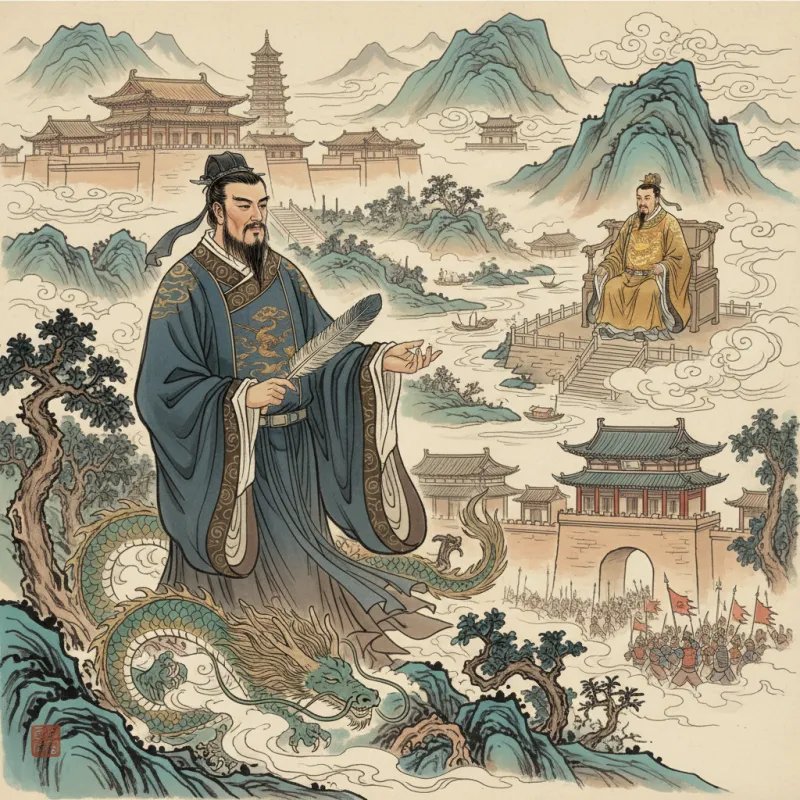
The young man lived in a thatched cottage on a mountain, farming by day and reading by night, while three kingdoms tore China apart in the valleys below. When the warlord Liu Bei finally climbed that mountain in 207 CE — on his third attempt — to beg for help, he found someone who would change the course of history. That reclusive scholar was Zhuge Liang (諸葛亮 Zhūgě Liàng, 181–234 CE), and the meeting between them would become one of the most famous recruitment stories in Chinese civilization.
The Reluctant Genius
Zhuge Liang didn't advertise his brilliance. He lived in Longzhong, in modern-day Hubei Province, deliberately avoiding the chaos that followed the collapse of the Han Dynasty. While ambitious men fought over scraps of the empire, he studied military texts, practiced agriculture, and compared himself to ancient strategists Guan Zhong and Yue Yi — a comparison his neighbors thought absurdly arrogant.
They were wrong. When Liu Bei made his famous Three Visits to the Thatched Cottage (三顾茅庐 sān gù máo lú), Zhuge Liang presented what became known as the Longzhong Plan (隆中对 Lóngzhōng Duì) — a complete strategic blueprint for conquering China. The plan was breathtakingly ambitious: Liu Bei should seize Jing Province and Yi Province (modern Sichuan), form an alliance with the southern warlord Sun Quan, and wait for the northern warlord Cao Cao to make a mistake. Then, in a two-pronged attack from both territories, they would restore the Han Dynasty.
It was the kind of grand strategy that sounds obvious in retrospect but required seeing decades into the future. Zhuge Liang was 27 years old.
The Battle That Made the Legend
The first test came quickly. In 208 CE, Cao Cao marched south with reportedly 800,000 troops (likely an exaggeration, but still a massive force) to crush Liu Bei and Sun Quan. Liu Bei's army was tiny by comparison. The situation looked hopeless.
Zhuge Liang traveled to Sun Quan's court as an envoy and convinced the southern warlord to form an alliance against their common enemy. The result was the Battle of Red Cliffs (赤壁之战 Chìbì Zhī Zhàn), one of the most decisive battles in Chinese history. Using fire ships and taking advantage of Cao Cao's unfamiliarity with naval warfare, the allied forces destroyed Cao Cao's fleet and sent him fleeing north.
The Romance of the Three Kingdoms credits Zhuge Liang with supernatural powers during this battle — summoning winds, predicting weather, and orchestrating the entire victory through mystical foresight. The historical reality was less magical but more impressive: he was a 28-year-old diplomat and strategist who convinced two rivals to work together and helped devise tactics that defeated a force many times their size.
This victory established the three-way division of China that would last for decades, exactly as Zhuge Liang had predicted in his Longzhong Plan. The Three Kingdoms period had truly begun.
The Administrator Who Made Shu Work
Here's what separates Zhuge Liang from other famous strategists: he wasn't just good at war. After Liu Bei captured Yi Province in 214 CE and established the kingdom of Shu Han, Zhuge Liang became his prime minister and proved equally brilliant at governance.
Shu was the poorest and smallest of the three kingdoms, with the worst geographical position. It was landlocked in mountainous Sichuan, cut off from the wealthy eastern plains. Yet under Zhuge Liang's administration, it remained competitive with the much larger kingdoms of Wei and Wu for decades.
He reformed the tax system, promoted agriculture, improved infrastructure, and maintained strict but fair laws. The Records of the Three Kingdoms (三国志 Sānguó Zhì), the historical source material, describes him as working tirelessly, personally reviewing even minor administrative matters. He famously said, "I shall devote myself entirely to the state until my dying day" — and he meant it literally.
His legal reforms were particularly notable. Zhuge Liang believed in rule of law applied equally to everyone, including himself. When his own trusted general Ma Su disobeyed orders and caused a military disaster, Zhuge Liang had him executed despite their close relationship. He then submitted a memorial to the emperor requesting punishment for himself as well. This incident, known as "Tearfully Executing Ma Su" (挥泪斩马谡 huī lèi zhǎn Mǎ Sù), became a symbol of putting duty above personal feelings.
The Northern Campaigns: Ambition Versus Reality
After Liu Bei died in 223 CE, Zhuge Liang became regent for the young emperor Liu Shan. He could have seized power — he had the loyalty of the army and the administration. Instead, he remained absolutely faithful to the Shu Han cause and focused on the original goal: conquering the northern kingdom of Wei and restoring the Han Dynasty.
Between 228 and 234 CE, Zhuge Liang launched five major military campaigns northward from Sichuan, trying to break through the mountain passes and invade the Wei heartland. These Northern Expeditions (北伐 Běi Fá) consumed the last years of his life and ultimately failed to achieve their strategic objective.
Why did he keep trying despite repeated setbacks? The historical records suggest Zhuge Liang understood that Shu's position was fundamentally weak. Wei was larger, richer, and growing stronger. If Shu remained defensive, it would eventually be conquered. The only hope was aggressive offense — to strike before Wei became unstoppable.
His campaigns were logistical marvels. Supplying an army through mountain passes hundreds of miles from home base was extraordinarily difficult, yet Zhuge Liang managed it repeatedly. He invented the "wooden ox and flowing horse" (木牛流马 mù niú liú mǎ), mechanical transport devices that helped move supplies through difficult terrain. He also improved the repeating crossbow (诸葛连弩 Zhūgě lián nǔ), which could fire multiple bolts rapidly.
But logistics and inventions couldn't overcome fundamental strategic disadvantages. His greatest opponent, the Wei general Sima Yi, understood that he didn't need to defeat Zhuge Liang in battle — he just needed to avoid losing. Sima Yi adopted a defensive strategy, refusing to be drawn into open combat, waiting for Shu's supply lines to stretch too thin.
The Death That Changed Nothing and Everything
In 234 CE, during his fifth northern campaign, Zhuge Liang fell ill at his military camp near Wuzhang Plains. He was 54 years old and had worked himself to exhaustion. According to legend, he attempted a ritual to extend his life, but it was interrupted and failed. He died in his tent, still planning the next phase of the campaign.
The Shu army retreated in perfect order, so disciplined that Sima Yi didn't dare pursue them. There's a famous saying: "A dead Zhuge Liang scared away a living Sima Yi" (死诸葛吓走活仲达 sǐ Zhūgě xià zǒu huó Zhòngdá). When Sima Yi later visited Zhuge Liang's former camp, he examined the fortifications and reportedly said, "He was truly a genius."
Zhuge Liang's death effectively ended Shu's hopes of conquering Wei. The kingdom lingered for another 29 years, but without his administrative genius and strategic vision, it gradually weakened. In 263 CE, Wei finally conquered Shu, exactly as Zhuge Liang had feared.
The Legend Versus the Man
Here's the uncomfortable truth: Zhuge Liang failed. His grand strategy didn't work. Shu didn't restore the Han Dynasty. The Northern Expeditions achieved nothing permanent. By purely military metrics, he was less successful than many other generals of his era.
So why is he considered China's greatest strategist?
Because the historical Zhuge Liang was never just about military victory. He represented something more important: the ideal of the loyal minister who serves with absolute dedication, the brilliant administrator who puts the state above personal gain, the strategist who tries to achieve the impossible because duty demands it.
The Romance of the Three Kingdoms, written over a thousand years after Zhuge Liang's death, transformed him into a semi-divine figure who could control the weather and predict the future. But the real Zhuge Liang, documented in Chen Shou's historical Records of the Three Kingdoms, is actually more impressive. He was a human being who worked himself to death trying to fulfill a promise to his lord, who maintained his integrity in an age of betrayal, and who governed so well that even his enemies respected him.
The novel version of Zhuge Liang never makes mistakes. The historical version made plenty — trusting Ma Su, perhaps launching too many northern campaigns, possibly working himself too hard to delegate effectively. But his mistakes were the mistakes of someone trying to do the impossible with insufficient resources, not the mistakes of someone who didn't care or didn't try.
Why Zhuge Liang Still Matters
In modern China, Zhuge Liang remains a cultural touchstone. Business books analyze his strategies. Television shows dramatize his life. Parents tell their children to study like Kongming. His name appears in everything from military academies to management seminars.
This enduring relevance comes from a particular Chinese ideal: the scholar-official who combines intellectual brilliance with practical competence and moral integrity. Zhuge Liang wasn't just smart — he was smart in service of something larger than himself. He didn't just win battles — he built institutions. He didn't just serve his lord — he served the principle of legitimate government.
Compare him to other famous strategists like Cao Cao, who was arguably more successful militarily but is remembered as cunning and ruthless rather than virtuous. Or consider Sun Quan, who built a stable kingdom but lacked Zhuge Liang's vision and administrative genius. Zhuge Liang occupies a unique position: brilliant enough to be respected by intellectuals, loyal enough to be admired by traditionalists, and tragic enough to be loved by romantics.
The thatched cottage where Liu Bei found him is now a tourist site in Hubei Province. His tomb in Shaanxi Province still receives visitors who come to pay respects. Temples dedicated to him exist throughout China. For a man who failed to achieve his primary objective, he succeeded remarkably well at something perhaps more important: becoming the embodiment of an ideal that Chinese culture has valued for nearly two thousand years.
When someone says you're "like Zhuge Liang," they're not just saying you're smart. They're saying you're the kind of person who uses intelligence in service of something greater, who works tirelessly for a cause, who maintains integrity even when it's difficult. In a culture that has seen countless brilliant people use their talents for selfish ends, that's the highest compliment possible.
Related Reading
- The Three Kingdoms: Why China's Favorite Story Is About Failure
- The Three Kingdoms: History, Fiction, and Why Everyone's Obsessed
- Three Kingdoms: The History That Became China's Greatest Story
- Liu Bei vs. Cao Cao: The Ultimate Rivalry in Chinese History
- The Grand Canal: China Greatest Engineering Project
- How to Learn Chinese History: A Beginner's Roadmap
- The Imperial Examination: The World's First Standardized Test