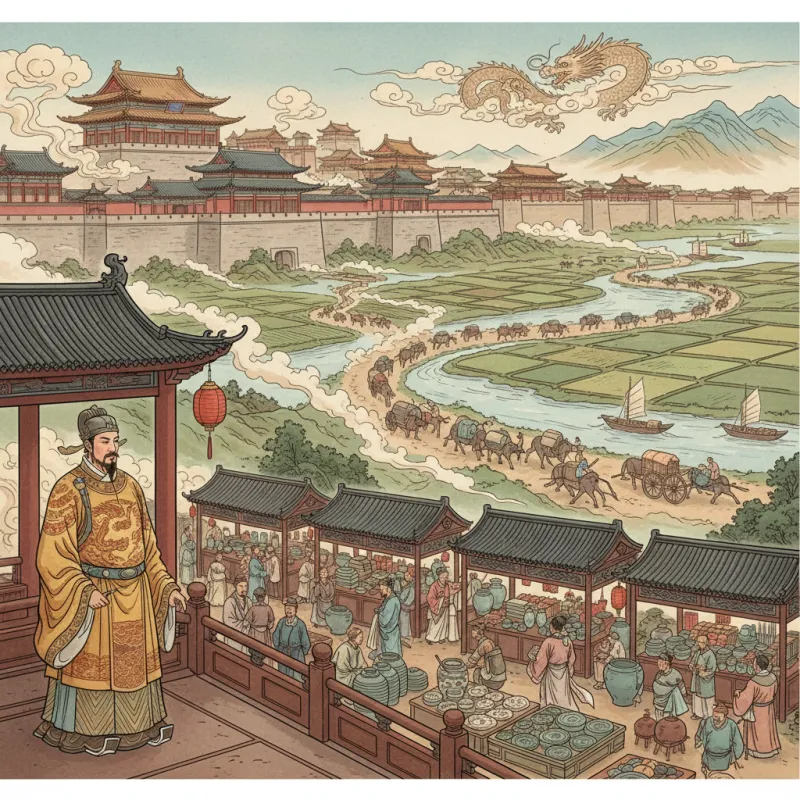
The bronze coins clinked in the merchant's pouch as he crossed the Yellow River, each one stamped with the square hole that would become the most recognizable currency design in human history. For over two millennia, these coins—and the complex economic systems behind them—powered empires that rose and fell like the tides of the Yangtze. Yet the story of ancient Chinese economics isn't just about money. It's about how emperors, farmers, merchants, and bureaucrats created an economic machine so sophisticated that it wouldn't be matched in the West until the Industrial Revolution.
The Agricultural Foundation: More Than Just Rice Paddies
When we talk about ancient Chinese economics, we're really talking about grain. The juntian (均田, "equal field") system of the Northern Wei Dynasty (386-534 CE) wasn't just land reform—it was a revolutionary attempt to stabilize the entire economy by ensuring every family had enough land to survive and pay taxes. The government allocated land based on family size and age, then reclaimed it when farmers died or aged out. Brilliant in theory, chaotic in practice.
But here's what most accounts miss: Chinese agriculture wasn't monolithic. The wheat-growing north and rice-cultivating south operated on fundamentally different economic principles. Rice paddies required massive irrigation projects and collective labor, creating tight-knit village economies and powerful local officials who controlled water rights. Northern wheat farming was more individualistic, leading to different social structures and, crucially, different tax collection methods. The Grand Canal construction under the Sui Dynasty (581-618 CE) wasn't just an engineering feat—it was an attempt to unify these two economic worlds by moving southern rice to feed northern armies and bureaucrats.
The Tang Dynasty (618-907 CE) perfected what I call "agricultural capitalism with Chinese characteristics." Their zuyongdiao (租庸調, "tax in grain, labor, and cloth") system let farmers pay taxes in multiple forms, creating flexibility that earlier dynasties lacked. Can't spare grain this year? Pay in labor days. Bad harvest? Weave some cloth. This wasn't mercy—it was pragmatic economics that kept revenue flowing even during regional disasters.
The Merchant Class: Despised Yet Indispensable
Here's a paradox that defined Chinese economic history: merchants were officially ranked at the bottom of the social hierarchy—below scholars, farmers, and artisans—yet they accumulated wealth that made them more powerful than many officials. The Confucian establishment viewed commerce as parasitic, creating nothing while profiting from others' labor. Emperor Wu of Han (141-87 BCE) went so far as to nationalize salt and iron production specifically to break merchant monopolies and fund his military campaigns against the Xiongnu.
But economics always wins over ideology. By the Song Dynasty (960-1279 CE), merchants had become so essential that the government couldn't function without them. The shangren (商人, "merchants") of Kaifeng and Hangzhou operated in a proto-capitalist environment that wouldn't emerge in Europe for another 500 years. They formed huiguan (會館, "guild halls") that functioned as banks, insurance companies, and trade associations. The famous Shanxi merchants, or Jinshang (晉商), created a credit system using piaohao (票號, "draft banks") that could transfer funds across thousands of miles using nothing but paper notes—centuries before Western banking developed similar instruments.
The government's relationship with merchants was transactional and cynical. Need to fund a war? Sell official titles to wealthy merchants. Need to control inflation? Manipulate merchant licenses. The Ming Dynasty's (1368-1644 CE) kaizhongfa (開中法, "salt certificate system") let merchants exchange grain delivered to border garrisons for salt monopoly rights. Everyone won: the army got fed, merchants got rich, and the government collected taxes without moving a single grain of rice itself.
Currency Evolution: From Cowrie Shells to Paper Money
The Chinese invented paper money during the Song Dynasty, but the story of Chinese currency starts much earlier and gets much weirder. The Shang Dynasty (1600-1046 BCE) used cowrie shells—yes, actual seashells—as currency. When natural shells became scarce, they made bronze replicas. This tells us something profound: the Chinese understood that money's value was symbolic, not intrinsic, from the very beginning.
The ban liang (半兩, "half tael") coins of the Qin Dynasty (221-206 BCE) standardized currency across the newly unified empire. Emperor Qin Shi Huang didn't just build the Great Wall and the Terracotta Army—he created a common currency that made interstate trade possible for the first time. That square hole in the middle? Practical genius. String a thousand coins together, and you have a diao (吊), a standardized unit that merchants could count by weight rather than individually.
But the real innovation came with jiaozi (交子), the world's first paper money, issued in Sichuan during the early Song Dynasty. Merchants tired of hauling heavy bronze coins created private notes backed by their deposits. The government, seeing an opportunity, nationalized the system by 1024 CE. This wasn't just convenient—it was revolutionary monetary policy. The government could now print money to fund projects, manipulate the money supply to control inflation, and even engage in what we'd now call quantitative easing.
Of course, they also discovered inflation the hard way. The Jin Dynasty (1115-1234 CE) printed so much paper money to fund wars against the Song that their currency became worthless. The Yuan Dynasty (1271-1368 CE) under Kublai Khan tried again, and Marco Polo marveled at paper money in his travels—but they too eventually printed themselves into hyperinflation. The Ming Dynasty learned the lesson and returned to silver-based currency, creating the maritime trade networks that would connect China to the global economy.
State Monopolies and Economic Control
Chinese emperors understood something that modern economists debate: strategic industries are too important to leave to the market. The Han Dynasty's nationalization of salt and iron wasn't ideological—it was practical. Salt was essential for food preservation, iron for agricultural tools and weapons. Control these, and you control the economy.
The yanzheng (鹽政, "salt administration") became one of the most sophisticated bureaucratic systems in the ancient world. The government didn't just tax salt—it controlled production, distribution, and pricing. Salt commissioners were among the most powerful officials in the empire, and salt smuggling became so profitable that entire criminal networks formed around it. The Tang Dynasty collected up to half its revenue from salt monopolies alone.
But here's where it gets interesting: these monopolies weren't static. Dynasties constantly experimented with different models. Sometimes the government ran production directly. Other times it licensed private producers but controlled distribution. The Song Dynasty created a hybrid system where merchants could buy salt certificates and sell at market prices, but within government-regulated zones. This flexibility—this willingness to adjust economic policy based on results rather than ideology—gave Chinese dynasties remarkable resilience.
The chaoma (茶馬, "tea-horse") trade with Tibet and Central Asia shows how economic policy served strategic goals. The government monopolized tea production and traded it for horses needed by the cavalry. This wasn't just commerce—it was national security policy implemented through economic means. The Tea and Horse Trading Agency, established during the Song Dynasty, operated for over 600 years, making it one of the longest-running government economic programs in history.
The Tribute System: Economics Disguised as Diplomacy
The chaogong (朝貢, "tribute") system is often described as diplomatic theater, but it was fundamentally an economic arrangement. Foreign kingdoms sent "tribute" to the Chinese emperor, who returned "gifts" of greater value. On the surface, this confirmed China's superiority. In reality, it was a trade system that benefited everyone.
Korean envoys brought ginseng and received silk. Vietnamese missions offered exotic woods and got bronze mirrors. Japanese traders presented swords and left with books and tea. The "tribute" was really just import duties, and the "gifts" were export goods. The genius was framing commerce as diplomacy, which allowed trade to continue even during periods of official hostility.
The Ming Dynasty's haijin (海禁, "sea ban") policy, which restricted maritime trade, shows the system's limits. Intended to control piracy and prevent smuggling, it instead drove trade underground. The wokou (倭寇, "Japanese pirates")—actually multinational smuggling networks—thrived by circumventing official channels. When the Qing Dynasty finally relaxed restrictions, legitimate trade exploded, proving that economic forces ultimately overwhelm political restrictions.
Labor and Taxation: The Social Contract
The corvée labor system—yaoyi (徭役) in Chinese—was the hidden engine of imperial economics. Every able-bodied man owed the state a certain number of labor days per year. This built the Great Wall, dug the Grand Canal, maintained roads, and constructed palaces. It was taxation in sweat rather than silver.
But the system was more nuanced than simple forced labor. The Tang Dynasty's zuyongdiao system let people pay money instead of serving labor days, creating a market for labor substitution. Wealthy families paid poor farmers to fulfill their obligations, effectively creating a labor market within a command economy. The Song Dynasty went further, largely replacing corvée with monetary taxes, which funded a professional labor force. This shift from labor obligations to cash taxes marked a fundamental transformation in how the Chinese economy operated.
The lijia (里甲) system of the Ming Dynasty organized households into groups of 110 families, with ten serving as leaders each year. These leaders collected taxes, organized corvée labor, and maintained local order. It was governance through community organization, distributing administrative costs across the population. When the system worked, it was remarkably efficient. When it failed—through corruption, natural disasters, or population shifts—entire regions could collapse into chaos.
The Legacy: What Ancient China Teaches Modern Economics
The economic sophistication of ancient Chinese dynasties challenges Western narratives about economic development. While Europe was still using barter systems, Song Dynasty China had paper money, credit instruments, and proto-corporations. While medieval European monarchs struggled to collect taxes, Chinese emperors ran complex bureaucracies that managed everything from grain prices to currency supply.
Yet this sophistication had limits. The Confucian disdain for merchants prevented the emergence of a true capitalist class with political power. The examination system, while meritocratic, funneled talent into government service rather than entrepreneurship. State monopolies, while effective for revenue collection, stifled innovation in key industries. And the agricultural tax base, no matter how efficiently collected, couldn't generate the capital accumulation that would later drive Western industrialization.
The real lesson isn't that ancient China was economically superior or inferior to other civilizations—it's that they developed a fundamentally different economic model that worked for over two millennia. An economy based on agricultural surplus, managed by a professional bureaucracy, regulated through state monopolies, and lubricated by sophisticated financial instruments. It was neither purely capitalist nor socialist, neither entirely free market nor completely planned. It was something uniquely Chinese, and understanding it helps us see that there's more than one path to economic development.
The bronze coins with square holes are long gone, replaced by digital yuan and global markets. But the tension between state control and market forces, between agricultural stability and commercial dynamism, between Confucian values and economic pragmatism—these debates that animated ancient Chinese courts still echo in modern economic policy worldwide.
Related Reading
- The Grand Canal: China Greatest Engineering Project
- Traditional Chinese Medicine: 2,500 Years of Healing
- Chinese Inventions the World Forgot: Beyond Paper, Printing, Gunpowder, and the Compass