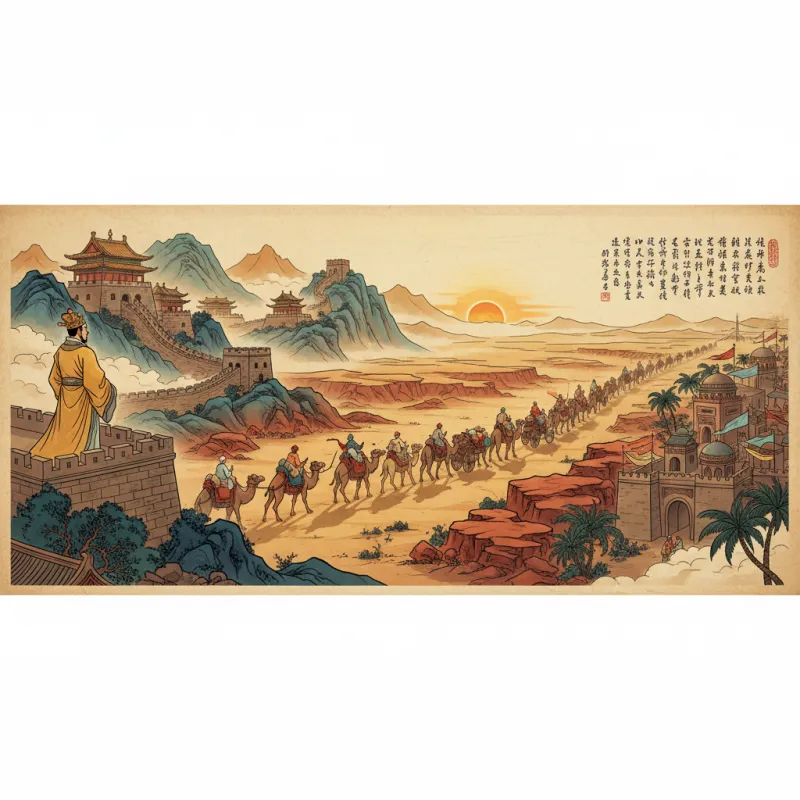
Picture this: In 138 BCE, a Chinese diplomat named Zhang Qian (张骞, Zhāng Qiān) sets out from the Han capital with a hundred men, heading west into territory no Chinese official has ever mapped. His mission? Find allies against the Xiongnu nomads terrorizing China's borders. What he discovers instead changes world history — not through military conquest, but through the accidental creation of humanity's first global trade network.
Zhang Qian's expedition was a disaster by its original metrics. The Xiongnu captured him almost immediately, holding him prisoner for ten years. When he finally escaped and reached Central Asia, the kingdoms he'd been sent to recruit refused his alliance. He returned to China thirteen years after departing, with only one companion from his original party still alive. Emperor Wu (汉武帝, Hàn Wǔdì) could have executed him for failure. Instead, he promoted him. Why? Because Zhang Qian brought back something more valuable than military allies: detailed intelligence about the Western Regions (西域, Xīyù) and their appetite for Chinese goods.
The Network That Wasn't a Road
Here's what most beginner guides get wrong: the Silk Road wasn't a road. It was a sprawling, constantly shifting network of routes that connected Chang'an (modern Xi'an) to Rome, with countless branches, detours, and maritime alternatives. No single merchant traveled the entire distance. Instead, goods passed through dozens of middlemen, each controlling a segment of the route and taking their cut.
The main overland route split into northern and southern branches around the Taklamakan Desert — one of the most inhospitable places on Earth. The northern route passed through oasis cities like Turpan and Kucha. The southern route went through Khotan and Kashgar. Both converged at Dunhuang (敦煌, Dūnhuáng), the last major Chinese outpost before the desert, where the famous Mogao Caves would later preserve Buddhist art for centuries. From there, routes continued through Samarkand, Baghdad, and eventually to Mediterranean ports.
Maritime routes were equally important but often overlooked. Chinese ships sailed from Guangzhou to Southeast Asia, India, and eventually East Africa, carrying porcelain, tea, and yes, silk. These sea routes were faster and safer than overland travel, though they came with their own risks: pirates, monsoons, and the occasional sea monster (according to contemporary accounts, though these were probably whales).
What Actually Traveled These Routes
Silk gets all the glory, but it was just one commodity among hundreds. The Chinese exported silk, porcelain, paper, gunpowder, and tea. In return, they imported horses from Central Asia (desperately needed for military campaigns), glassware from Rome, spices from India, precious stones from Persia, and grapes from the Fergana Valley. The Han Dynasty's obsession with Fergana horses — described as "heavenly horses" that supposedly sweated blood — nearly bankrupted the imperial treasury and sparked multiple military campaigns.
But the most consequential cargo wasn't physical goods. Buddhism traveled the Silk Road from India to China, fundamentally transforming Chinese philosophy and culture. Islam spread eastward along the same routes. Nestorian Christianity reached Tang Dynasty China by 635 CE. Mathematical concepts, astronomical knowledge, and artistic techniques flowed in both directions. The Tang Dynasty became cosmopolitan partly because Chang'an was a Silk Road terminus where Persian merchants, Arab traders, and Indian monks mingled in the markets.
Diseases traveled too. The Antonine Plague (possibly smallpox) that devastated Rome in 165 CE likely arrived via Silk Road trade. The Black Death followed similar routes in the 14th century, though by then the Mongol Empire had created an unprecedented level of connectivity across Eurasia — making pandemic spread faster and more thorough.
The Golden Age: Tang Dynasty Dominance
The Silk Road reached its peak during the Tang Dynasty (618-907 CE), when China was arguably the world's most powerful and sophisticated civilization. Tang emperors secured the western routes through military garrisons and diplomatic marriages. They established the Protectorate General to Pacify the West (安西都护府, Ānxī Dūhùfǔ) with headquarters in Kucha, maintaining control over the Tarim Basin and ensuring safe passage for merchants.
Chang'an during this period was the world's largest city, with over a million residents, including substantial foreign quarters where Central Asian, Persian, and Arab merchants lived according to their own customs. The Tang court employed foreign musicians, dancers, and artists. Polo — imported from Persia — became a favorite sport among aristocrats. Foreign fashions influenced Chinese clothing styles. This wasn't cultural appropriation; it was cultural exchange on an unprecedented scale.
The Tang Dynasty's cosmopolitanism had limits, though. When Emperor Wuzong (唐武宗, Táng Wǔzōng) launched his anti-Buddhist persecution in 845 CE, he also targeted foreign religions, destroying Zoroastrian, Nestorian Christian, and Manichaean temples. The persecution was partly religious, partly economic — Buddhist monasteries had accumulated enormous wealth and land, threatening imperial finances. But it marked the beginning of the end for Tang openness to foreign influence.
The Mongol Superhighway
If the Tang Dynasty was the Silk Road's golden age, the Mongol Empire (1206-1368) was its most efficient phase. Genghis Khan and his successors created the largest contiguous land empire in history, and they understood that trade generated more sustainable wealth than plunder. The Mongols established the Yam system (站赤, zhànchì) — a network of relay stations providing fresh horses, food, and lodging for official messengers and approved merchants.
Under Mongol rule, a merchant could theoretically travel from Beijing to Baghdad with a single passport (paiza, 牌子, páizi) and reasonable expectation of safety. The Mongols brutally punished bandits and corrupt officials who preyed on traders. They standardized weights and measures across their empire. They even provided insurance for merchant caravans.
This is when Europeans like Marco Polo could actually travel to China and return to tell about it. The Polos were Venetian merchants who spent 17 years in Kublai Khan's court (1275-1292). Whether Marco Polo actually went to China remains debated — his account contains suspicious omissions like the Great Wall and foot-binding — but his book inspired European interest in Asian trade that would eventually lead to the Age of Exploration.
Why It Ended
The Silk Road didn't end on a specific date; it gradually declined over several centuries due to multiple factors. The fall of the Mongol Empire fragmented Eurasia into competing states that couldn't guarantee safe passage. The Ming Dynasty (1368-1644) turned inward, abandoning the western garrisons and focusing on maritime defense against Japanese pirates. The rise of the Ottoman Empire created a hostile intermediary between Europe and Asia, motivating Europeans to seek alternative routes.
But the real killer was maritime technology. By the 15th century, European ships could sail around Africa to reach Asia directly, bypassing the Silk Road entirely. Portuguese navigator Vasco da Gama reached India by sea in 1498, opening a route that was faster, cheaper, and didn't require paying off dozens of Central Asian middlemen. The Ming Dynasty's maritime expeditions under Admiral Zheng He (郑和, Zhèng Hé) demonstrated Chinese naval capabilities, but the Ming court chose to abandon ocean exploration just as Europeans were ramping up.
The final blow came from changing tastes and technologies. Europeans learned to produce their own silk. Coffee and chocolate from the Americas replaced Asian spices as luxury goods. The Industrial Revolution made European manufactured goods competitive with Asian crafts. By the 18th century, the overland Silk Road was a historical memory, its oasis cities reduced to dusty backwaters.
Why It Still Matters
The Silk Road's legacy extends far beyond trade statistics. It proved that different civilizations could cooperate for mutual benefit despite language barriers, religious differences, and political conflicts. It demonstrated that ideas travel faster and farther than armies. It created the first truly global economy, where a drought in Central Asia could affect silk prices in Rome, and a plague in China could devastate Mediterranean cities.
Modern China's Belt and Road Initiative explicitly invokes Silk Road imagery, proposing to rebuild trade connections across Eurasia through infrastructure investment. Whether this succeeds or becomes a debt-trap for participating nations remains to be seen, but the symbolism is deliberate: China positioning itself as the center of a new global trade network, just as it was two thousand years ago.
For beginners trying to understand Chinese history, the Silk Road offers a crucial corrective to the myth of Chinese isolation. China was never a hermit kingdom sealed off from the world. It was a central node in transcontinental networks of trade, religion, and cultural exchange. The Chinese didn't just invent paper, gunpowder, and the compass — they shared these inventions with the world through Silk Road connections, fundamentally altering human history.
The next time you drink tea, wear silk, or use paper, remember: these everyday items were once luxury goods that traveled thousands of miles through deserts, over mountains, and across seas, carried by merchants who risked their lives for profit and adventure. The Silk Road wasn't just about commerce. It was about human curiosity, ambition, and the stubborn belief that what lies beyond the horizon is worth the journey.
Related Reading
- The Silk Road Was Not About Silk: What Actually Traveled Between China and the West
- The Silk Road Was Not a Road (And Other Things You Got Wrong)
- How Buddhism, Islam, and Christianity Traveled the Silk Road
- Zheng He's Treasure Fleet: When China Ruled the Seas
- The Silk Road: Bridge Between East and West
- Zhuge Liang: The Sleeping Dragon Who Became China's Greatest Strategist
- The Military Strategies and Key Battles of Ancient Chinese Dynasties