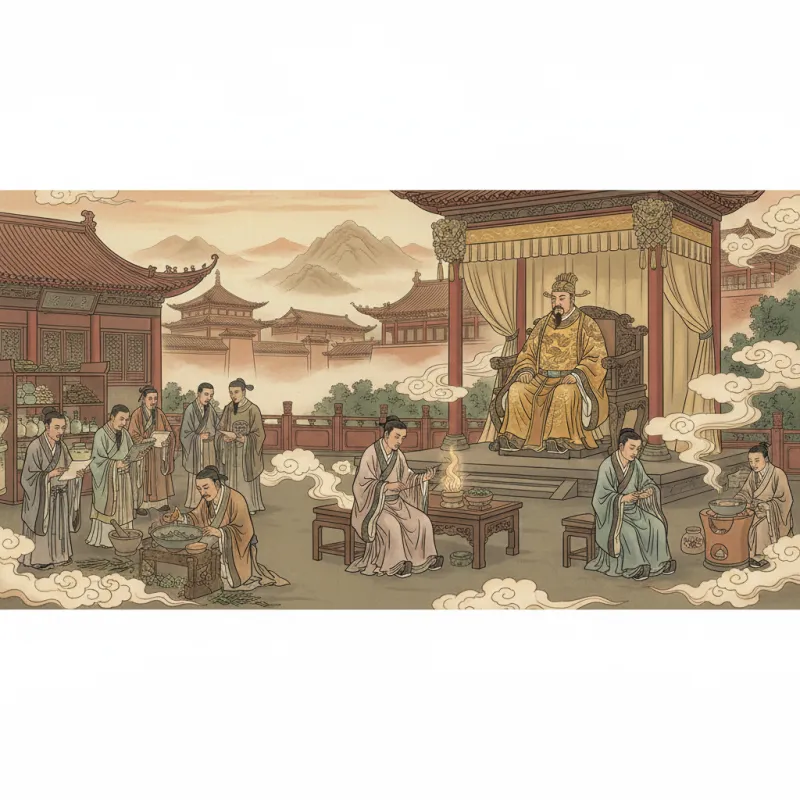
When Emperor Qin Shi Huang swallowed his final mercury pill in 210 BCE—prescribed by court physicians who promised immortality—he proved what Chinese medical practitioners would spend the next two millennia refining: healing isn't about defying nature, but understanding it. The irony of China's first emperor dying from his medicine rather than being saved by it marks a pivotal moment in medical history, one that would push subsequent dynasties toward more empirical, observation-based healing practices.
The Shang Dynasty: When Bones Spoke of Illness
Long before acupuncture needles and herbal decoctions, the Shang Dynasty (c. 1600-1046 BCE) approached medicine through oracle bones and shamanic rituals. Physicians—if we can call them that—were often priests who interpreted cracks in heated turtle shells to diagnose ailments. The oracle bone inscriptions reveal over 20 different terms for diseases, from tooth decay (齿疾, chǐjí) to eye disorders (目疾, mùjí). What's remarkable isn't the supernatural framework, but the systematic categorization. These early practitioners were already thinking in terms of disease classification, a concept that would mature dramatically in later dynasties.
Archaeological evidence from Shang tombs shows surgical tools made of bronze and stone, suggesting that alongside spiritual healing, there existed practical interventions. The Shang people understood that some problems required physical solutions—abscesses needed draining, wounds needed cleaning. This dual approach—spiritual and physical—would echo through Chinese medical philosophy for centuries, though the balance would shift decisively toward the empirical.
The Zhou Dynasty: Philosophy Meets Physiology
The Zhou Dynasty (1046-256 BCE) brought something revolutionary to Chinese medicine: systematic philosophy. This is when Qi (氣, qì)—that vital life force—transitioned from vague spiritual concept to medical principle. The idea wasn't invented from nothing; it emerged from observing breath, steam, and the apparent energy that animated living things versus dead ones. Zhou physicians began mapping this Qi through the body, creating early versions of what would become meridian theory.
The Yin-Yang (陰陽, yīnyáng) framework also crystallized during this period, borrowed from cosmological observations and applied to human health. Cold versus hot, interior versus exterior, deficiency versus excess—these weren't just philosophical musings but diagnostic categories. A physician examining a patient with fever and red face would identify Yang excess; someone with cold extremities and pale complexion showed Yin deficiency. This binary thinking, crude as it might seem, gave practitioners a reproducible framework for pattern recognition.
The Five Phases theory (五行, wǔxíng)—wood, fire, earth, metal, water—added another layer of complexity. Each phase corresponded to organs, seasons, emotions, and tastes. The liver connected to wood, spring, anger, and sour flavors. This wasn't arbitrary mysticism; it was an attempt to create a unified theory of health that connected environment, emotion, and physiology. Modern medicine might scoff at the specifics, but the impulse toward holistic, systems-based thinking was remarkably sophisticated for its time.
The Han Dynasty: Medicine Becomes Literature
The Han Dynasty (206 BCE-220 CE) gave us the texts that would define Chinese medicine for two millennia. The "Huangdi Neijing" (黃帝內經, Huángdì Nèijīng, Yellow Emperor's Inner Canon) wasn't written by the mythical Yellow Emperor, of course—it was compiled by multiple authors over decades, possibly centuries. But its influence cannot be overstated. This text established the theoretical foundation: the meridian system with its 365 acupoints (matching the days of the year, a numerological coincidence the authors couldn't resist), the organ systems, and diagnostic methods including pulse-taking that could supposedly reveal the state of internal organs through wrist palpation.
Zhang Zhongjing's "Shanghan Lun" (傷寒論, Shānghán Lùn, Treatise on Cold Damage Disorders) took a different approach—clinical and practical rather than theoretical. Written around 200 CE, it presented actual case studies and herbal formulas for specific disease patterns. Many of these formulas, like Gui Zhi Tang (Cinnamon Twig Decoction), are still prescribed today. Zhang wasn't interested in cosmic philosophy; he wanted to cure people dying from epidemic fevers. His empirical approach—observe symptoms, apply treatment, record results—reads surprisingly modern.
The Han also saw the legendary physician Hua Tuo (華佗, Huà Tuó), who allegedly performed surgery using anesthesia made from cannabis and wine (麻沸散, máfèisǎn). Whether the stories of him opening abdomens and removing tumors are true remains debated, but his reputation suggests that surgical intervention, though rare, was part of the medical toolkit. The development of anesthesia represents one of Chinese medicine's most underappreciated contributions to global medical history.
The Tang Dynasty: Medicine Goes Imperial
The Tang Dynasty (618-907 CE) bureaucratized medicine in ways that would make modern healthcare administrators proud—or horrified. The Imperial Medical Bureau employed hundreds of physicians, organized into specialties: internal medicine, surgery, pediatrics, ophthalmology, and dentistry. Medical education became formalized with the establishment of the Imperial Medical College in 629 CE, which required students to master classic texts and pass examinations. This wasn't just about healing; it was about standardization and quality control.
Sun Simiao (孫思邈, Sūn Sīmiǎo), the "King of Medicine," wrote "Qianjin Yaofang" (千金要方, Qiānjīn Yàofāng, Essential Formulas Worth a Thousand Gold Pieces) during this period. His work emphasized medical ethics—treat all patients equally regardless of status, never exploit the sick for profit, maintain confidentiality. These principles, written in 652 CE, predate the Hippocratic Oath's widespread adoption in the West. Sun also documented over 5,000 herbal formulas and was among the first to describe symptoms of diabetes, which he called "wasting-thirst disease" (消渴病, xiāokě bìng).
The Tang's international connections through the Silk Road brought foreign medical knowledge into China—Indian Ayurvedic concepts, Persian pharmacology, even early Islamic medicine. This cross-pollination enriched Chinese medical practice, adding new herbs and treatment methods. The influence of Silk Road trade on medical knowledge demonstrates how Chinese civilization absorbed and adapted foreign innovations while maintaining its theoretical core.
The Song Dynasty: Forensics and Pharmacology
The Song Dynasty (960-1279 CE) might be Chinese medicine's most innovative period. Song Ci's "Xi Yuan Ji Lu" (洗冤集錄, Xǐyuān Jílù, Washing Away of Wrongs), published in 1247, was the world's first forensic medicine textbook. It detailed how to distinguish drowning from strangulation, identify poison deaths, and determine time of death—practical knowledge for a legal system that required medical evidence in criminal cases. This wasn't healing the living, but it showed how medical knowledge extended into social institutions.
The Song government published the "Taiping Huimin Heji Jufang" (太平惠民和劑局方, Tàipíng Huìmín Héjì Júfāng, Imperial Grace Formulary of the Taiping Era) in 1151, a massive pharmacological compendium containing 788 formulas. This was essentially the first government-issued pharmaceutical reference, standardizing prescriptions across the empire. The state even operated pharmacies that sold these standardized medicines at regulated prices—socialized medicine, Song Dynasty style.
Acupuncture advanced significantly during this period with the creation of bronze anatomical models showing all meridian points. These weren't just teaching tools; they were used for examination purposes. Aspiring acupuncturists had to correctly identify points on the bronze figure, which was covered in wax and filled with water. Insert the needle correctly, and water would flow out—a practical test of anatomical knowledge.
The Ming Dynasty: Systematization and Synthesis
The Ming Dynasty (1368-1644 CE) produced Li Shizhen (李時珍, Lǐ Shízhēn), whose "Bencao Gangmu" (本草綱目, Běncǎo Gāngmù, Compendium of Materia Medica) remains the most comprehensive pharmacological text in Chinese history. Published in 1596 after 27 years of research, it catalogued 1,892 substances—plants, animals, minerals—with 11,096 prescriptions. Li didn't just compile existing knowledge; he corrected errors, added personal observations, and organized everything using a classification system that anticipated modern taxonomy.
What makes Li Shizhen remarkable isn't just the scope of his work, but his methodology. He traveled extensively, interviewed practitioners, tested substances himself, and questioned traditional authorities when evidence contradicted them. His entry on ginseng, for instance, corrects centuries of exaggerated claims while documenting legitimate therapeutic uses. This critical, evidence-based approach represents Chinese medicine at its empirical best.
The Ming also saw increased specialization. Pediatrics, gynecology, and orthopedics developed distinct theoretical frameworks and treatment protocols. Chen Shigong's "Wai Ke Zheng Zong" (外科正宗, Wàikē Zhèngzōng, Orthodox Manual of External Medicine) from 1617 described surgical procedures including tumor removal, cataract surgery, and plastic surgery techniques for reconstructing noses and ears—procedures that wouldn't appear in European medical texts for another century.
Legacy: What Ancient Practice Teaches Modern Medicine
Ancient Chinese medicine's greatest contribution isn't any single treatment or theory—it's the framework of thinking holistically about health. While modern biomedicine excels at identifying specific pathogens and targeted interventions, it often struggles with chronic conditions, preventive care, and the mind-body connection. Chinese medicine, with its emphasis on pattern recognition, constitutional differences, and lifestyle factors, offers complementary insights.
The concept of "treating the root, not the branch" (治本不治標, zhì běn bù zhì biāo) remains relevant. A Chinese physician seeing a patient with recurring headaches wouldn't just prescribe pain relief; they'd investigate sleep patterns, stress levels, diet, and emotional state. This systems-thinking approach, developed over dynasties of clinical observation, anticipates modern understanding of how interconnected our physiological systems truly are.
That said, we shouldn't romanticize ancient practices or ignore their limitations. Mercury pills killed emperors. Bloodletting harmed patients. Many herbal remedies do nothing, and some are actively dangerous. The value lies not in uncritical adoption of ancient methods, but in understanding the observational wisdom accumulated over millennia. When Zhang Zhongjing documented that certain fever patterns responded to specific herb combinations, he was conducting clinical trials—crude by modern standards, but trials nonetheless.
The evolution of Chinese medical philosophy across dynasties shows a civilization constantly refining its understanding of health and disease. From Shang oracle bones to Ming pharmacological encyclopedias, each dynasty built upon previous knowledge while adapting to new challenges. Modern integrative medicine, which combines conventional treatments with evidence-based complementary approaches, continues this tradition of synthesis. The question isn't whether ancient Chinese medicine was "right" or "wrong" by modern standards—it's what we can learn from a medical tradition that kept hundreds of millions of people alive for thousands of years before antibiotics and surgery.
Related Reading
- Delving into Ancient China: A Journey Through Dynasties, Emperors, and Cultural Treasures
- The Great Wall of China: The Complete History Beyond the Myth
- Exploring the Rich Tapestry of Ancient Chinese History and Culture