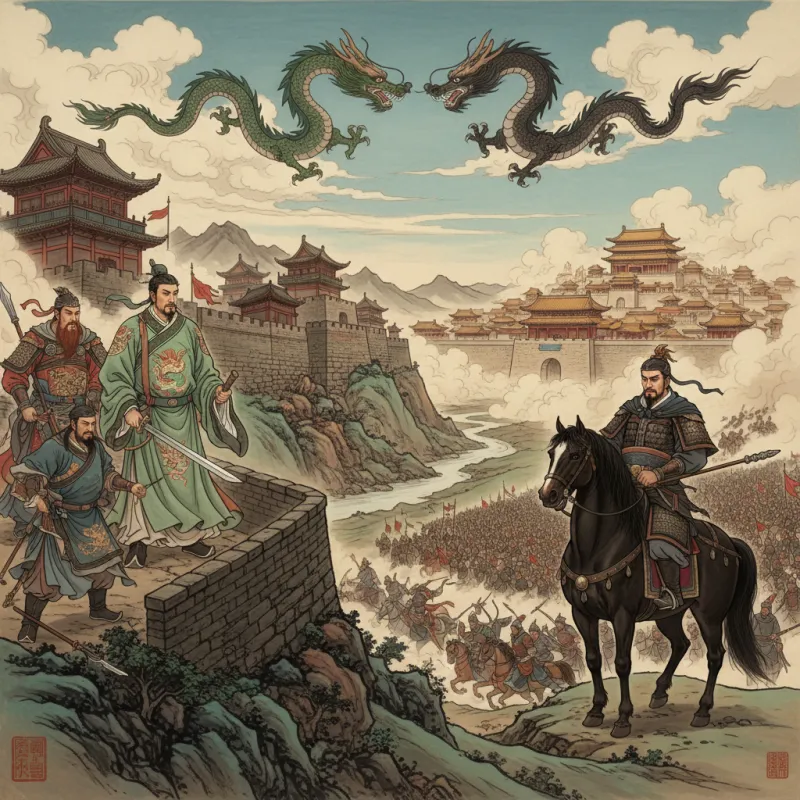
Ask any group of Chinese history enthusiasts who was the greater leader — Cao Cao (曹操, Cáo Cāo) or Liu Bei (刘备, Liú Bèi) — and watch friendships strain. This isn't some dusty academic question. It's a debate that's raged for 1,800 years, one that cuts to the heart of what we value in leadership: ruthless effectiveness or principled virtue. The rivalry between these two men defined the Three Kingdoms period (220–280 CE) and continues to shape how Chinese culture thinks about power, morality, and the compromises leaders must make.
The Warlord Who Rewrote the Rules
Cao Cao didn't come from nowhere, but his origins were embarrassing enough that his enemies never let him forget them. His grandfather was a 宦官 (huànguān, eunuch), which in Han Dynasty society meant the family wealth was built on castration and court intrigue rather than scholarly merit or military glory. This background haunted Cao Cao throughout his life, giving his rivals ammunition to question his legitimacy even as he conquered half of China.
But what Cao Cao lacked in pedigree, he made up for in raw capability. He was a military innovator who understood logistics, a poet whose works are still studied today, and a political operator who could spot talent regardless of social class. When the Han Dynasty collapsed into chaos after the Yellow Turban Rebellion (184 CE), Cao Cao built a power base through meritocracy — he promoted capable administrators and generals even if they came from humble backgrounds, a radical departure from the aristocratic norms of his time.
His methods were brutal. When he conquered Xu Province, his troops massacred civilians in retaliation for his father's death. He executed subordinates who questioned his authority. He manipulated the puppet Emperor Xian, using imperial legitimacy as a tool while holding real power himself. The historical records, particularly the Records of the Three Kingdoms (三国志, Sānguó Zhì) compiled by Chen Shou, don't hide these facts. Cao Cao was effective, but the cost in human suffering was staggering.
The Reluctant Hero's Long Road
Liu Bei's story reads like a deliberate counterpoint to Cao Cao's rise. He claimed descent from Liu Sheng, a Han Dynasty prince, which gave him imperial blood — though by the time of his birth in 161 CE, that connection was so distant it meant little beyond a surname. He grew up poor, selling straw sandals with his mother. Where Cao Cao had education and connections, Liu Bei had charisma and an uncanny ability to inspire loyalty.
The pattern repeated throughout his early career: Liu Bei would gather followers, lose territory, flee, and start over. He served under various warlords, was betrayed, was defeated, and kept returning. What's remarkable isn't his military record — which was mediocre at best — but that people kept following him. Guan Yu (关羽, Guān Yǔ) and Zhang Fei (张飞, Zhāng Fēi), two of the most capable warriors of the era, stayed loyal to Liu Bei through decades of failure. Zhuge Liang (诸葛亮, Zhūgě Liàng), perhaps the most brilliant strategist of the period, came out of retirement to serve him.
Liu Bei's power came from his ability to position himself as the legitimate heir to Han Dynasty values. While Cao Cao manipulated the emperor, Liu Bei claimed to be restoring him. While Cao Cao promoted based on ability, Liu Bei emphasized 仁义 (rényì, benevolence and righteousness). He wasn't just building a kingdom; he was building a moral alternative to Cao Cao's pragmatic authoritarianism.
The Battle of Red Cliffs: When Virtue Met Reality
The defining moment of their rivalry came in 208 CE at the Battle of Red Cliffs (赤壁之战, Chìbì Zhī Zhàn). Cao Cao had just unified the north and marched south with an army that contemporary sources claim numbered 800,000 men — almost certainly an exaggeration, but even a force of 200,000 would have been overwhelming. Liu Bei, allied with the southern warlord Sun Quan (孙权, Sūn Quán), had perhaps 50,000 troops. The smart money was on Cao Cao.
But Cao Cao's northern troops weren't prepared for naval warfare on the Yangtze River. Zhuge Liang and Sun Quan's commander Zhou Yu (周瑜, Zhōu Yú) exploited this weakness with fire ships, turning Cao Cao's fleet into an inferno. The northern army retreated in chaos, and Cao Cao's dream of quick unification died in the flames.
The battle's significance goes beyond military history. It proved that Liu Bei's coalition — built on shared opposition to Cao Cao's methods — could survive against superior force. It gave Liu Bei the breathing room to establish his kingdom of Shu Han in the southwest, creating the three-way division that gave the period its name. Most importantly, it became a story about how virtue and clever strategy could triumph over raw power, a narrative that Chinese culture has retold countless times since.
What the Romance Got Wrong (and Right)
We can't discuss this rivalry without addressing the Romance of the Three Kingdoms (三国演义, Sānguó Yǎnyì), the 14th-century novel that transformed historical figures into archetypes. Luo Guanzhong's novel, building on centuries of storytelling tradition, turned Cao Cao into a villain and Liu Bei into a hero. It's brilliant literature and terrible history.
The novel exaggerates Liu Bei's virtue to the point of parody — he weeps constantly, he's almost superhumanly humble, and his military victories are attributed entirely to Zhuge Liang's genius. Meanwhile, Cao Cao becomes a mustache-twirling schemer whose every action is motivated by selfish ambition. The real figures were far more complex.
Historical Cao Cao was a patron of literature who wrote poetry about the suffering of common people. He implemented agricultural reforms that helped stabilize the north after decades of warfare. Yes, he was ruthless, but he was also capable of mercy when it served his purposes. Historical Liu Bei was genuinely charismatic and probably believed in his own rhetoric about restoring the Han, but he was also willing to abandon allies when necessary and could be vindictive toward those who betrayed him.
The novel's influence is so pervasive that even modern Chinese people often struggle to separate the historical figures from their fictional counterparts. When you hear someone praise Cao Cao's pragmatism or Liu Bei's virtue, you're hearing echoes of a debate that's been filtered through 600 years of popular culture.
The Philosophical Divide
At its core, the Cao Cao versus Liu Bei debate is about competing visions of legitimate authority. Cao Cao represented 法家 (fǎjiā, Legalism) — the philosophy that effective governance requires clear laws, harsh punishments, and pragmatic decision-making regardless of traditional morality. He believed that a ruler's duty was to create order and prosperity, even if the methods were ugly.
Liu Bei embodied 儒家 (rújiā, Confucianism) — the belief that legitimate authority flows from moral virtue, that a ruler must lead by example, and that the means matter as much as the ends. His claim to power rested not on military might but on his connection to the Han Dynasty and his reputation for benevolence.
This wasn't just political theater. The choice between these philosophies had real consequences for how each man governed. Cao Cao's territories in the north recovered faster from the chaos of the late Han period because his meritocratic system promoted capable administrators. But his regime was also more authoritarian, with less tolerance for dissent. Liu Bei's kingdom of Shu Han inspired fierce loyalty and produced some of the era's most celebrated figures, but it was also smaller, poorer, and ultimately less stable than Cao Cao's Wei Dynasty.
Who Actually Won?
Here's the uncomfortable truth: Cao Cao won. Not personally — he died in 220 CE without declaring himself emperor, maintaining the fiction of serving the Han until the end. But his son Cao Pi (曹丕, Cáo Pī) forced Emperor Xian to abdicate and founded the Wei Dynasty, which controlled the wealthiest and most populous parts of China. Liu Bei's Shu Han was conquered by Wei in 263 CE, just 40 years after Liu Bei's death. The Three Kingdoms period ended when Wei's successor state, Jin, unified China in 280 CE.
But cultural victory is different from military victory. In Chinese popular culture, Liu Bei is the hero and Cao Cao is the villain. The Romance of the Three Kingdoms has been adapted into countless operas, films, TV series, and video games, almost all of which follow the novel's moral framework. When Chinese people quote the period's famous sayings, they're more likely to cite Zhuge Liang's wisdom or Guan Yu's loyalty than Cao Cao's poetry.
This cultural verdict reflects something deep in Chinese civilization's self-image. China wants to believe that virtue matters, that legitimacy comes from moral authority rather than just effective force. Cao Cao's practical success is acknowledged, even admired, but Liu Bei's principled struggle is celebrated. It's the difference between respecting someone and wanting to be like them.
The Debate Continues
Modern China's relationship with this rivalry is complicated. During the Cultural Revolution, Mao Zedong praised Cao Cao as a progressive reformer who challenged feudal aristocracy, trying to rehabilitate his reputation. In recent decades, as China has emphasized economic development and effective governance, some intellectuals have argued that Cao Cao's pragmatism is more relevant than Liu Bei's idealism.
But the popular verdict hasn't really changed. When Chinese people argue about whether the end justifies the means, whether leaders should prioritize effectiveness or morality, whether it's better to be feared or loved — they're still arguing about Cao Cao and Liu Bei. The rivalry between these two men isn't just history. It's a framework for thinking about power that remains relevant 1,800 years later.
So who was greater? The question assumes there's a single standard for greatness. Cao Cao built more, conquered more, and left a more lasting political legacy. Liu Bei inspired more, represented more, and created a more enduring cultural legacy. Which matters more depends on what you value — and that's exactly why Chinese people are still arguing about it.
Related Reading
- The Three Kingdoms: Why China's Favorite Story Is About Failure
- Zhuge Liang: The Sleeping Dragon Who Became China's Greatest Strategist
- Three Kingdoms: The History That Became China's Greatest Story
- The Three Kingdoms: History, Fiction, and Why Everyone's Obsessed
- The Porcelain Trade: How Chinese Pottery Conquered the World
- Exploring Ancient Agricultural Practices in Chinese Dynasties
- The Strategical Brilliance of Chinese Battles: A Journey Through Ancient History