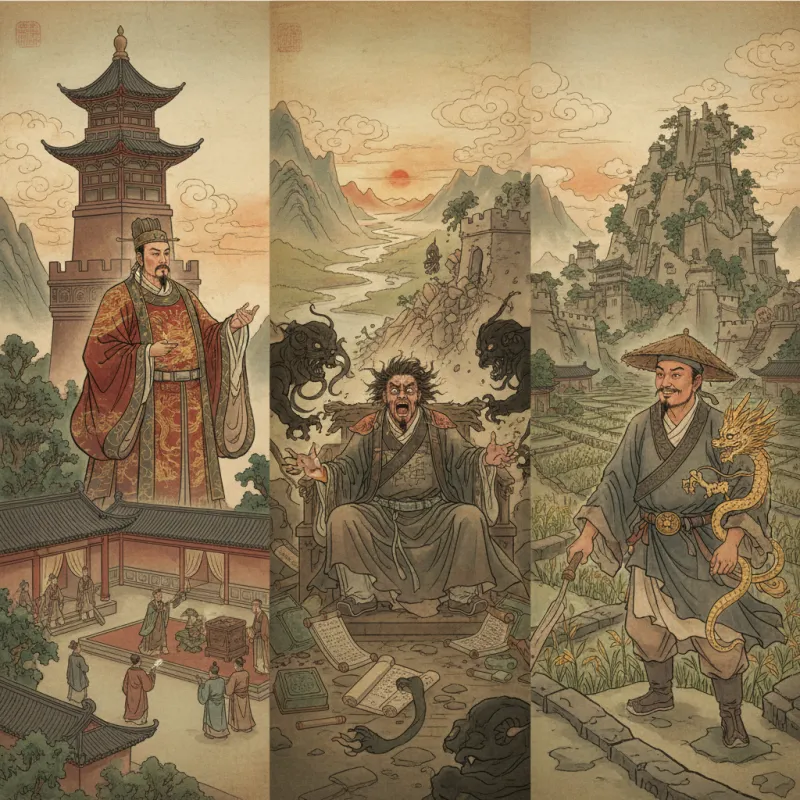
A paranoid emperor drinks mercury believing it will make him immortal. A teenage ruler disguises himself as a commoner to roam Beijing's streets at night. A woman claws her way to absolute power in a world designed to exclude her. China's imperial history isn't just a parade of silk-robed figures on thrones — it's a 2,000-year psychological experiment in what happens when you give one person unlimited power.
Qin Shi Huang: The Man Who Invented China (and Tyranny)
Ying Zheng (嬴政, yíng zhèng) became king of Qin at thirteen. By thirty-eight, he'd conquered six rival kingdoms and declared himself Qin Shi Huang (秦始皇, qín shǐ huáng) — "First Emperor of Qin." The title wasn't just grandiose. It was a statement: history starts now.
What he accomplished in eleven years of rule is staggering. He standardized Chinese script, ensuring that people from different regions could communicate in writing. He unified currency, weights, and measures. He built roads and canals connecting his vast empire. He started construction on the Great Wall, linking and extending earlier fortifications into a defensive barrier thousands of miles long.
He also buried 460 Confucian scholars alive for criticizing his policies. He burned books that didn't align with his vision of history. He forced hundreds of thousands into labor on his construction projects. His tomb — guarded by the famous Terracotta Army — was built by 700,000 workers, many of whom were sealed inside when construction finished.
The Qin dynasty collapsed three years after his death. But the unified China he created never disappeared. Every dynasty that followed claimed to be restoring or continuing what he began. He's the reason "China" exists as a concept. He's also the template for every authoritarian ruler who followed.
Wu Zetian: The Only Woman Who Made It
Wu Zetian (武则天, wǔ zé tiān, 624-705 CE) entered the imperial palace as a low-ranking concubine at fourteen. Fifty years later, she was emperor — not empress, emperor — of the Zhou dynasty she'd founded. She's the only woman in Chinese history to rule in her own name.
Her path to power reads like a thriller. She became concubine to Emperor Taizong. When he died, she was supposed to become a Buddhist nun — the standard fate for imperial concubines. Instead, she seduced his son, the new Emperor Gaozong. She eliminated rivals through a combination of political maneuvering and, according to traditional histories, murder. When Gaozong suffered a stroke, she ruled through him. When he died, she ruled through her sons. Finally, she stopped pretending and declared herself emperor.
Traditional Confucian historians despised her. They accused her of killing her own daughter to frame a rival. They portrayed her as a sexual deviant who kept male concubines. They blamed her for every disaster during her reign. Modern historians are more measured: she was ruthless, yes, but no more so than successful male emperors. She promoted officials based on merit rather than aristocratic birth. She expanded the civil service examination system. She commissioned Buddhist art and architecture. She kept the empire stable for half a century.
The question isn't whether she was "good" or "bad." It's how she managed to break through a system specifically designed to prevent women from holding power — and what it cost her to do it.
The Yongle Emperor: Ambition Without Limits
Zhu Di (朱棣, zhū dì, 1360-1424) wasn't supposed to be emperor. He was the fourth son of the Hongwu Emperor, founder of the Ming dynasty. His nephew inherited the throne. Zhu Di launched a civil war, captured the capital, and declared himself the Yongle Emperor (永乐帝, yǒng lè dì).
Then he set out to make everyone forget how he got there.
He moved the capital from Nanjing to Beijing and built the Forbidden City — the massive palace complex that still defines Beijing's center. He commissioned the Yongle Encyclopedia, a 11,000-volume compilation of all Chinese knowledge. He sent Admiral Zheng He (郑和, zhèng hé) on seven naval expeditions that reached Africa decades before European explorers rounded the Cape of Good Hope.
The treasure fleets Zheng He commanded were technological marvels — ships over 400 feet long, carrying crews of hundreds. They weren't conquest missions. They were diplomatic expeditions designed to demonstrate Ming power and collect tribute. After the Yongle Emperor died, his successors canceled the voyages and burned the records. China turned inward. Historians still debate what would have happened if the expeditions had continued.
The Yongle Emperor also purged thousands of officials he suspected of disloyalty. He had one official's entire extended family — over 800 people — executed. He was brilliant, ambitious, paranoid, and cruel. He built monuments that lasted centuries. He also left a legacy of fear that shaped Ming politics for generations.
The Jiajing Emperor: The Daoist Recluse
The Jiajing Emperor (嘉靖帝, jiā jìng dì, 1507-1567) started his reign dealing with court politics and ended it trying to achieve immortality through Daoist alchemy. For the last twenty years of his forty-five-year reign, he barely left his palace. He was too busy consuming elixirs made from mercury, lead, and other toxic substances.
He wasn't just eccentric. He was dangerous. He had officials beaten to death for disagreeing with him. In 1542, a group of palace women tried to strangle him in his sleep — the only known assassination attempt by palace servants in Chinese history. They failed, and he had them all executed along with anyone who might have been involved.
Meanwhile, the empire deteriorated. Pirates raided the coast. Mongols threatened the northern border. Corruption spread through the bureaucracy. The emperor didn't care. He was focused on his quest for immortality, funding Daoist priests who promised him eternal life through increasingly bizarre rituals.
He died at sixty from mercury poisoning. The elixirs he thought would make him immortal killed him. His reign is a case study in what happens when an emperor checks out but refuses to give up power.
The Kangxi Emperor: The Philosopher-King
The Kangxi Emperor (康熙帝, kāng xī dì, 1654-1722) took the throne at seven and ruled for sixty-one years — the longest reign in Chinese history. He was everything the Jiajing Emperor wasn't: engaged, curious, hardworking, and effective.
He crushed the Revolt of the Three Feudatories, a civil war that threatened to tear the Qing dynasty apart. He conquered Taiwan, bringing it under Chinese control for the first time. He negotiated the Treaty of Nerchinsk with Russia, establishing the border between the two empires. He sponsored the Kangxi Dictionary, which standardized Chinese characters and remained the authoritative reference for centuries.
He was also genuinely interested in learning. He studied mathematics with Jesuit missionaries. He commissioned detailed maps of the empire using European surveying techniques. He wrote poetry and essays on philosophy. He was the closest thing China had to an Enlightenment monarch.
But he was still an absolute ruler. He executed officials who displeased him. He maintained the Qing system of ethnic hierarchy that privileged Manchus over Han Chinese. And his refusal to clearly designate an heir led to a succession crisis that poisoned the final years of his reign and the beginning of his successor's.
The Guangxu Emperor: The Reformer Who Failed
The Guangxu Emperor (光绪帝, guāng xù dì, 1871-1908) tried to save China and was destroyed for it. He took power in 1889 in a dynasty already in decline. Foreign powers had carved out spheres of influence. China had lost wars to Britain, France, and Japan. The imperial system was failing.
In 1898, he launched the Hundred Days' Reform — a crash program of modernization covering everything from education to the military to the legal system. He wanted to transform China into a constitutional monarchy that could compete with Western powers and Japan.
Conservative officials, led by his aunt the Empress Dowager Cixi (慈禧太后, cí xǐ tài hòu), staged a coup. They placed him under house arrest. They reversed his reforms. He spent the last ten years of his life as a prisoner in his own palace, watching the dynasty collapse around him.
He died in 1908, one day before Cixi. The official cause was natural illness. Most historians believe he was poisoned. His reforms might have saved the Qing dynasty. Instead, they got him killed, and the dynasty fell three years later.
What the Emperors Tell Us
These six emperors — the unifier, the woman, the builder, the recluse, the philosopher, and the reformer — show the range of what was possible within the imperial system. They also show its fundamental problem: everything depended on one person. A brilliant emperor could accomplish extraordinary things. A mediocre or mad emperor could cause catastrophic damage. And there was no mechanism to remove a bad emperor short of rebellion or assassination.
The imperial examination system was supposed to ensure competent governance by recruiting talented officials. But officials served at the emperor's pleasure. The emperor could ignore them, imprison them, or execute them. The system had no checks on imperial power.
That's why Chinese history is full of fascinating emperors. The position attracted ambitious, intelligent, and often ruthless people. It also gave them the power to reshape society according to their vision — or their delusions. The results were sometimes magnificent, sometimes horrifying, and always revealing about what humans do with absolute power.
Related Reading
- Kangxi: The Longest-Reigning Emperor
- Wu Zetian: China's Only Female Emperor
- The Influential Emperors of Ancient China: Dynasties, Battles, and Cultural Impact
- The Kangxi Emperor: China's Longest-Reigning and Greatest Ruler
- Qin Shi Huang: The First Emperor Who Created China
- Diplomacy and Cultural Exchange in Chinese Ancient Dynasties
- Ancient Chinese Currency: From Cowrie Shells to Paper Money
- Three Kingdoms: The History That Became China's Greatest Story