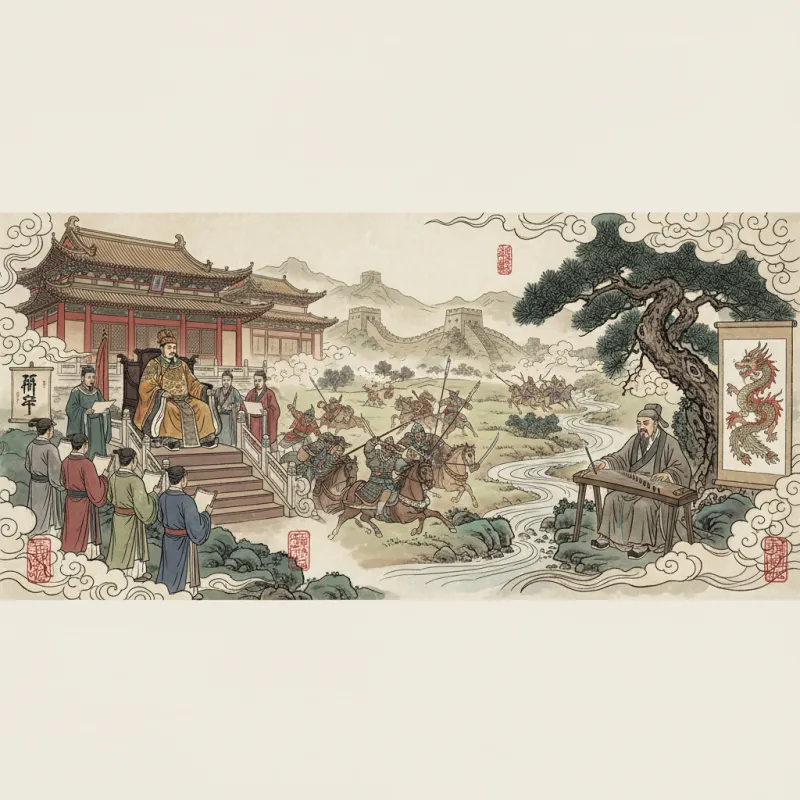
When Emperor Qin Shi Huang ordered the burning of books and burial of scholars alive in 213 BCE, he wasn't just silencing dissent—he was attempting to erase competing legal philosophies that threatened his vision of absolute imperial law. This brutal act crystallized a tension that would define Chinese governance for two millennia: the struggle between Legalist control through harsh punishment and Confucian rule through moral example. The legal systems that emerged from this conflict weren't mere collections of statutes—they were battlegrounds where philosophy, power, and culture collided to shape one of history's most enduring civilizations.
The Legalist Revolution: When Law Became a Weapon
The Qin Dynasty (221–206 BCE) didn't invent Chinese law, but it weaponized it. Under the guidance of Chancellor Li Si, Qin Shi Huang implemented a Legalist system—法家 (fǎjiā)—that treated law as a tool of state control rather than moral guidance. Every aspect of life fell under codified regulations: farmers who failed to meet grain quotas faced mutilation, soldiers who retreated in battle were executed, and even discussing Confucian classics became a capital offense.
The Qin legal code, fragments of which were discovered in the Shuihudi tomb excavations of 1975, reveals a system of shocking precision. Punishments were graded by severity: tattooing the face, cutting off the nose, amputation of feet, castration, and finally death. What's remarkable isn't the brutality—ancient societies were universally harsh—but the bureaucratic thoroughness. The code specified exact punishments for hundreds of offenses, from improper horse care to unauthorized border crossings.
This system worked, briefly. Qin Shi Huang unified China, standardized weights and measures, and built the Great Wall. But the dynasty collapsed within fifteen years of his death, a victim of its own severity. The lesson wasn't lost on subsequent rulers: law without legitimacy breeds rebellion. The Han Dynasty's approach to governance would attempt a more sustainable balance.
The Confucian Compromise: Ritual, Morality, and Imperial Justice
When Emperor Wu of Han (r. 141–87 BCE) established Confucianism as state orthodoxy in 136 BCE, he didn't abandon law—he reframed it. The resulting synthesis, which would dominate Chinese legal thought until 1911, subordinated written statutes to ritual propriety (禮, lǐ) and moral cultivation. Law became the backup plan when moral education failed.
The Tang Code (唐律, Táng Lǜ), completed in 653 CE under Emperor Taizong, represents the pinnacle of this Confucian-Legalist fusion. Its 502 articles covered everything from treason to property disputes, but unlike the Qin code, it explicitly incorporated Confucian principles. The "Ten Abominations" (十恶, shí è)—crimes so heinous they couldn't be pardoned—included not just rebellion and treason but also "lack of filial piety" and "discord" within families. Personal morality had become a legal category.
The Tang Code's genius lay in its flexibility through analogy. When judges encountered situations not explicitly covered, they could apply punishments from similar cases, creating a common-law-like system within a statutory framework. This code was so influential that Japan, Korea, and Vietnam adopted modified versions, making it arguably the most important legal document in East Asian history.
Emperors as Lawgivers: The Divine Right to Judge
Chinese emperors weren't merely executives enforcing laws—they were the ultimate source of legal authority, the "Son of Heaven" (天子, tiānzǐ) whose will theoretically superseded all written codes. This created a paradox: how could law constrain a ruler who was himself above the law?
Emperor Taizong of Tang grappled with this question after executing his brother-in-law for treason, then regretting it. He established the principle that even imperial death sentences required three reviews and a waiting period, institutionalizing a check on his own power. His successor, Empress Wu Zetian (r. 690–705 CE)—China's only female emperor—went further, encouraging subjects to report official corruption directly to the throne through a system of complaint boxes.
Yet imperial mercy could be as arbitrary as imperial wrath. Emperor Kangxi of Qing (r. 1661–1722) once pardoned a man sentenced to death for patricide after reading his eloquent appeal, declaring that the man's literary talent proved he couldn't be truly evil. Such capriciousness reveals the fundamental instability of a system where one person's judgment could override centuries of legal precedent.
Battlefield Justice: Military Law and the Price of Defeat
Ancient Chinese military law operated under different rules than civilian codes, and nowhere was this clearer than in the treatment of defeated generals. After General Li Ling surrendered to the Xiongnu in 99 BCE, Emperor Wu ordered his entire family executed—except for the historian Sima Qian, who defended Li and was instead castrated. This punishment, meant to be worse than death for a Confucian gentleman, inadvertently gave Sima Qian time to complete the Records of the Grand Historian, China's foundational historical text.
The Battle of Fei River in 383 CE demonstrated how legal systems could collapse under military pressure. When Former Qin forces were routed by the vastly outnumbered Eastern Jin army, Emperor Fu Jiān's elaborate military regulations—which specified formations, supply chains, and command hierarchies—proved worthless against panic and poor morale. The defeat shattered the Former Qin state and proved that legal systems, however sophisticated, couldn't substitute for effective leadership.
Military law also governed the treatment of conquered peoples. After the Mongol conquest established the Yuan Dynasty (1271–1368), Kublai Khan implemented a four-tier legal system that explicitly discriminated based on ethnicity: Mongols received the lightest punishments, followed by Central Asians, northern Chinese, and finally southern Chinese. This legal apartheid, while brutal, was at least codified—a perverse form of rule of law that acknowledged different groups had different rights.
Cultural Legacy: How Ancient Law Shaped Modern China
The examination system (科举, kējǔ), established during the Sui Dynasty (581–618 CE) and perfected under the Tang, created a meritocratic path to legal and administrative power that persisted for 1,300 years. Candidates memorized Confucian classics and legal codes, then competed in grueling multi-day exams. Success meant appointment as a magistrate—a position combining judge, prosecutor, tax collector, and local administrator.
This system had profound consequences. It created a literate bureaucratic class whose authority derived from textual knowledge rather than birth or military prowess. It also meant that Chinese law remained remarkably consistent across vast distances and long time periods, as officials trained in the same texts applied similar principles from Guangzhou to Beijing.
The concept of collective responsibility (连坐, liánzuò), where families or communities bore legal liability for individual crimes, shaped Chinese social organization in ways still visible today. The baojia system, formalized during the Song Dynasty (960–1279), organized households into mutual surveillance groups where each member was responsible for reporting others' crimes. This wasn't just authoritarian control—it was a legal mechanism that made social cohesion a survival necessity.
The Paradox of Precedent: Continuity and Change
Despite dynastic cycles of rise and fall, Chinese legal principles showed remarkable continuity. The Ming Code (1397) borrowed heavily from the Tang Code written 750 years earlier. The Qing Code (1740) was essentially the Ming Code with additions. This conservatism reflected the Confucian belief that ancient sage-kings had discovered timeless principles of governance—innovation meant deviation from perfection.
Yet this apparent stasis masked constant adaptation. Local magistrates developed informal practices that diverged from official codes, creating a gap between law-in-books and law-in-action. The Qing Dynasty's "sub-statutes" (例, lì) eventually outnumbered the main code's articles by ten to one, as administrators added specific rules for new situations while maintaining the fiction of unchanging fundamental law.
This tension between continuity and adaptation mirrors broader patterns in Chinese philosophical approaches to governance. The legal system's genius wasn't rigid consistency but flexible application of core principles—a pragmatism that allowed ancient codes to govern modern situations.
Conclusion: The Long Shadow of Imperial Law
When the Qing Dynasty fell in 1911, it ended not just an empire but a legal tradition stretching back millennia. Yet ancient Chinese legal concepts didn't disappear—they transformed. The emphasis on social harmony over individual rights, the preference for mediation over litigation, the assumption that law serves state interests rather than constraining them—these ideas, forged in battles between Legalists and Confucians, still shape Chinese legal culture today.
The ancient Chinese never developed the Western concept of law as a check on sovereign power, but they created something equally sophisticated: a system where ritual, morality, and statute intertwined to govern the world's largest population across its longest continuous civilization. Understanding this legacy isn't just historical curiosity—it's essential for comprehending how a quarter of humanity thinks about justice, authority, and the proper relationship between individual and state. The emperors are gone, but their legal philosophy endures, adapted but recognizable, in the world's most populous nation.
Related Reading
- The Grand Canal: China Greatest Engineering Project
- Unveiling the Role of Women in Ancient Chinese Dynasties
- Delving into Ancient China: A Journey Through Dynasties, Emperors, and Cultural Treasures