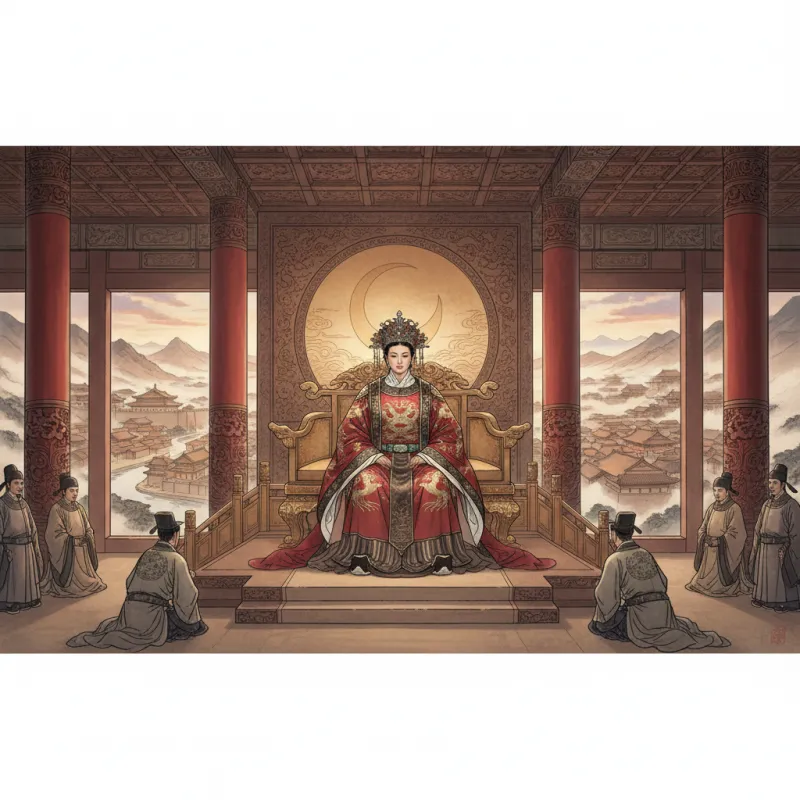
She entered the imperial palace at fourteen as a low-ranking concubine, destined to fade into obscurity like thousands of women before her. Sixty-seven years later, she died as the Son of Heaven — the only woman in Chinese history to claim that title for herself. Wu Zetian (武則天, Wǔ Zétiān, 624–705 CE) didn't just break the rules. She rewrote them, declared herself emperor of her own dynasty, and governed one of the most powerful empires on earth for over two decades. In a civilization where Confucian scholars used the phrase "hens crowing at dawn" (牝雞司晨, pìnjī sīchén) as shorthand for cosmic disorder, Wu Zetian made the hen's crow the law of the land.
The Concubine Who Wouldn't Disappear
Wu Zhao — her birth name — entered Emperor Taizong's harem in 638 CE as a fifth-rank concubine, a cairen (才人). The position was respectable but unremarkable. Most women at this level served, bore children if fortunate, and vanished from history. Wu had other plans. She caught Taizong's attention not through beauty alone but through literacy and political acumen — rare qualities the emperor valued. She studied statecraft, observed court politics, and positioned herself strategically.
When Taizong died in 649 CE, Wu faced the standard fate of childless imperial concubines: lifelong confinement in a Buddhist convent. But she had already cultivated a relationship with Taizong's son, the crown prince Li Zhi. Within a year of his father's death, the new Emperor Gaozong summoned Wu back to the palace, scandalizing the court. Technically, she was now his father's widow — the relationship bordered on incest by Confucian standards. Gaozong didn't care. Neither did Wu.
The Empress Who Eliminated Her Rivals
Wu's return ignited a vicious power struggle with Empress Wang and the emperor's favored concubine, Consort Xiao. The historical accounts of what happened next are contested and likely exaggerated by Wu's enemies, but the outcome is undisputed: by 655 CE, both women were deposed, imprisoned, and dead. Wu became Empress Wu.
The most notorious accusation claims Wu strangled her own infant daughter and framed Empress Wang for the murder. Whether true or propaganda, it reveals how Wu's enemies portrayed her — as a woman willing to sacrifice anything for power. What's certain is that Wu understood palace politics as blood sport and played to win. She systematically eliminated rivals, promoted loyalists, and expanded her influence over the increasingly frail Emperor Gaozong, who suffered from debilitating illnesses throughout his reign.
By the 660s, Wu wasn't just empress — she was co-ruler. She sat behind a screen during imperial audiences, issued edicts, made appointments, and directed policy. When Gaozong proposed abdicating in her favor in 664 CE, his ministers blocked it. Wu waited. She had learned patience in the convent.
The Emperor in Everything But Name
After Gaozong's death in 683 CE, Wu placed her son Li Zhe on the throne as Emperor Zhongzong. He lasted six weeks before Wu deposed him for "disrespect" — he had suggested appointing his wife's father to high office without consulting her. She replaced him with another son, Li Dan (Emperor Ruizong), who understood his role: sit quietly while mother rules.
For the next seven years, Wu governed as empress dowager, the traditional role for powerful women in Chinese politics. But Wu had never been interested in tradition. In 690 CE, at age sixty-six, she forced Ruizong to abdicate and declared herself huangdi (皇帝), Emperor — not empress regnant, not female emperor, but Emperor, using the masculine title without qualification. She proclaimed a new dynasty, the Zhou (周, Zhōu), interrupting the Tang Dynasty that had ruled since 618 CE.
The symbolism was radical. Wu created new Chinese characters, including a new character for her name. She elevated Buddhism over Confucianism, patronizing temples and commissioning the massive Longmen Grottoes. She promoted officials based on merit through expanded civil service examinations, breaking the aristocratic monopoly on power. She established the Magnificent Hall (明堂, Míngtáng), a ritual center where she performed imperial sacrifices traditionally reserved for male emperors.
The Reign: Competence and Cruelty
Wu's critics — and there were many — portrayed her reign as a nightmare of secret police, false accusations, and political purges. They weren't entirely wrong. Wu employed a network of informants and ruthlessly eliminated threats, real or perceived. The Comprehensive Mirror in Aid of Governance (資治通鑒, Zīzhì Tōngjiàn), compiled centuries later, describes her reign as a period of terror where officials lived in constant fear.
But the historical record also shows something inconvenient for Wu's detractors: the empire prospered. She maintained the territorial gains of the early Tang, kept the borders secure, and presided over continued economic growth. She expanded the examination system, creating opportunities for talented men from non-aristocratic backgrounds — men who owed their positions to her, not to hereditary privilege. She promoted capable administrators regardless of their family connections, a meritocratic approach that strengthened imperial governance.
Agricultural production increased. Trade flourished. The capital Chang'an remained the world's largest and most cosmopolitan city. Wu's reign wasn't a golden age, but neither was it the catastrophe her enemies claimed. She governed competently, if brutally — much like many male emperors before and after her.
The Lovers and the Scandal
Wu's personal life provided endless ammunition for her critics. After Gaozong's death, she took lovers openly, most notoriously the Zhang brothers, Zhang Yizhi and Zhang Changzong. The brothers were young, handsome, and politically ambitious. Wu showered them with titles and influence, and court gossips whispered that she used cosmetics and potions to maintain her vitality into her seventies.
Confucian historians treated Wu's sexuality as evidence of moral corruption — a woman in power, they argued, inevitably succumbs to base desires. But male emperors had maintained harems of hundreds of women for centuries without similar moral panic. The double standard was obvious. Wu's crime wasn't having lovers; it was having them while wielding supreme power.
The Zhang brothers' influence eventually triggered Wu's downfall. In 705 CE, a group of officials, including Wu's own son Li Xian, staged a coup. They killed the Zhang brothers and forced the eighty-year-old Wu to abdicate. She died later that year, and her son restored the Tang Dynasty, erasing the Zhou interregnum from official chronology.
The Wordless Stele
Wu Zetian was buried beside Emperor Gaozong in the Qianling Mausoleum. At the tomb's entrance stands her memorial stele — completely blank. No inscription, no epitaph, no official assessment of her reign. Historians debate whether Wu ordered the blank stele herself, acknowledging that her legacy was too controversial for words, or whether her successors left it blank, unable to praise her without legitimizing female rule or condemn her without insulting their own grandmother.
The blank stele is perfect. It invites every generation to write its own judgment. Traditional Confucian historians portrayed Wu as a usurper, a murderer, and a cautionary tale about women in power. Modern scholars see a capable administrator who challenged gender hierarchies and governed effectively despite systematic opposition. Feminist readings celebrate her as a woman who refused to accept the limitations her society imposed.
All these interpretations contain truth. Wu Zetian was ruthless, ambitious, and willing to destroy anyone who threatened her power — qualities that would be called "strong leadership" in a male emperor but became evidence of feminine monstrosity in her. She was also intelligent, politically skilled, and administratively competent. She didn't just survive in a system designed to exclude her; she conquered it.
The Legacy: One Woman, No Successors
Wu Zetian's most striking legacy is its singularity. In the 1,200 years of imperial history after her death, no other woman claimed the title of emperor. Empress dowagers wielded power — most notably Empress Dowager Cixi in the late Qing Dynasty — but always as regents, never as emperors in their own right. Wu's example didn't open doors for other women; it seemed to seal them shut. Her reign became the proof text for why women shouldn't rule: look what happened when one did.
But Wu's story endures because it reveals the contingency of power structures that present themselves as natural and inevitable. The Confucian order that subordinated women wasn't a law of nature — it was a human construction, and Wu demonstrated that human constructions can be dismantled by someone sufficiently determined and skilled. She didn't need to be perfect to be significant. She just needed to prove it was possible.
The blank stele still stands at Qianling, waiting for each generation to inscribe its own verdict. Wu Zetian remains what she always was: impossible to ignore, impossible to categorize, and absolutely impossible to forget.
Related Reading
- Qin Shi Huang: The First Emperor Who Created China
- Kangxi: The Longest-Reigning Emperor
- The Kangxi Emperor: China's Longest-Reigning and Greatest Ruler
- The Legacy of Chinese Emperors: Dynasties, Power, and Cultural Influence
- The Influential Emperors of Ancient China: Dynasties, Battles, and Cultural Impact
- The Hundred Schools of Thought: China's Golden Age of Philosophy
- Diplomacy and Cultural Exchange in Chinese Ancient Dynasties
- Unveiling the Role of Women in Ancient Chinese Dynasties