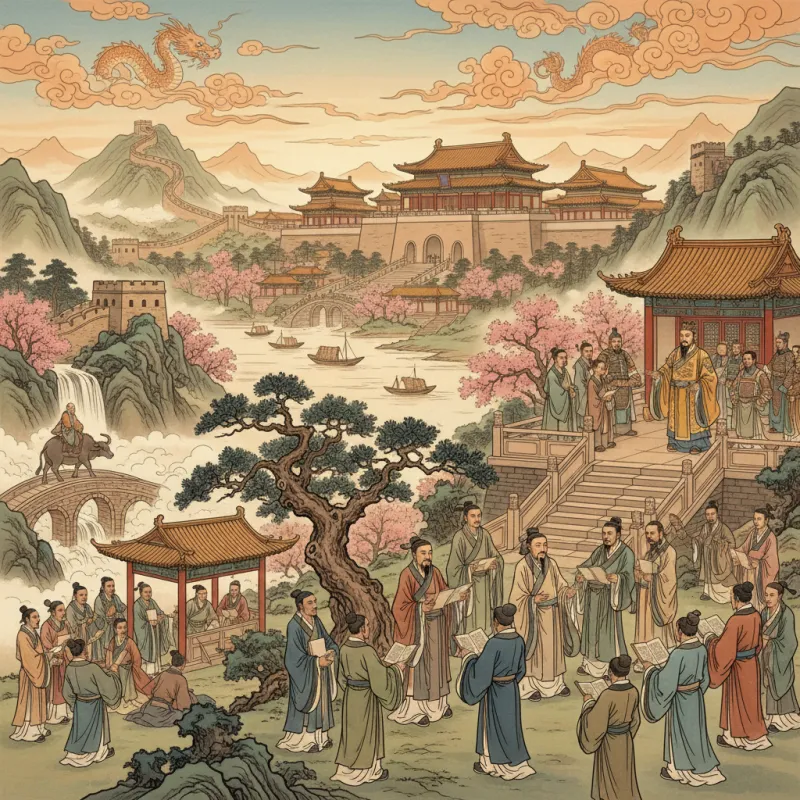
Imagine a world where philosophers weren't dusty academics but political consultants, traveling from kingdom to kingdom pitching their ideas like venture capitalists pitch startups. Where a good argument could win you a ministerial position, and a bad one might get you exiled — or worse. This was China between 770 and 221 BCE, an era so intellectually explosive that we're still arguing about the ideas born then.
The Chinese call it the Hundred Schools of Thought (百家争鸣 bǎijiā zhēngmíng, literally "a hundred schools contending"). The number is poetic hyperbole, but the intellectual chaos was real. During the Spring and Autumn period (770-476 BCE) and the Warring States period (476-221 BCE), China fractured into dozens of competing kingdoms, each desperate for any edge — military, economic, or ideological — that might help them survive. Into this power vacuum stepped the philosophers, and they had opinions about everything.
The Chaos That Bred Brilliance
Here's the paradox: the Hundred Schools emerged precisely because the Zhou Dynasty was collapsing. When the Zhou king lost real authority around 770 BCE, the old feudal order crumbled. Suddenly, merit mattered more than birth. A peasant's son with a clever tongue could advise kings. A minor official with radical ideas could reshape a state's policies.
This wasn't just political fragmentation — it was the death of certainty itself. The old ritual order, where everyone knew their place and the ancestors watched over everything, had failed to prevent catastrophe. If the traditional ways couldn't save China from tearing itself apart, maybe something new could. Every wandering scholar became a potential savior, every philosophical system a possible solution to the crisis.
The result was intellectual competition on a scale rarely seen in history. Confucians debated Mohists in public squares. Legalists mocked Daoists at court. The School of Names tied everyone in logical knots. It was messy, contentious, and absolutely brilliant.
The Major Players
Confucianism (儒家 Rújiā) wasn't originally called that — it was just "the school of scholars." Confucius (551-479 BCE) himself was a failed politician who spent his life trying to convince rulers to govern through virtue and ritual propriety (礼 lǐ) rather than force. He believed human nature was perfectible through education and that society needed a moral hierarchy where everyone fulfilled their role with sincerity. His followers, especially Mencius (372-289 BCE) and Xunzi (310-235 BCE), would spend centuries arguing about whether humans were naturally good or naturally selfish — a debate that still hasn't been settled.
Daoism (道家 Dàojiā) took the opposite approach. Where Confucians wanted to fix society through better government and education, Daoists like Laozi and Zhuangzi argued that most human problems came from trying too hard to fix things. The Dao (道, "the Way") couldn't be captured in rules or rituals — it was the natural pattern underlying everything, and the wise person learned to flow with it rather than against it. Zhuangzi's writings are full of stories about useless trees that survive because no one wants to cut them down, and cripples who avoid military service. His message: sometimes weakness is strength, and the best government is the one that governs least.
Mohism (墨家 Mòjiā) was the radical egalitarian movement that history mostly forgot. Mozi (470-391 BCE) preached "universal love" (兼爱 jiān'ài) — the idea that you should care about strangers' children as much as your own. He opposed Confucian ritual as wasteful, condemned offensive warfare as murder, and organized his followers into a quasi-military organization that would literally defend cities under attack. For a while, Mohism was as influential as Confucianism. Then it vanished, possibly because its demands were too extreme, possibly because Legalism stole its organizational techniques while dropping the compassion.
Legalism (法家 Fǎjiā) was the school that actually won — at least in the short term. Legalists like Han Feizi (280-233 BCE) had no patience for Confucian virtue or Daoist spontaneity. They believed humans were fundamentally selfish and would only behave if laws were clear, punishments were harsh, and rewards were certain. The state of Qin used Legalist principles to build the most efficient war machine in Chinese history, eventually conquering all rivals and establishing the Qin Dynasty in 221 BCE. The cost was brutal: book burnings, mass executions, and a totalitarian state that collapsed within fifteen years of its founding.
The Weird and Wonderful
Beyond the big four, the Hundred Schools included some genuinely strange traditions. The School of Names (名家 Míngjiā) was obsessed with logic puzzles and paradoxes — their most famous proposition was "a white horse is not a horse," which sounds absurd until you realize they're making a sophisticated point about the relationship between categories and particulars.
The Yin-Yang school (阴阳家 Yīnyángjiā) tried to explain everything through complementary opposites and the Five Phases (wood, fire, earth, metal, water). While their cosmology seems mystical to modern eyes, they were actually trying to create a systematic natural philosophy, a way to predict and understand change.
The Agriculturalists (农家 Nóngjiā) believed rulers should literally work in the fields alongside peasants. The Strategists (兵家 Bīngjiā) wrote military treatises like Sun Tzu's Art of War that are still studied today. There were even the Eclectics (杂家 Zájiā), who tried to synthesize the best ideas from all schools — the ancient Chinese equivalent of "why can't we all just get along?"
The Great Debate: Human Nature
If there's one question that obsessed the Hundred Schools, it was this: what are humans really like, deep down? Your answer determined everything else about your philosophy.
Mencius insisted humans were naturally good — we all have innate compassion, we just need to cultivate it. He pointed to how everyone instinctively rushes to save a child about to fall into a well. That impulse, he argued, was proof of our moral nature.
Xunzi, also a Confucian, completely disagreed. Humans are naturally selfish, he said. We need ritual, education, and social pressure to become good. Left to our own devices, we'd tear each other apart.
The Legalists agreed with Xunzi's diagnosis but rejected his cure. Why bother with slow, uncertain education when you could just make the penalties for bad behavior so severe that people behaved out of fear?
The Daoists thought the whole debate was missing the point. Humans aren't naturally good or bad — we're naturally natural. It's society, with all its artificial rules and hierarchies, that corrupts us. Return to simplicity, stop trying to improve everything, and we'd be fine.
Why It Ended
The Hundred Schools died the way they were born — through political change. When Qin Shi Huang unified China in 221 BCE, he had no patience for philosophical debate. The First Emperor wanted uniformity: one script, one currency, one set of laws, one approved ideology. In 213 BCE, he ordered the burning of books that didn't serve the state's interests. Confucian scholars who protested were reportedly buried alive.
The Qin Dynasty's brutality discredited Legalism, but the damage was done. The intellectual diversity of the Warring States period never fully returned. The Han Dynasty (206 BCE - 220 CE) eventually made Confucianism the official state ideology, and while Daoism survived as both philosophy and religion, most other schools faded into obscurity.
The Legacy
Yet the Hundred Schools' influence never really ended. Every major debate in Chinese intellectual history — about government, ethics, human nature, the relationship between individual and society — traces back to arguments first made during those chaotic centuries. When Neo-Confucians in the Song Dynasty (960-1279 CE) tried to revitalize their tradition, they borrowed heavily from Daoist and Buddhist metaphysics. When modern Chinese reformers criticized traditional culture, they were often reviving Legalist or Mohist critiques of Confucianism.
The Hundred Schools proved that intellectual diversity isn't a luxury — it's what happens when smart people are free to disagree, when political fragmentation creates space for competing ideas, when the old certainties have collapsed and everything is up for debate. We remember this period not despite the chaos but because of it. Sometimes you need the world to fall apart before you can think clearly about how to put it back together.
The tragedy is that China's rulers learned the wrong lesson. Instead of seeing the Hundred Schools as proof that diversity breeds brilliance, they saw it as dangerous disorder that needed to be suppressed. For the next two thousand years, Chinese governments would try to enforce ideological uniformity, and Chinese culture would be poorer for it. The Hundred Schools had their moment, and then the door closed. We're still wondering what might have happened if it had stayed open.
Related Reading
- Confucius vs. Laozi: The Debate That Shaped Chinese Civilization
- Exploring the Philosophical Legacy of China’s Ancient Dynasties
- Mohism: The Lost Philosophy of Universal Love
- Chinese Philosophy in Five Minutes: Confucius, Laozi, and the Arguments That Shaped a Civilization
- Legalism and the Qin Dynasty: When Ruthless Efficiency Built an Empire
- Exploring the Rich Tapestry of Ancient Chinese History and Culture
- Chinese Architecture: Forbidden Cities, Pagodas, and Garden Design
- Ancient Chinese Law: When Justice Was Personal and Punishment Was Public