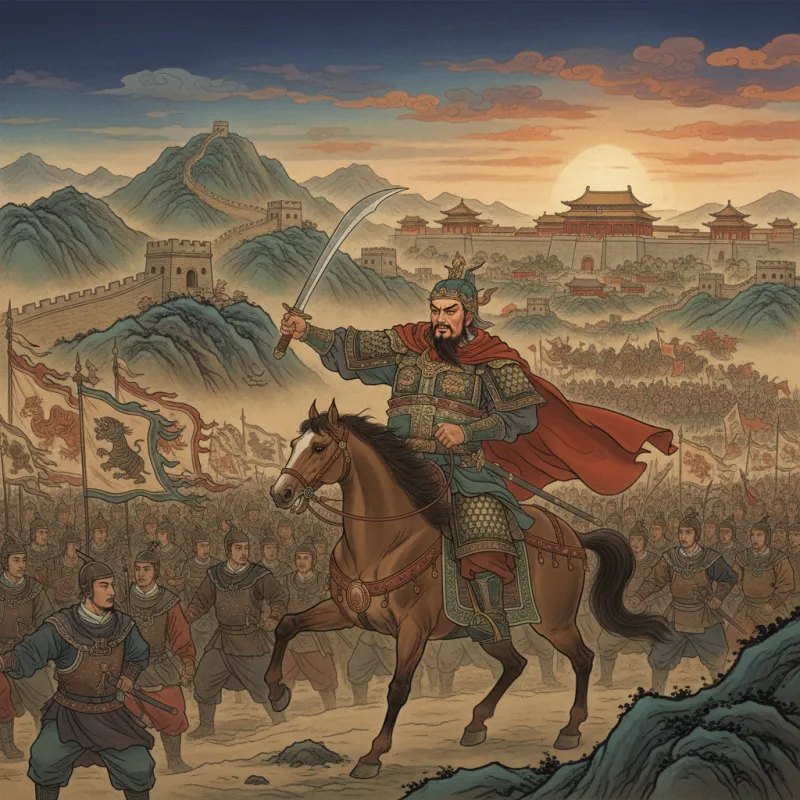
The year is 138 BCE. A twenty-something emperor sits in his palace in Chang'an, listening to a man describe cities he's never seen. Zhang Qian has just returned from a failed diplomatic mission to Central Asia — captured, imprisoned for a decade, escaped — but he brings back something more valuable than any treaty: knowledge of a world beyond China's borders. Emperor Wu of Han (汉武帝 Hàn Wǔdì) leans forward. Within months, he'll launch the expeditions that create the Silk Road. Within decades, he'll transform a regional power into an empire that defines what "Chinese" means for the next two millennia.
The Inheritance Problem
When Wu took the throne in 141 BCE at fifteen, he inherited a paradox. His great-great-grandfather Liu Bang had founded the Han Dynasty (汉朝 Hàn Cháo) in 206 BCE by overthrowing the brutal Qin, but the early Han emperors were terrified of repeating Qin's mistakes. They practiced 无为而治 (wúwéi ér zhì, "governing through non-action"), a Daoist-influenced hands-off approach that let regional kings accumulate dangerous amounts of power.
By Wu's time, these vassal kingdoms controlled more territory than the emperor himself. His grandmother, Empress Dowager Dou, championed the old Daoist policies and blocked any reforms. Wu spent his first years as emperor essentially powerless, watching elderly advisors debate philosophy while the empire's centrifugal forces grew stronger.
Then Empress Dowager Dou died in 135 BCE. Wu was twenty-one. The real reign began.
The Confucian Revolution
Wu's first major decision reshaped Chinese civilization: he made Confucianism the state ideology. This wasn't obvious or inevitable. For centuries, Chinese courts had been intellectually diverse, with Daoists, Legalists, and various other schools competing for influence. The First Emperor of Qin had famously burned Confucian books and buried Confucian scholars alive.
Wu took the opposite approach. In 136 BCE, he established the 太学 (Tàixué, Imperial Academy) to train officials exclusively in Confucian classics. He created a system where government positions required mastery of texts like the Analects and the Book of Rites. Within a generation, Confucian scholars dominated the bureaucracy.
This wasn't about personal piety — Wu himself was hardly a model Confucian gentleman. He was superstitious, obsessed with immortality, and spent fortunes on shamans and alchemists. But he understood that Confucianism provided something the empire desperately needed: an ideology of centralized authority wrapped in the language of moral virtue. Confucian scholars taught that the emperor was the Son of Heaven, that loyalty to the ruler was a cosmic principle, that hierarchy and ritual maintained universal order.
The 科举 (kējǔ, civil service examination) system wouldn't be fully developed until the Sui Dynasty, but Wu laid its foundation. For the first time, you could rise to power in China not through birth or military prowess, but through mastering a specific body of texts. This created a scholar-official class whose loyalty was to the imperial system itself — because that system was the source of their status.
The Xiongnu Problem
The northern frontier was bleeding. For decades, the Xiongnu (匈奴 Xiōngnú) — a confederation of nomadic peoples — had raided Chinese settlements, demanding tribute, humiliating Han emperors. Early Han policy was appeasement: send silk, grain, and occasionally a princess, and hope they'd stay quiet.
Wu decided to end this. In 133 BCE, he launched the first of many campaigns against the Xiongnu. These weren't border skirmishes — they were massive military expeditions involving hundreds of thousands of troops, pushing deep into the steppes. His general Wei Qing and Wei's nephew Huo Qubing became legendary for their cavalry tactics, learning to fight the Xiongnu on their own terms.
The campaigns were staggeringly expensive. Wu emptied the treasury, debased the currency, imposed new taxes, and established state monopolies on salt and iron to fund the wars. Critics argued he was bankrupting the empire for military glory. They weren't entirely wrong — by the end of his reign, the Han economy was in crisis.
But Wu achieved his strategic goal. By 119 BCE, the Xiongnu confederation was broken, its leadership in disarray, its people scattered. Chinese military colonies dotted the Hexi Corridor (河西走廊 Héxī Zǒuláng), securing the route to Central Asia. The northern frontier would remain contested for centuries, but never again would the Xiongnu pose an existential threat to Chinese civilization.
Opening the Silk Road
Zhang Qian's journey to the Western Regions (西域 Xīyù) was supposed to be a diplomatic mission to form an alliance against the Xiongnu. It failed spectacularly — he was captured almost immediately and spent ten years as a Xiongnu prisoner. But when he finally returned to Chang'an in 126 BCE, he brought detailed reports of the kingdoms of Central Asia: Ferghana with its "heavenly horses," Bactria with its Hellenistic cities, Parthia with its connections to Rome.
Wu saw opportunity. If he couldn't defeat the Xiongnu through direct military force alone, he'd outflank them economically and diplomatically. He sent Zhang Qian back west with a larger expedition. He dispatched envoys to dozens of Central Asian kingdoms. He established military garrisons and trading posts along what would become the Silk Road (丝绸之路 Sīchóu zhī Lù).
The economic impact was transformative. Chinese silk became the luxury good of the ancient world, traded as far as Rome. In return, China received horses from Ferghana (crucial for cavalry warfare), jade from Khotan, and eventually Buddhism from India. The Silk Road wasn't just a trade route — it was a cultural transmission belt that would shape Chinese civilization for centuries.
Wu himself was obsessed with the "heavenly horses" of Ferghana, believing they were supernatural creatures that could help him achieve immortality. He launched a military expedition in 104 BCE specifically to acquire them — one of history's most expensive horse-buying trips. The campaign was a logistical nightmare, but it demonstrated Han power projection across thousands of miles and secured the Silk Road's western terminus.
The Cost of Glory
By the end of Wu's reign, the Han Empire stretched from Korea to Vietnam, from the Pacific to Central Asia. It was the largest Chinese state that had ever existed, rivaling Rome in size and sophistication. The ethnic majority of China still calls itself 汉族 (Hànzú, the Han people). The Chinese language is 汉语 (Hànyǔ). Chinese characters are 汉字 (Hànzì). This isn't coincidence — it's because Wu's reign defined what "Chinese" meant.
But the empire was exhausted. Decades of warfare had drained the treasury and depopulated entire regions. Wu's state monopolies and heavy taxation had created resentment among merchants and peasants alike. His paranoia in old age led to purges and witch hunts, including the tragic suicide of his crown prince in 91 BCE.
In 89 BCE, two years before his death, Wu issued the 轮台罪己诏 (Lúntái Zuìjǐ Zhào, Edict of Self-Blame at Luntai), acknowledging his mistakes and calling for a return to lighter governance. It's one of the most remarkable documents in Chinese history — an emperor at the height of his power admitting he'd pushed too hard, cost too much, demanded too much of his people.
The Warrior Emperor's Legacy
Wu died in 87 BCE after fifty-four years on the throne — the longest reign of any Han emperor. His immediate successors spent decades recovering from his military adventures and fiscal policies. But his institutional innovations endured.
The Confucian bureaucracy he created lasted until 1905. The Silk Road he opened remained the primary conduit between East and West for over a millennium. The territorial extent he achieved became the template for Chinese imperial ambitions. Even the Tang Dynasty emperors, seven centuries later, measured their success against Wu's conquests.
Was he a great emperor? By traditional Chinese standards — territorial expansion, institutional innovation, cultural legacy — absolutely. He transformed a regional power into a world empire and created the ideological framework that would define Chinese civilization. The fact that we call the Chinese people "Han" is his most lasting monument.
Was he a good emperor? That's harder to answer. His wars killed hundreds of thousands. His policies impoverished millions. His paranoia destroyed families, including his own. He achieved greatness through methods that caused immense suffering.
Perhaps that's the point. Wu understood that building an empire requires more than virtue — it requires vision, ruthlessness, and the willingness to pay terrible costs for lasting achievements. He created Chinese identity not through benevolence but through conquest, not through wisdom but through will. Two thousand years later, we're still living in the world he made.
Related Reading
- China's Most Fascinating Emperors: The Brilliant, the Mad, and the Unexpected
- The Kangxi Emperor: China's Longest-Reigning and Greatest Ruler
- Wu Zetian: China's Only Female Emperor
- Qin Shi Huang: The First Emperor Who Created China
- Kangxi: The Longest-Reigning Emperor
- Ancient Chinese Dynasties and Emperors: Legal Systems, Battles, and Cultural Legacy
- The Imperial Examination: Meritocracy in Ancient China
- Confucius vs. Laozi: The Debate That Shaped Chinese Civilization