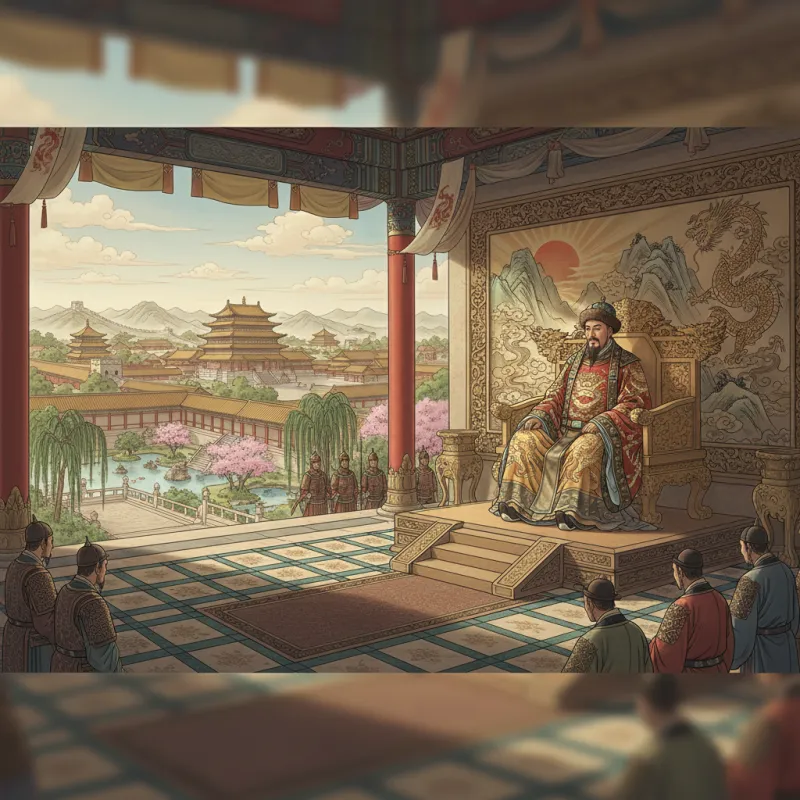
At seven years old, most children are learning to read. At seven, Xuanye was learning to rule an empire of 150 million people. The year was 1661, and the boy who would become the Kangxi Emperor had just inherited the Dragon Throne from his father, who'd died of smallpox at twenty-three. The Manchu conquest of China was barely complete, the realm was fractured by rebellion, and four powerful regents stood between the child and actual power. What happened next would determine whether the Qing Dynasty became a footnote in history or China's last and longest imperial age.
Sixty-one years later, when Kangxi died in 1722, he had transformed that precarious inheritance into the largest, most prosperous empire on earth. His reign remains the longest of any Chinese emperor — a record that will never be broken, since there are no more emperors. But longevity alone doesn't make greatness. What makes Kangxi exceptional is what he accomplished during those six decades: crushing the most dangerous rebellion in Qing history, personally leading military campaigns that doubled the empire's territory, mastering both Confucian classics and Western calculus, and establishing a template of governance that would sustain the Qing for another two centuries.
The Regency and the Coup
The Qing Dynasty (清朝 Qīng Cháo, 1644–1912) was still a foreign occupation when Kangxi took the throne. The Manchus had conquered China only seventeen years earlier, and many Han Chinese viewed them as barbarians. Kangxi's father, the Shunzhi Emperor, had died suddenly, leaving the empire in the hands of four regents led by the formidable Oboi, a military strongman who'd helped conquer China and had no intention of surrendering power to a child.
For eight years, young Xuanye played the role of puppet emperor while Oboi consolidated control. The regent purged rivals, seized land, and ruled with increasing brutality. But Kangxi was studying — not just the Confucian classics expected of an emperor, but the art of survival. He practiced Manchu wrestling and archery. He memorized the faces and loyalties of every official at court. And he waited.
In 1669, at age fifteen, Kangxi struck. He'd been training a group of young wrestlers and guards, boys his own age whom Oboi dismissed as the emperor's playmates. When Oboi arrived for an audience, these "playmates" seized him. Kangxi charged him with twenty-four crimes and had him imprisoned. The regency was over. The reign had begun.
This wasn't just a palace coup — it was a declaration. Kangxi had announced that he would be no figurehead, no ceremonial emperor content to let others govern. He would rule, personally and absolutely, for the next fifty-three years.
The Revolt of the Three Feudatories
The greatest test came just four years later. In 1673, three powerful Chinese generals who'd helped the Manchus conquer the south — Wu Sangui, Shang Kexi, and Geng Jingzhong — controlled vast territories as semi-independent feudatories (藩 fān). They commanded their own armies, collected their own taxes, and ruled like kings. When Kangxi moved to abolish these feudatories and bring the south under direct imperial control, Wu Sangui rebelled.
This was no minor uprising. Wu Sangui had been one of China's greatest generals — he'd opened the gates at Shanhai Pass that let the Manchus into China in the first place. Now he declared himself emperor of a new Zhou Dynasty and marched north with 100,000 troops. Within months, the other feudatories joined him, and the rebellion controlled eight provinces covering half of China.
Many at court urged Kangxi to negotiate, to compromise, to buy peace. He refused. For eight years, from 1673 to 1681, the Revolt of the Three Feudatories (三藩之乱 Sānfān zhī Luàn) consumed the empire. Kangxi personally directed strategy, appointed commanders, managed logistics, and maintained the loyalty of wavering generals. When Wu Sangui died in 1678, his grandson continued the fight. But Kangxi's patience and strategic acumen prevailed. By 1681, the rebellion was crushed, the feudatories abolished, and the south finally integrated into the empire.
The victory established Kangxi's reputation as a military strategist and proved that the Qing Dynasty could survive its greatest internal threat. More importantly, it demonstrated that a Manchu emperor could command the loyalty of Han Chinese generals and officials — a crucial step in legitimizing foreign rule.
Conquest and Consolidation
With the south secured, Kangxi turned to the borders. In 1683, his forces conquered Taiwan, ending the last Ming loyalist holdout under the Zheng family. This wasn't just symbolic — it brought the island into the Chinese empire for the first time in history, establishing a claim that would echo through centuries.
But Kangxi's most ambitious campaigns targeted the north and west. The Dzungar Khanate, a powerful Mongol confederation, threatened the empire's northwestern frontier and controlled Tibet. Between 1690 and 1697, Kangxi personally led three major expeditions into Mongolia, commanding armies in the field like no emperor had done in centuries. At the Battle of Jao Modo in 1696, he defeated the Dzungar khan Galdan, securing Outer Mongolia and establishing Qing dominance over the steppe.
These weren't just military victories — they were acts of imperial expansion that transformed China's geography. Kangxi pushed the empire's borders to include Mongolia, Tibet, and Xinjiang, creating the territorial framework that defines China today. The Qing Empire under Kangxi became larger than any previous Chinese dynasty, and he achieved this through a combination of military force, diplomatic marriage alliances, and strategic patience.
Compare this to his contemporary, Louis XIV of France, who reigned from 1643 to 1715. The Sun King built Versailles and claimed absolute power, but his wars of expansion largely failed and left France exhausted. Kangxi, ruling an empire ten times larger, achieved far more lasting territorial gains while maintaining internal stability and economic prosperity.
The Scholar Emperor
What makes Kangxi truly exceptional is that he wasn't just a warrior — he was perhaps China's most intellectually curious emperor. He rose at dawn every day to read memorials and study. He mastered classical Chinese despite Manchu being his native language. He could quote the Confucian classics from memory and write poetry in multiple styles.
But his intellectual interests extended far beyond traditional Chinese learning. When Jesuit missionaries arrived at court, Kangxi welcomed them as teachers. He studied Euclidean geometry with Ferdinand Verbiest, learned to calculate eclipses, and mastered Western astronomy. He commissioned the Jesuits to survey and map the entire empire using Western cartographic techniques — the resulting maps were the most accurate of China ever produced.
This wasn't mere dilettantism. Kangxi understood that knowledge was power, and he was willing to learn from anyone, even foreign barbarians, if they had something useful to teach. He once told the Jesuits: "I have never let a day pass without devoting some time to study." This from a man who ruled 150 million people and personally reviewed thousands of official documents each month.
His greatest scholarly achievement was commissioning the Kangxi Dictionary (康熙字典 Kāngxī Zìdiǎn), completed in 1716. This massive work catalogued 47,035 Chinese characters — it remained the standard reference for two centuries and is still consulted today. He also sponsored the compilation of an encyclopedia of Chinese knowledge, a complete library of classical texts, and numerous other scholarly projects that preserved and systematized Chinese learning.
The Art of Governance
Kangxi's administrative reforms shaped Chinese governance for the next two centuries. He perfected the palace memorial system (奏折 zòuzhé), which allowed officials to report directly to him in secret, bypassing the regular bureaucracy. This gave him unprecedented information and control — he could know what was happening in the remotest province and respond immediately.
He conducted six major inspection tours of the south, traveling thousands of miles to see conditions firsthand, meet with local officials, and show himself to the people. No emperor since the early Ming had done this. These tours weren't ceremonial — Kangxi inspected flood control projects, reviewed tax records, dismissed corrupt officials, and promoted capable ones. He understood that effective rule required personal knowledge, not just reports from ministers.
His tax policies were remarkably enlightened for the era. In 1712, he froze the head tax at current population levels, declaring that any future population growth would not increase tax burdens. This encouraged accurate census reporting and population growth — China's population would double during the Qing Dynasty, partly because of this policy.
He also navigated the delicate balance between Manchu and Han Chinese interests. The Qing maintained the Eight Banners military system and reserved certain positions for Manchus, but Kangxi appointed capable Han Chinese to high office, patronized Chinese culture, and presented himself as a Confucian sage-king. This dual identity — Manchu warrior and Chinese emperor — allowed the Qing to rule effectively where previous conquest dynasties had failed.
The Succession Crisis
Kangxi's greatest failure was succession. In 1675, he designated his second son Yinreng as crown prince — an unusual move, since Chinese emperors typically didn't name heirs until late in their reigns. But Yinreng proved unstable and possibly mentally ill. Kangxi deposed him in 1708, reinstated him in 1709, then deposed him again in 1712.
The uncertainty created vicious competition among Kangxi's many sons. Factions formed, plots were hatched, and the court descended into intrigue. Kangxi, who'd ruled so decisively for decades, couldn't bring himself to name a new heir. When he died in 1722, his fourth son Yinzhen seized power and became the Yongzheng Emperor, though rumors persisted that he'd altered Kangxi's will or even poisoned his father.
This succession crisis would haunt the Qing Dynasty. Yongzheng's reign was marked by paranoia and purges of his brothers. The trauma of Kangxi's indecision created a pattern — future Qing emperors would keep their choice of heir secret until their deathbed, creating uncertainty and instability.
Legacy
When Kangxi died at sixty-eight, he'd ruled longer than any Chinese emperor before or since. He'd transformed a precarious Manchu conquest into a stable, prosperous empire that would last another two centuries. He'd doubled China's territory, crushed the greatest rebellion in Qing history, patronized scholarship on an unprecedented scale, and established administrative systems that would endure until 1912.
But his legacy extends beyond these achievements. Kangxi proved that a foreign dynasty could successfully rule China by mastering Chinese culture while maintaining Manchu identity. He demonstrated that an emperor could be both a warrior and a scholar, both a Confucian sage-king and a pragmatic administrator open to foreign knowledge. He showed that effective governance required personal engagement, not just ceremonial authority.
Compare him to other great Chinese emperors — Emperor Taizong of Tang, who established the Tang Dynasty's golden age, or Emperor Hongwu, who founded the Ming Dynasty. Kangxi matches them in military achievement and surpasses them in intellectual curiosity and administrative innovation. His sixty-one-year reign gave the Qing Dynasty the stability and legitimacy it needed to become China's last and longest imperial dynasty.
The Kangxi Emperor wasn't perfect — his succession crisis created lasting problems, and his later years saw some decline in vigor. But measured against the full scope of Chinese imperial history, he has the strongest claim to the title of China's greatest emperor. He inherited a fragile conquest and left a continental empire. He took the throne as a child and died as a legend. And he proved that greatness isn't just about longevity — it's about what you do with the time you're given.
Related Reading
- Wu Zetian: China's Only Female Emperor
- Qin Shi Huang: The First Emperor Who Created China
- The Influential Emperors of Ancient China: Dynasties, Battles, and Cultural Impact
- The Legacy of Chinese Emperors: Dynasties, Power, and Cultural Influence
- Wu Zetian: China's Only Female Emperor
- Unveiling the Splendor of Ancient Chinese Architecture Across Dynasties
- Delving into Ancient China: A Journey Through Dynasties, Emperors, and Cultural Treasures
- Zheng He's Treasure Fleet: When China Ruled the Seas