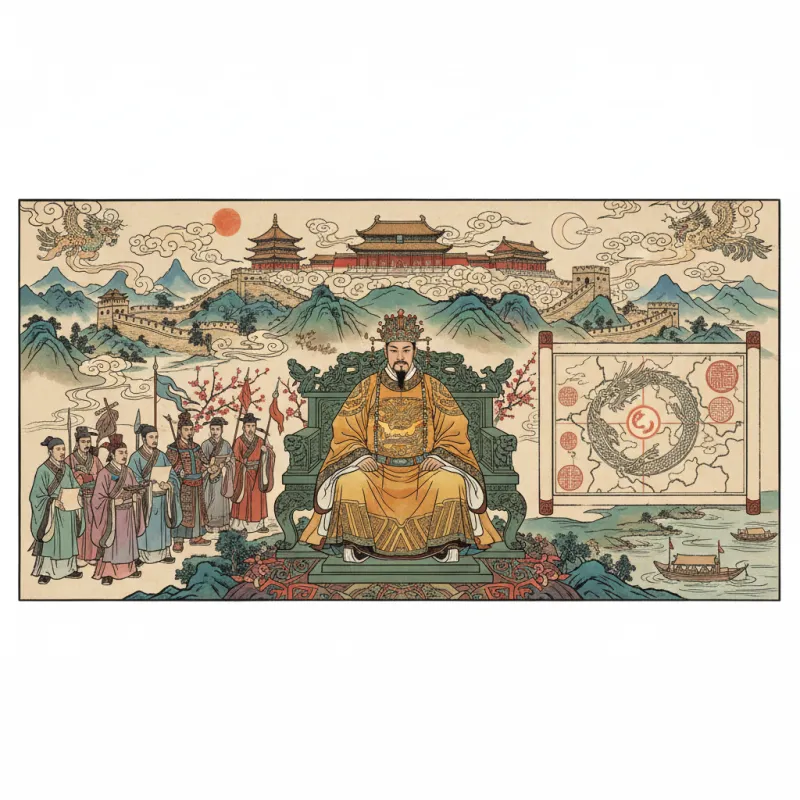
The year is 221 BCE. A 38-year-old king from the western state of Qin stands before a newly unified China, and he faces an unprecedented problem: there's no word in the Chinese language for what he's about to become. The title "wang" (王, king) suddenly feels inadequate for someone who has just conquered six rival kingdoms and brought the known world under one rule. So he invents a new title by combining two characters: "huangdi" (皇帝, emperor), borrowing "huang" from the legendary Three Sovereigns and "di" from the Five Emperors of mythology. This act of linguistic innovation would define not just his reign, but the next 2,132 years of Chinese political history.
The Mandate of Heaven: Divine Right with an Expiration Date
Unlike European monarchs who claimed divine right as an eternal, unquestionable privilege, Chinese emperors operated under a far more precarious system. The "Mandate of Heaven" (天命, tianming) was essentially a performance-based contract with the cosmos. You could be born into the imperial family, but natural disasters, military defeats, or widespread famine were interpreted as signs that Heaven had withdrawn its approval—and with it, your right to rule.
This concept, first articulated by the Zhou Dynasty (1046-256 BCE) to justify their overthrow of the Shang, created a paradox at the heart of Chinese imperial ideology. On one hand, the emperor was the "Son of Heaven" (天子, tianzi), the sole intermediary between the human and divine realms. On the other, any successful rebel could claim that Heaven had transferred its mandate to them. The system was simultaneously absolutist and revolutionary, which explains why Chinese history saw so many dynastic transitions—each one justified by the very ideology that had supported the previous regime.
The practical implications were profound. Emperors couldn't simply rule through force; they had to demonstrate cosmic approval through good governance. When the Yellow River flooded or locusts destroyed crops, it wasn't just an agricultural problem—it was a political crisis that questioned the emperor's legitimacy. This is why Chinese emperors invested heavily in flood control, granaries, and disaster relief. They weren't just being benevolent; they were protecting their mandate.
The Imperial Examination: Meritocracy or Elaborate Theater?
The civil service examination system that emerged during the Sui Dynasty (581-618 CE) and flourished under the Tang and Song represents one of the most ambitious social experiments in human history. In theory, any man—regardless of birth—could study the Confucian classics, pass the examinations, and rise to the highest levels of government. In practice, it was far more complicated.
The examinations created a scholar-official class (士大夫, shidafu) whose loyalty was theoretically to Confucian principles rather than to any particular emperor or dynasty. This had a stabilizing effect on Chinese governance—even when dynasties fell, the bureaucratic machinery continued functioning. But it also meant that emperors often found themselves in tension with their own officials, who could cite classical texts to argue against imperial policies.
Consider Emperor Wanli of the Ming Dynasty (r. 1572-1620), who essentially went on a 30-year strike, refusing to meet with his ministers or conduct routine government business. The bureaucracy continued operating without him, which tells you something about where real power resided. The examination system had created a government that could function despite the emperor, not just because of him.
Empress Wu Zetian: The Woman Who Broke Every Rule
When Wu Zetian (武則天, 624-705 CE) declared herself emperor—not empress, but emperor—of the Zhou Dynasty in 690 CE, she didn't just break the glass ceiling; she shattered the entire Confucian cosmological order. Confucian ideology held that women ruling was as unnatural as "a hen crowing at dawn," yet Wu ruled for fifteen years and, by most objective measures, did it well.
Her path to power reads like a political thriller. Starting as a low-ranking concubine to Emperor Taizong, she became the empress to his son, Emperor Gaozong, then ruled as regent, and finally took the throne herself. She eliminated rivals ruthlessly—including her own daughter, according to traditional accounts—and established an extensive secret police network. But she also promoted officials based on merit rather than aristocratic birth, expanded the examination system, and presided over a period of relative peace and prosperity.
The historical treatment of Wu Zetian reveals the deep ambivalence in Chinese culture about female power. Confucian historians portrayed her as a usurper and a monster, yet they couldn't deny her administrative competence. Modern reassessments have been more favorable, but the debate itself illustrates how the role of women in imperial China was always contested territory, with Wu Zetian representing the most dramatic exception to the rule.
The Qing Dynasty: When Foreigners Became the Son of Heaven
The Qing Dynasty (1644-1912) presents a fascinating case study in imperial legitimacy. The Manchus were foreign conquerors who spoke a different language and came from beyond the Great Wall—the very barrier built to keep such people out. Yet they ruled China for 268 years, longer than many "native" Chinese dynasties.
How did they pull this off? Through a brilliant strategy of dual identity. In China proper, Qing emperors presented themselves as traditional Confucian rulers, performing all the proper rituals and maintaining the examination system. In Manchuria, Mongolia, Tibet, and Xinjiang, they ruled as Manchu khans, Mongol great khans, or Buddhist protectors, depending on the audience. Emperor Qianlong (r. 1735-1796) could write poetry in classical Chinese, conduct Confucian ceremonies, and also lead military campaigns in Mongol armor. He was, in effect, multiple emperors simultaneously.
This adaptability allowed the Qing to create the largest Chinese empire in history, but it also planted the seeds of their downfall. By the 19th century, Han Chinese revolutionaries like Sun Yat-sen could argue that the Qing were foreign occupiers, not legitimate Chinese rulers—conveniently forgetting that "Chinese" identity itself had been expanded and redefined under Qing rule.
The Emperor's Daily Life: Ritual, Bureaucracy, and Loneliness
Popular imagination pictures emperors living lives of unlimited pleasure and power, but the reality was far more constrained. An emperor's day was structured by elaborate ritual. He rose before dawn to perform sacrifices, spent hours reviewing memorials from officials across the empire, attended audiences with ministers, and participated in seasonal ceremonies that marked the agricultural calendar.
The Forbidden City in Beijing, home to Ming and Qing emperors, was less a palace than a ritual machine—a vast complex where every building, every gate, every color had cosmological significance. The emperor lived at the center of this mandala, theoretically at the axis where Heaven and Earth met. But this centrality came at a cost: extreme isolation. Emperors were surrounded by eunuchs, concubines, and officials, yet genuine human connection was nearly impossible when everyone you meet is either trying to manipulate you or terrified of you.
Many emperors died young, not from assassination but from the toxic combination of stress, isolation, and the mercury-laden "elixirs of immortality" that Daoist alchemists convinced them to consume. Emperor Yongzheng of the Qing Dynasty, one of the most hardworking rulers in Chinese history, died at 58, possibly from mercury poisoning. The irony is almost too perfect: killed by the very potions meant to make him immortal.
The Last Emperor and the End of an Era
When six-year-old Puyi ascended the throne in 1908, he became the last in a line of emperors stretching back more than two millennia. Four years later, the Qing Dynasty collapsed, and with it, the entire imperial system. The Republic of China, established in 1912, represented a complete break with the past—or so it seemed.
Yet the legacy of imperial rule persists in unexpected ways. The emphasis on centralized authority, the importance of education and examinations, the concept of a unified Chinese civilization—these ideas, forged over centuries of imperial rule, continue to shape modern China. Even the Communist Party, which officially repudiated the imperial past, has found itself drawing on imperial precedents for legitimacy and governance models.
The story of Chinese emperors isn't just ancient history; it's a living tradition that continues to influence how power is understood and exercised in China today. When Xi Jinping eliminated term limits in 2018, comparisons to imperial rule were inevitable—and not entirely inaccurate. The forms have changed, but the fundamental questions remain: Who has the right to rule? How is that legitimacy maintained? And what happens when Heaven—or the people—withdraw their mandate?
Cultural Influence: The Emperor's Shadow Across Asia
The Chinese imperial model didn't stay within China's borders. Korea, Vietnam, and Japan all adopted modified versions of the Chinese bureaucratic system, Confucian ideology, and even the concept of the Mandate of Heaven. The Vietnamese emperor, for instance, performed the same rituals as his Chinese counterpart, just on a smaller scale. Korean kings (who carefully avoided calling themselves emperors to acknowledge Chinese superiority) sent their sons to study in China and modeled their government on Chinese lines.
This cultural influence extended beyond politics to art, literature, and philosophy. The development of Chinese writing systems and the prestige of classical Chinese meant that educated elites across East Asia could communicate in writing even if they couldn't speak each other's languages. Chinese emperors were patrons of massive literary projects—Emperor Qianlong commissioned a 36,000-volume encyclopedia—that preserved and systematized knowledge across the region.
Even today, when tourists visit the Forbidden City or watch historical dramas about imperial China, they're engaging with a cultural legacy that shaped not just China but much of East Asia. The emperor may be gone, but his shadow remains long.
Related Reading
- Wu Zetian: China's Only Female Emperor
- Qin Shi Huang: The First Emperor Who Created China
- The Influential Emperors of Ancient China: Dynasties, Battles, and Cultural Impact
- The Kangxi Emperor: China's Longest-Reigning and Greatest Ruler
- China's Most Fascinating Emperors: The Brilliant, the Mad, and the Unexpected
- What Ordinary People Ate in Ancient China (It Was Not What You Think)
- Unveiling the Role of Women in Ancient Chinese Dynasties
- Chinese Painting: Mountains, Mist, and Empty Space