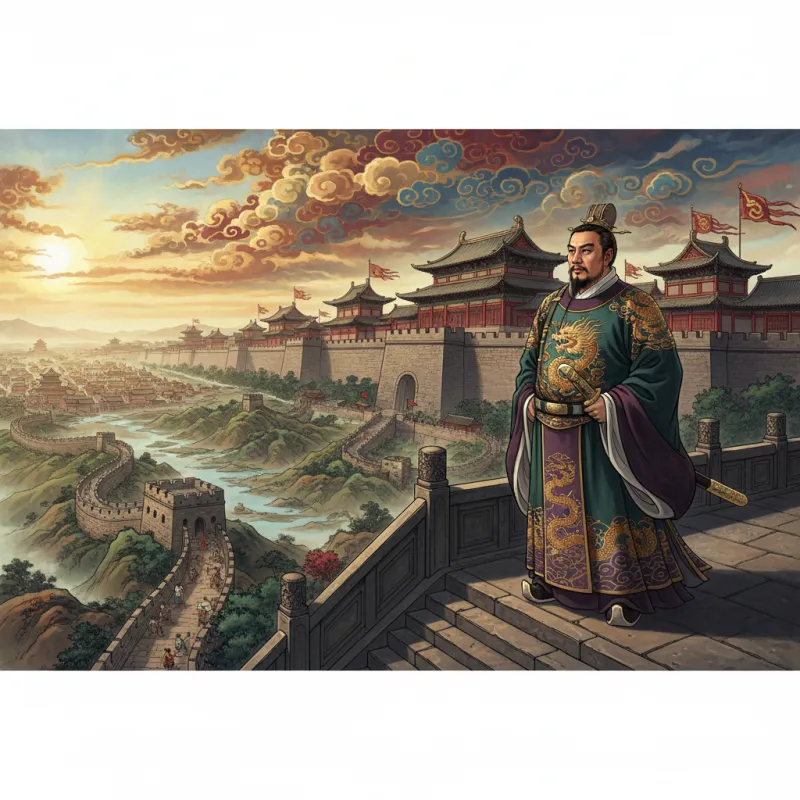
The year is 221 BCE. A 38-year-old king stands atop the ruins of six conquered kingdoms, surveying a landscape that has never been united under one ruler. He faces a choice: call himself "king" like every petty warlord before him, or invent something new. He chooses the latter, combining the words for "Three Sovereigns" and "Five Emperors" from mythology to create a title that has never existed: Huángdì (皇帝) — Emperor. His name is Ying Zheng (嬴政), but history will know him as Qin Shi Huang (秦始皇 Qín Shǐhuáng), the First Emperor. In doing so, he doesn't just conquer territory. He invents the very concept of China.
The Warring States Inheritance
Qin Shi Huang was born in 259 BCE into a world that knew nothing of unity. The Zhou Dynasty (周朝 Zhōu Cháo) had collapsed into the Warring States period (战国时代 Zhànguó Shídài, 475–221 BCE), where seven major kingdoms — Qin, Chu, Zhao, Wei, Han, Yan, and Qi — fought for supremacy. Each state had its own currency, its own script variations, its own axle widths for carts. A merchant traveling from Qin to Chu would need to exchange money three times and couldn't read the road signs.
Ying Zheng became King of Qin at age 13 in 246 BCE, though the chancellor Lü Buwei (吕不韦) held real power during his minority. There are persistent rumors that Lü Buwei was actually Ying Zheng's biological father — his mother had been Lü's concubine before being given to Ying Zheng's nominal father. True or not, the young king eliminated Lü Buwei by 235 BCE and began his conquest in earnest.
What made Qin different wasn't just military strength. A century earlier, the state had adopted the reforms of Legalist philosopher Shang Yang (商鞅), creating a ruthlessly efficient bureaucratic machine that rewarded merit and punished failure without regard for aristocratic birth. While other states clung to feudal traditions, Qin had become something new: a centralized state where loyalty to the system mattered more than family connections.
The Unification Campaign
Between 230 and 221 BCE, Ying Zheng systematically destroyed the other six kingdoms. Han fell first in 230 BCE, then Zhao in 228 BCE (despite the heroic resistance of General Li Mu), Wei in 225 BCE, Chu in 223 BCE despite its vast size, Yan in 222 BCE, and finally Qi in 221 BCE. The speed was unprecedented — nine years to conquer a territory roughly the size of modern France and Germany combined.
But conquest was only the beginning. The real revolution came in what he did next. Instead of ruling through vassal kings like every dynasty before him, Qin Shi Huang abolished the feudal system entirely. He divided the empire into 36 commanderies (郡 jùn), each governed by appointed officials who could be promoted, transferred, or executed based on performance. Aristocratic families were forcibly relocated to the capital Xianyang (咸阳) where they could be watched. It was the death of the old order.
Then came the standardizations that would define China for millennia. One writing system (the small seal script, later evolving into clerical script). One currency (the round copper coin with a square hole). One system of weights and measures. Even the axle width of carts was standardized so that ruts worn into roads would be uniform across the empire. These weren't minor administrative reforms — they were the creation of a common civilization from disparate peoples.
The Great Projects
Qin Shi Huang thought in terms of geological time. He connected and extended existing border walls into what would become the Great Wall (长城 Chángchéng), though the brick structure tourists visit today is mostly Ming Dynasty construction. The Qin wall was rammed earth and stone, built by hundreds of thousands of conscript laborers, many of whom died in the process. The folk song "Meng Jiangnu Weeps at the Great Wall" preserves the memory of this suffering.
He built a network of imperial roads radiating from Xianyang, with the Straight Road (直道 Zhídào) running 800 kilometers north to the Ordos region. He dug the Lingqu Canal connecting the Yangtze and Pearl River systems, enabling the conquest of southern territories. These weren't vanity projects — they were infrastructure that would serve China for centuries.
And then there was his tomb. Construction began when he took the throne at 13 and continued until his death. The tomb complex near modern Xi'an covers 56 square kilometers. The terracotta army discovered in 1974 — over 8,000 life-sized soldiers, each with unique features — was just the outer guardian force. The tomb itself remains unexcavated, but ancient historian Sima Qian (司马迁) described rivers of mercury flowing through a model of the empire, with crossbows set to automatically fire at intruders. Recent soil tests have confirmed abnormally high mercury levels, suggesting Sima Qian wasn't exaggerating.
The Burning of the Books
In 213 BCE, Qin Shi Huang made the decision that would cement his reputation as a tyrant. On the advice of his chancellor Li Si (李斯), he ordered the burning of books (焚书 fénshū) — specifically, all texts except those on medicine, divination, agriculture, and Qin state history. The following year, he allegedly buried 460 Confucian scholars alive (坑儒 kēngrú) for criticizing his policies.
The traditional narrative, written by Confucian historians who hated everything Qin represented, portrays this as pure barbarism. But there's a logic to it, however brutal. The Hundred Schools of Thought had spent centuries arguing about how society should be organized. Confucians wanted to restore the Zhou feudal system. Mohists advocated universal love. Daoists rejected government intervention entirely. Qin Shi Huang saw these competing philosophies as threats to unity — intellectual diversity as dangerous as military rebellion.
Was he right? The question is impossible to answer objectively. We know that much ancient literature was lost forever. We also know that the empire he built lasted only 15 years after his death, collapsing into civil war partly because his Legalist system was too harsh to sustain. Yet the idea of a unified China survived, and every subsequent dynasty claimed to be restoring what Qin had created. Emperor Wu of Han would build on Qin's foundations while softening its edges with Confucian ideology.
The Quest for Immortality
The man who unified China was terrified of death. Qin Shi Huang became obsessed with finding the elixir of immortality (不老药 bùlǎoyào), sending expeditions to mythical islands in the eastern sea where immortals supposedly lived. He consumed mercury pills prescribed by alchemists, believing they would extend his life — they likely hastened his death.
In 210 BCE, during his fifth imperial tour, Qin Shi Huang fell ill and died at age 49. His chief eunuch Zhao Gao (赵高) and chancellor Li Si concealed his death, keeping his corpse in a sealed carriage for months while they forged an edict forcing his eldest son to commit suicide and installing the pliable younger son Huhai as Second Emperor. They filled the carriage with rotting fish to mask the smell of the decomposing emperor.
The Second Emperor was incompetent, Zhao Gao was treacherous, and the empire collapsed within three years. The Qin Dynasty lasted only 15 years total — shorter than many individual reigns in later dynasties. Yet its impact was permanent.
The Unresolved Legacy
Modern China remains deeply ambivalent about Qin Shi Huang. Mao Zedong identified with him, famously declaring "He buried 460 scholars alive; we have buried 46,000 scholars alive... You [intellectuals] revile us for being Qin Shi Huangs. You are wrong. We have surpassed Qin Shi Huang a hundredfold." The Communist Party saw him as a progressive revolutionary who destroyed feudalism.
Contemporary Chinese nationalism often celebrates him as the founder of the nation, the man who proved that unity was possible. The 2002 film "Hero" portrayed him sympathetically as a leader whose violence served a greater purpose — a reading that sparked fierce debate about whether the film was justifying authoritarianism.
But the Confucian critique has never disappeared. The historian Jia Yi (贾谊), writing just decades after Qin's fall, argued that the dynasty collapsed precisely because it relied on force rather than virtue. The debate continues: Was Qin Shi Huang a visionary state-builder or a megalomaniacal tyrant? Did he create China or merely conquer it?
The answer is probably both. He didn't unite China through persuasion or shared culture — he did it through overwhelming force and ruthless standardization. But the systems he created — centralized bureaucracy, standardized writing, the expectation of unity — became so fundamental to Chinese civilization that they're now inseparable from it. Every subsequent dynasty, even while condemning Qin's methods, adopted his administrative model.
Perhaps the most telling fact is this: for 2,200 years, whenever China fragmented, the goal was always reunification. The Three Kingdoms period, the Northern and Southern Dynasties, the Five Dynasties and Ten Kingdoms — all were seen as aberrations to be corrected. The Kangxi Emperor of the Qing Dynasty ruled over a territory far larger than Qin's, but he was still claiming to restore the unity that Qin Shi Huang had first established.
The First Emperor died seeking immortality and failed. But his idea — that these disparate peoples, languages, and territories should be one civilization — achieved a kind of immortality he never imagined. Whether that makes him a hero or a villain depends on whether you think the cost was worth it. China has been arguing about that question for two millennia and shows no signs of reaching a consensus.
Related Reading
- China's Most Fascinating Emperors: The Brilliant, the Mad, and the Unexpected
- The Influential Emperors of Ancient China: Dynasties, Battles, and Cultural Impact
- The Legacy of Chinese Emperors: Dynasties, Power, and Cultural Influence
- Wu Zetian: China's Only Female Emperor
- The Imperial Examination: The World's First Standardized Test
- The Tang Dynasty: China's Golden Age of Poetry, Power, and Culture
- The Hundred Schools of Thought: China's Golden Age of Philosophy