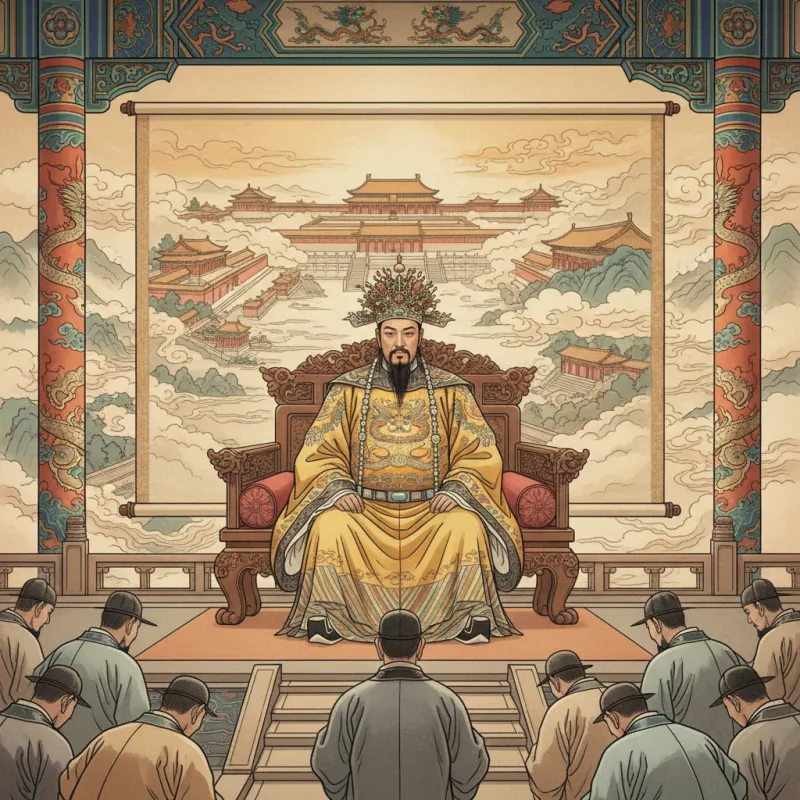
Picture this: a seven-year-old boy sits on the Dragon Throne, surrounded by scheming regents who treat him like a puppet. Fast forward six decades, and that same ruler has crushed rebellions, expanded China's borders to their greatest extent, patronized the arts, and personally studied Western science with Jesuit missionaries. The Kangxi Emperor's 康熙帝 (Kāngxī Dì) 61-year reign from 1661 to 1722 wasn't just the longest in Chinese history—it was a masterclass in how to transform from figurehead to absolute monarch while building an empire that would dominate East Asia for another two centuries.
The Boy Emperor and His Power Play
Aisin Gioro Xuanye 爱新觉罗·玄烨 (Àixīnjuéluó Xuányè) became emperor at seven years old in 1661, but calling him "emperor" at that point was generous. Four regents, led by the ambitious Oboi 鳌拜 (Áobài), controlled every aspect of government while the child sat through endless ceremonies he barely understood. These weren't benevolent guardians—they were Manchu strongmen who'd helped conquer China and weren't about to let a kid tell them what to do.
But Kangxi was playing a longer game than anyone realized. He studied martial arts in secret, built a network of loyal young nobles, and waited. In 1669, at just fifteen years old, he made his move. During what appeared to be a casual wrestling match in the palace, Kangxi's hand-picked guards overpowered Oboi and arrested him for treason. No bloodbath, no civil war—just a teenager who'd outmaneuvered the most powerful man in China. It was the kind of political theater that would define his entire reign: calculated, decisive, and always one step ahead.
Crushing the Three Feudatories
Kangxi's real test came in 1673 when three powerful Chinese generals who'd helped the Qing conquer southern China decided they'd rather be independent warlords. The Revolt of the Three Feudatories 三藩之乱 (Sānfān zhī Luàn) wasn't some minor uprising—at its peak, the rebels controlled most of southern China, and many officials in Beijing were quietly betting on Kangxi to lose.
The war dragged on for eight brutal years. Wu Sangui 吴三桂 (Wú Sānguì), the most powerful rebel leader, even declared himself emperor of a new dynasty. But Kangxi refused every compromise, personally directing military strategy and rotating generals when they failed. He understood something crucial: if he gave an inch to these warlords, the Qing Dynasty would fracture into competing kingdoms like China had done so many times before. By 1681, all three feudatories were crushed, and Kangxi had proven that the Manchu conquest of China was permanent, not temporary.
The Scholar-Warrior Emperor
Here's what made Kangxi genuinely unusual: he was as comfortable discussing mathematics with Jesuit missionaries as he was leading military campaigns. This wasn't just Renaissance man posturing—Kangxi actually studied Euclidean geometry, learned to use Western astronomical instruments, and commissioned the Kangxi Dictionary 康熙字典 (Kāngxī Zìdiǎn), which catalogued over 47,000 Chinese characters and remained the standard reference for two centuries.
He rose at dawn every day, spent hours reviewing memorials from officials across the empire, practiced calligraphy, and still found time for six major military campaigns. His Southern Tours 南巡 (Nánxún) weren't pleasure cruises—they were inspection tours where he'd show up unannounced at local government offices, question officials directly, and check whether imperial policies were actually being implemented. Officials learned quickly that Kangxi had an elephant's memory for details and zero tolerance for incompetence.
The Jesuits at court, like Ferdinand Verbiest and Jean-François Gerbillon, were amazed by his intellectual curiosity. Kangxi didn't just want Western technology—he wanted to understand the principles behind it. He had them explain everything from hydraulics to cartography, then commissioned the first accurate maps of the entire Qing Empire. When he got malaria, he even took quinine from the Jesuits after testing it on other patients first. This was empiricism in action, centuries before it became fashionable in China.
Expanding the Empire
Kangxi didn't just consolidate Qing rule—he expanded it dramatically. In 1683, he finally conquered Taiwan, ending the last Ming loyalist holdout under the Zheng family. This wasn't inevitable; Taiwan could easily have remained independent or fallen to Dutch or Spanish colonization. Kangxi's decision to integrate it into the empire shaped East Asian geopolitics for the next three centuries.
His northern campaigns were even more significant. The Dzungar Khanate in Mongolia and Central Asia posed a genuine threat to Qing security, and Kangxi personally led three major expeditions against them between 1690 and 1697. These weren't symbolic appearances—he slept in tents, ate military rations, and directed battlefield tactics. The decisive victory at Jao Modo in 1696 broke Dzungar power and secured Qing control over Mongolia and Xinjiang.
Then there was Russia. The Treaty of Nerchinsk in 1689 was China's first formal treaty with a European power, and Kangxi negotiated from a position of strength. He forced Russia to abandon settlements in the Amur River valley and established clear borders that lasted for over 150 years. Compare this to how the Qianlong Emperor would later handle European powers, and you see Kangxi's diplomatic genius—he knew when to fight and when to negotiate.
The Succession Crisis
For all his brilliance, Kangxi made one catastrophic mistake: he couldn't figure out succession. In 1708, he publicly deposed his crown prince Yinreng 胤礽 (Yìnréng) for erratic behavior, then reinstated him, then deposed him again. This created a free-for-all among his other sons, who formed factions and plotted against each other for the next fourteen years.
Kangxi had over thirty sons who survived to adulthood, and the competition got vicious. His fourteenth son led military campaigns in the west, clearly positioning himself as the martial heir. His eighth son built a power base among Chinese officials. His fourth son, the future Yongzheng Emperor, played the long game by appearing unambitious while quietly building alliances.
When Kangxi died in 1722, the succession was so contested that rumors of a forged will persist to this day. The official story says he named his fourth son emperor on his deathbed, but many contemporaries believed it was a coup. Regardless, the succession crisis showed that even the greatest emperor couldn't solve the fundamental problem of hereditary monarchy: how do you ensure the next guy is competent?
The Kangxi Legacy
Sixty-one years is an almost incomprehensible length of time to rule. Kangxi came to power when Louis XIV was still building Versailles and died after Peter the Great had already transformed Russia. He outlasted six popes and five Mughal emperors. Most importantly, he transformed the Qing from a conquest dynasty that might have collapsed like the Mongol Yuan into a genuinely Chinese empire that would last until 1912.
His reign set the template for what historians call the "High Qing"—a century of prosperity, territorial expansion, and cultural confidence that wouldn't end until the Opium Wars shattered China's isolation in the 1840s. The population doubled during his reign, agriculture flourished, and Chinese culture reached new heights in literature, painting, and porcelain.
But Kangxi's legacy is complicated. His military campaigns were brilliant but expensive. His tolerance for Jesuits and Western learning didn't extend to Christianity spreading among ordinary Chinese—he eventually banned it when he realized it challenged Confucian social order. His refusal to clearly designate an heir created the succession crisis that would plague the Qing for the next two centuries.
Why Kangxi Still Matters
Walk into any Chinese bookstore today, and you'll find dozens of books about Kangxi—historical novels, leadership manuals, even business guides claiming to reveal his management secrets. He's become a symbol of competent, hands-on governance in an era when many Chinese feel their leaders are distant and bureaucratic.
What makes Kangxi fascinating isn't just that he ruled for 61 years—it's that he remained engaged and effective for almost all of it. He didn't retreat into palace life or let officials run things while he pursued hobbies. At seventy, he was still reviewing memorials, conducting military campaigns, and making major policy decisions. That kind of sustained excellence is rare in any political system, let alone an absolute monarchy.
His reign also represents a road not taken in Chinese history. Kangxi was genuinely curious about Western science and technology, but he saw it as tools to strengthen traditional Chinese civilization, not as a challenge to it. Imagine if his successors had maintained that openness instead of gradually closing China off from foreign influence. The Qing might have industrialized a century earlier, and modern Chinese history would look completely different.
Instead, Kangxi's openness died with him. The Yongzheng and Qianlong emperors grew increasingly suspicious of foreign influence, and by the 19th century, China's technological gap with the West had become catastrophic. But for 61 years, one emperor showed that China could engage with the world on its own terms, adapt what was useful, and remain fundamentally Chinese. That's a legacy worth remembering.
Related Reading
- Qin Shi Huang: The First Emperor Who Created China
- Wu Zetian: China's Only Female Emperor
- The Kangxi Emperor: China's Longest-Reigning and Greatest Ruler
- The Influential Emperors of Ancient China: Dynasties, Battles, and Cultural Impact
- Wu Zetian: China's Only Female Emperor
- What Did Ancient Chinese People Eat? A Dynasty-by-Dynasty Food History
- Delving into Ancient China: A Journey Through Dynasties, Emperors, and Cultural Treasures
- Exploring the Rich Tapestry of Ancient Chinese History and Culture