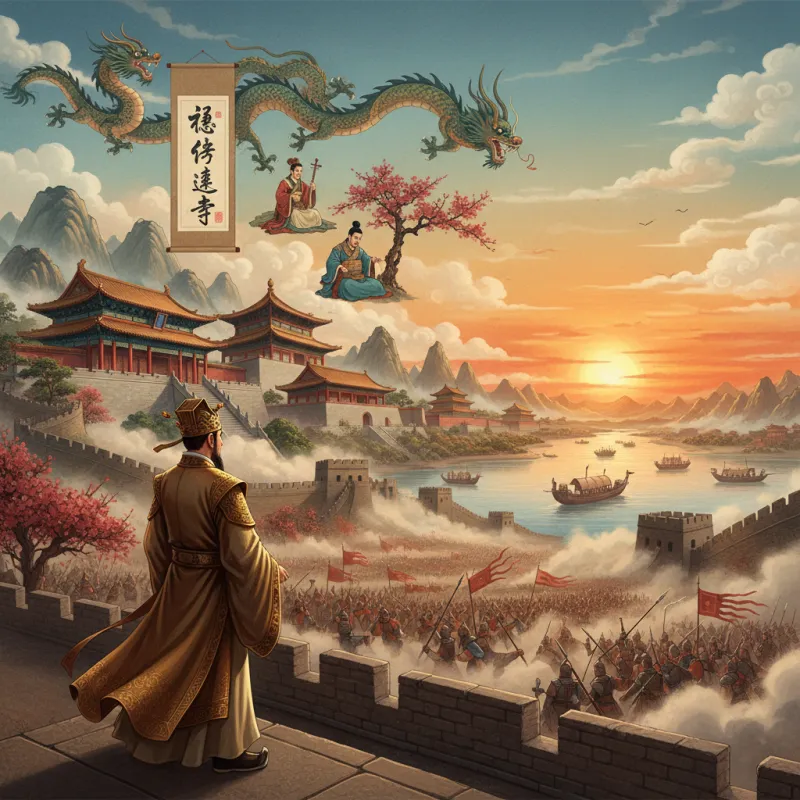
Picture this: A teenage king orders the construction of an underground army of 8,000 life-sized terracotta soldiers, each with unique facial features, to guard his tomb for eternity. This wasn't the fantasy of a delusional ruler—it was Qin Shi Huang (秦始皇, Qín Shǐ Huáng), and his megalomania would forge the very concept of a unified China. The emperors who followed him, whether they admired or despised his methods, couldn't escape his shadow. From the Great Wall to the Silk Road, from Confucian academies to Buddhist temples, China's imperial rulers didn't just govern—they sculpted civilization itself.
Qin Shi Huang: The Architect of Unity and Terror
When Ying Zheng became King of Qin at age thirteen in 246 BC, China was a patchwork of seven warring kingdoms that had been slaughtering each other for over two centuries. By 221 BC, he had conquered them all and declared himself Qin Shi Huang—literally "First Emperor of Qin." The title itself was revolutionary; previous rulers had been mere kings (王, wáng), but Shi Huang borrowed the term "huangdi" (皇帝) from mythological god-kings, positioning himself as semi-divine.
His achievements were staggering and brutal in equal measure. He standardized Chinese script, ensuring that a merchant in the south could read documents from the north. He unified weights, measures, and even the axle width of carts so they'd fit the same ruts in roads across the empire. He connected and extended defensive walls into what would become the Great Wall, though the romantic brick structure tourists visit today was mostly built by the Ming Dynasty over a millennium later.
But Shi Huang's paranoia was as legendary as his accomplishments. He buried 460 Confucian scholars alive and burned books that contradicted his Legalist philosophy—the infamous "burning of books and burying of scholars" (焚书坑儒, fénshū kēngrú) of 213-210 BC. He sent thousands to their deaths building his tomb complex, which remains partially unexcavated because archaeologists fear the mercury rivers described in ancient texts might actually exist. When he died in 210 BC during a tour of eastern China, his advisors hid his corpse in a cart of rotting fish to mask the smell until they could orchestrate a succession crisis. The Qin Dynasty collapsed just four years after his death, but the template for imperial China was set.
Emperor Wu of Han: The Expansionist Scholar-Warrior
If Qin Shi Huang was China's Alexander the Great, then Emperor Wu of Han (汉武帝, Hàn Wǔdì, r. 141-87 BC) was its Augustus Caesar—a ruler who transformed military conquest into lasting institutional power. Taking the throne at sixteen, Wu would reign for 54 years and expand Han territory to its greatest extent, pushing into Central Asia, Korea, and Vietnam.
Emperor Wu's most consequential decision had nothing to do with warfare: in 136 BC, he established Confucianism as the state ideology, creating the imperial examination system that would define Chinese governance for two millennia. Suddenly, power came not just from aristocratic birth or military prowess, but from mastering the Confucian classics. This was revolutionary—a meritocracy built on literary scholarship rather than bloodlines.
His military campaigns were equally transformative. Wu sent the explorer Zhang Qian (张骞, Zhāng Qiān) westward in 138 BC, inadvertently opening the Silk Road trade routes that would connect China to Rome. His generals pushed the Xiongnu nomads—possibly ancestors of the Huns who later terrorized Europe—far beyond China's northern borders. He conquered the Nanyue kingdom in modern Vietnam and established commanderies in northern Korea that lasted for centuries.
But Wu's ambitions nearly bankrupted the empire. His constant military campaigns required new taxes, including state monopolies on salt and iron that sparked fierce debates about government intervention in the economy—debates recorded in the "Discourses on Salt and Iron" (盐铁论, Yántiělùn) that still resonate today. By his death in 87 BC, the Han Dynasty was militarily supreme but financially exhausted. Still, his fusion of Confucian culture with imperial power created a model that subsequent dynasties would emulate for over 2,000 years.
Emperor Taizong of Tang: The Philosopher-King
Li Shimin (李世民, Lǐ Shìmín), better known as Emperor Taizong of Tang (唐太宗, Táng Tàizōng, r. 626-649), came to power through fratricide—he killed his brothers at the Xuanwu Gate in 626 and forced his father to abdicate. Yet this blood-soaked beginning led to what many historians consider the golden age of Chinese civilization. The Tang Dynasty under Taizong became so prosperous and culturally dominant that overseas Chinese communities still call themselves "Tang people" (唐人, Tángrén).
Taizong was obsessed with good governance in a way that bordered on neurotic. He famously kept a book of his ministers' criticisms and advice, the "Zhenguan Zhengyao" (贞观政要), which became a manual for rulers across East Asia. His chief censor, Wei Zheng (魏征, Wèi Zhēng), was so brutally honest that Taizong once complained to his wife that he wanted to kill the man—she congratulated him for having such a loyal minister. When Wei Zheng died, Taizong wept and said he had lost his mirror.
Under Taizong, Chang'an (modern Xi'an) became the world's largest city, with over a million residents and foreign quarters for Persian, Arab, and Central Asian merchants. Buddhism flourished—the famous monk Xuanzang returned from India in 645 with hundreds of Sanskrit texts, inspiring the classic novel "Journey to the West" centuries later. The Tang legal code became the model for Japanese and Korean law. Poetry reached heights it would never again achieve; Du Fu and Li Bai, China's greatest poets, would write during the dynasty Taizong established.
Taizong's military campaigns were equally impressive. He defeated the Eastern Turks in 630, earning the title "Heavenly Khagan" from Central Asian peoples. He established the protectorate system that extended Tang influence from the Korean Peninsula to the borders of Persia. Unlike many conquerors, he integrated defeated peoples into his administration—his government included officials from dozens of ethnic groups. This cosmopolitan approach made the Tang Dynasty a cultural magnet, drawing students, monks, and merchants from across Asia.
Kublai Khan: The Mongol Who Became Chinese
When Kublai Khan (忽必烈, Hūbìliè, r. 1260-1294) completed the Mongol conquest of China in 1279, he faced an impossible challenge: how does a nomadic warrior from the steppes rule the world's most sophisticated agrarian civilization? His solution was brilliant—he became Chinese while remaining Mongol, founding the Yuan Dynasty (元朝, Yuán Cháo) and adopting Chinese imperial rituals while maintaining Mongol military supremacy.
Kublai moved the capital from Karakorum to Dadu (modern Beijing), building a city that would remain China's capital for most of the next 750 years. He patronized Chinese arts and Confucian scholars while keeping Mongols in top military and political positions. He completed the Grand Canal, linking northern and southern China in an engineering feat that facilitated trade and tax collection. He established a paper currency system that amazed Marco Polo, who spent seventeen years at Kublai's court and wrote accounts that introduced China to medieval Europe.
But Kublai's reign also revealed the limits of Mongol power. His attempted invasions of Japan in 1274 and 1281 ended in disaster when typhoons—the famous "kamikaze" or divine winds—destroyed his fleets. His campaigns in Southeast Asia drained the treasury without securing lasting conquests. The Yuan Dynasty's ethnic hierarchy, which placed Mongols at the top and southern Chinese at the bottom, created resentments that would eventually fuel rebellion.
Still, Kublai's cultural impact was profound. He patronized the development of Chinese opera and drama, which flourished under Yuan rule. He supported the compilation of historical records and the translation of Buddhist texts. His religious tolerance—he consulted with Buddhists, Daoists, Muslims, and Christians—created a cosmopolitan court culture. When the Ming Dynasty overthrew the Yuan in 1368, they inherited administrative systems and a capital city that Kublai had created.
The Kangxi Emperor: The Qing Dynasty's Intellectual Warrior
The Kangxi Emperor (康熙帝, Kāngxī Dì, r. 1661-1722) ruled for 61 years, the longest reign in Chinese history, and transformed the Qing Dynasty from a Manchu conquest regime into a legitimate Chinese empire. Taking power at age seven after his father died of smallpox, Kangxi survived the disease himself, leaving his face pockmarked but granting him immunity during future outbreaks—a significant advantage in an era when smallpox killed emperors and commoners alike.
Kangxi was a Renaissance man before the term existed in China. He studied mathematics with Jesuit missionaries, mastered Manchu, Chinese, and Mongolian, and could discuss astronomy, geography, and Western science with foreign visitors. He commissioned the "Kangxi Dictionary" (康熙字典, Kāngxī Zìdiǎn), which standardized Chinese characters and remained authoritative for centuries. He ordered the creation of detailed maps of the empire using Western surveying techniques, producing the most accurate cartography China had ever seen.
His military campaigns secured Qing borders for generations. He crushed the Revolt of the Three Feudatories (1673-1681), which threatened to split southern China from Qing control. He conquered Taiwan in 1683, ending the Ming loyalist Kingdom of Tungning. He personally led campaigns against the Dzungar Mongols, securing Qing control over Mongolia and Xinjiang. He negotiated the Treaty of Nerchinsk with Russia in 1689, the first treaty between China and a European power, establishing borders that largely remain today.
But Kangxi's greatest achievement might have been cultural. He mastered Chinese classical literature and positioned himself as a Confucian sage-king, despite being Manchu. He held court debates on philosophy and history, wrote poetry, and patronized Chinese arts. This cultural legitimacy allowed the Qing Dynasty to rule China for another two centuries after his death. When he died in 1722, he left an empire that stretched from Taiwan to Tibet, from Mongolia to Burma—the largest territory China had ever controlled.
Cultural Legacies: How Emperors Shaped Chinese Identity
The emperors of ancient China weren't just political rulers—they were cultural architects who shaped everything from language to cuisine, from religious practice to artistic expression. The imperial examination system, established by Emperor Wu and refined over centuries, created a scholar-official class that valued literary achievement over martial prowess. This emphasis on education and meritocracy became central to Chinese identity, influencing educational philosophies that persist today.
Imperial patronage determined which art forms flourished and which faded. Tang Dynasty emperors loved poetry, so poetry became the highest literary form. Song Dynasty emperors collected paintings, so landscape painting reached unprecedented sophistication. Ming emperors rebuilt the Great Wall in brick, creating the iconic structure that symbolizes China globally. Qing emperors commissioned massive encyclopedias and literary compilations, preserving texts that might otherwise have been lost.
Religious policy under various emperors shaped China's spiritual landscape. Emperor Ming of Han (r. 57-75 AD) officially introduced Buddhism to China after dreaming of a golden deity. Tang emperors patronized Buddhism so extensively that the religion became thoroughly sinicized, developing uniquely Chinese schools like Chan (Zen). Ming Dynasty founder Hongwu (r. 1368-1398) promoted a return to Confucian orthodoxy, suppressing Buddhist and Daoist institutions that had grown too powerful. These imperial decisions created the syncretic religious culture—mixing Confucianism, Buddhism, and Daoism—that characterizes Chinese spirituality.
Even Chinese cuisine bears imperial fingerprints. Peking duck originated in imperial kitchens during the Yuan Dynasty. The elaborate banquet culture of Chinese restaurants mimics imperial feast traditions. Regional cuisines gained prestige when emperors from those regions took power—Sichuan food became fashionable when Qing Dynasty officials from Sichuan rose to prominence.
The Double-Edged Sword of Imperial Power
The legacy of China's emperors is paradoxical. They created a unified civilization with shared language, culture, and identity across a vast territory—an achievement unmatched in human history. The Roman Empire fragmented into dozens of nations; China, despite periods of division, always reunified under the imperial model. This continuity gave Chinese civilization remarkable resilience and cultural depth.
Yet imperial power also stifled innovation and dissent. The examination system, while meritocratic, channeled China's best minds into memorizing ancient texts rather than developing new ideas. The Qing Dynasty's literary inquisition under the Qianlong Emperor (r. 1735-1796) destroyed thousands of books and killed hundreds of scholars for perceived disloyalty. The imperial system's emphasis on hierarchy and obedience to authority created social structures that some argue hindered China's response to Western imperialism in the 19th century.
The emperors profiled here—Qin Shi Huang, Emperor Wu, Taizong, Kublai Khan, and Kangxi—represent different approaches to imperial power. Qin Shi Huang unified through terror and standardization. Emperor Wu built institutions that outlasted his military conquests. Taizong balanced Confucian ideals with pragmatic governance. Kublai Khan bridged nomadic and agrarian civilizations. Kangxi combined military prowess with intellectual curiosity. Together, they created a template for governance that shaped not just China, but influenced political systems across East Asia.
When the last emperor, Puyi, abdicated in 1912, ending over 2,000 years of imperial rule, China didn't simply abandon its imperial heritage. The Communist Party's organizational structure echoes imperial bureaucracy. The emphasis on national unity over regional autonomy reflects imperial priorities. The reverence for strong, visionary leadership has imperial roots. Understanding China's emperors isn't just about understanding the past—it's essential for comprehending how the world's most populous nation sees itself today.
Related Reading
- Qin Shi Huang: The First Emperor Who Created China
- Emperor Wu of Han: The Warrior Emperor Who Shaped Chinese Identity
- China's Most Fascinating Emperors: The Brilliant, the Mad, and the Unexpected
- The Kangxi Emperor: China's Longest-Reigning and Greatest Ruler
- Wu Zetian: China's Only Female Emperor
- Forgotten Chinese Inventions That Changed the World Before the West Noticed
- Unveiling the Role of Women in Ancient Chinese Dynasties
- Unraveling the Economic Tapestry of Ancient Chinese Dynasties