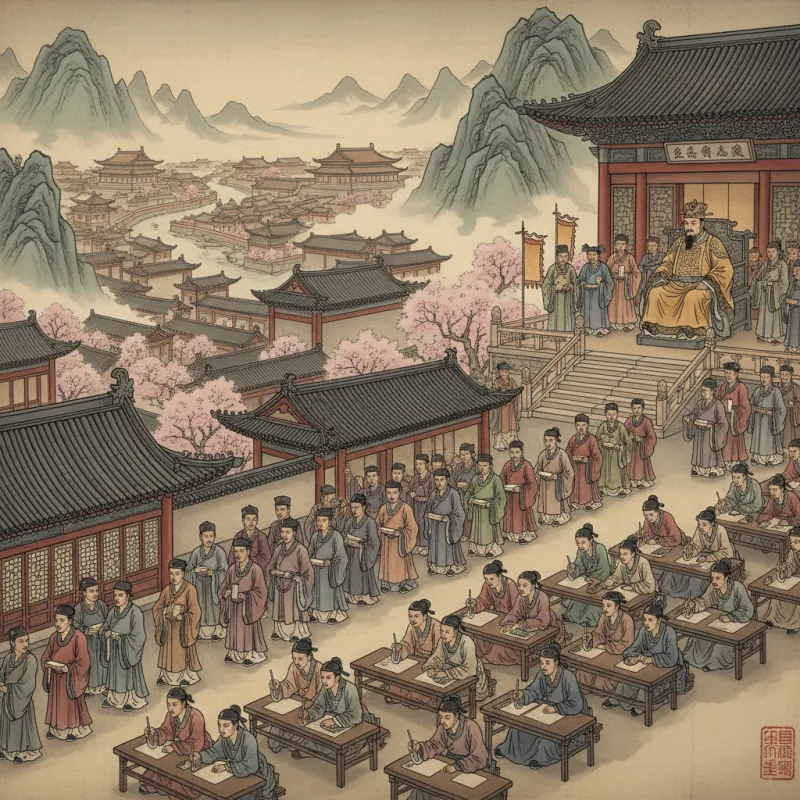
A young man sits in a tiny brick cell, barely six feet square, for three days and nights. He has a wooden board for a desk, a brick for a seat, and a single oil lamp. Outside, armed guards patrol to prevent cheating. Inside, he writes furiously, composing essays on Confucian philosophy that will determine whether he spends his life as a farmer or as an imperial official. This is the 科举 (kējǔ) examination — and for 1,300 years, it was the only path to power in China.
The Radical Idea: Merit Over Birth
When Emperor Yang of Sui established the imperial examination system in 605 CE, he did something unprecedented in world history. He declared that government positions would go not to aristocrats, not to the wealthy, not to military heroes, but to whoever could best demonstrate mastery of Confucian texts through written examination.
The implications were staggering. A peasant's son who could memorize the Four Books and Five Classics had a theoretical shot at becoming a provincial governor. A duke's son who couldn't write a proper eight-legged essay (八股文, bāgǔwén) would be shut out of government entirely. Birth still mattered — wealthy families could afford tutors and years of study — but it no longer guaranteed anything.
Compare this to medieval Europe, where noble birth was everything, or to the Roman Empire's patronage system where who you knew mattered more than what you knew. The Islamic caliphates valued religious scholarship, but political connections remained crucial. Only China built an entire governmental apparatus on standardized testing.
The Three-Tiered Gauntlet
The examination system wasn't a single test but a brutal three-stage elimination process that could consume a man's entire life.
First came the county-level exam (童試, tóngshì), which candidates typically took in their teens. Pass this, and you became a 秀才 (xiùcái), a "cultivated talent" — which sounds impressive until you realize that xiucai were essentially professional students with no actual government position. Still, it exempted you from corvée labor and gave you social status.
Next was the provincial exam (鄉試, xiāngshì), held every three years in provincial capitals. The pass rate hovered around 1-2%. Success here earned you the title of 舉人 (jǔrén), "recommended man," and qualified you for minor official posts. Many candidates took this exam dozens of times over decades. The Qing dynasty scholar Pu Songling, author of Strange Tales from a Chinese Studio, failed the provincial exam repeatedly and spent his life as a xiucai, bitter about the system that had rejected him.
The final stage was the metropolitan exam (會試, huìshì) in the capital, followed by the palace exam (殿試, diànshì) administered by the emperor himself. Pass these, and you became a 進士 (jìnshì), "presented scholar" — the empire's elite. During the entire Ming dynasty (1368-1644), only about 24,000 men achieved jinshi status. That's roughly 90 per year across an empire of 100-150 million people.
Inside the Examination Cells
The physical ordeal of taking these exams was itself a test of endurance. Candidates entered examination compounds containing thousands of individual cells — Beijing's compound had 8,500 — and remained locked inside for three days and nights. Each cell measured roughly 4 feet wide, 5 feet deep, and 6 feet tall. You brought your own food, water, bedding, and writing supplies.
The wooden board that served as your desk could be laid across the cell to create a sleeping platform at night. Candidates wrote by lamplight, often in sweltering summer heat or freezing winter cold. Illness was common. Deaths occurred. In 1850, fourteen candidates died during the provincial exam in Guangdong province, likely from heatstroke.
Guards patrolled constantly to prevent cheating, which was rampant despite severe penalties. Candidates smuggled in tiny books written in microscopic characters, hid notes in their clothing, or bribed proctors. Getting caught meant permanent banishment from the examination system and public humiliation. Some desperate candidates risked it anyway — the rewards of success were simply too great.
What They Actually Tested
The content of the exams evolved over centuries, but the core remained constant: mastery of Confucian classics and the ability to write in highly formalized styles.
During the Ming and Qing dynasties, the infamous eight-legged essay became the standard format. This rigid structure required exactly eight sections, with specific rules about parallelism, antithesis, and classical allusions. You had to take a passage from the Four Books — the Analects, Mencius, Great Learning, and Doctrine of the Mean — and write an essay from the perspective of Confucius or another sage, explaining the passage's meaning.
Critics, both then and now, argued this format rewarded memorization and stylistic conformity over original thinking. They had a point. The system produced brilliant administrators who could quote Confucius chapter and verse but sometimes struggled with practical governance. Yet it also created a shared intellectual culture among China's ruling class and ensured that officials had at least a theoretical grounding in ethics and statecraft.
The exams also included sections on poetry, history, and sometimes practical subjects like law or mathematics, though these carried less weight than the Confucian essays. A candidate might spend twenty years memorizing classical texts and practicing calligraphy, only to fail because his essay's parallelism wasn't quite perfect.
The Social Revolution That Wasn't
In theory, the examination system was radically egalitarian. In practice, it reinforced existing hierarchies while allowing just enough social mobility to maintain the illusion of meritocracy.
Wealthy families dominated the system. They could afford private tutors, extensive libraries, and decades of study without their sons needing to work. Poor families might scrape together resources to educate one promising son, but most couldn't spare the labor or afford the books. Studies of Qing dynasty examination results show that while some jinshi came from humble backgrounds, the majority came from families with previous examination success.
Still, that "some" mattered. The system produced enough rags-to-riches stories to sustain belief in its fairness. Every village knew tales of the poor scholar who passed the exams and returned home in glory. These stories, whether true or embellished, gave the system legitimacy and gave ambitious young men hope.
The examination system also created a unique social class: the failed scholars. Men who passed the county exam but never advanced further, or who spent decades attempting the provincial exam without success. These educated but unemployed men became teachers, secretaries, writers, and sometimes rebels. Many of the leaders of the Taiping Rebellion (1850-1864), which nearly toppled the Qing dynasty, were failed examination candidates who channeled their frustration into revolutionary fervor.
The System's Long Shadow
When the Qing government finally abolished the examination system in 1905, it ended a 1,300-year tradition. The decision came amid China's desperate attempts to modernize in the face of Western and Japanese imperialism. Reformers argued that the classical curriculum was obsolete, that China needed engineers and scientists, not Confucian scholars.
They were probably right. Yet something was lost. The examination system, for all its flaws, had created a shared culture among China's elite and provided a non-violent mechanism for social mobility. Its abolition contributed to the chaos of the early 20th century, as traditional paths to status and power disappeared without clear replacements.
The system's influence extends far beyond China. Korea, Vietnam, and Japan all adopted versions of the examination system. Modern standardized testing — from the SAT to civil service exams — owes a debt to the keju, even if few test-takers realize they're participating in a tradition that began in 605 CE.
Today, China's gaokao (高考), the college entrance examination, echoes the old system. Millions of students spend years preparing for a single test that determines their future. The format has changed — no more eight-legged essays — but the underlying logic remains: a standardized test as the gateway to opportunity. Whether this represents wisdom or folly depends on your perspective, but it's undeniably Chinese.
The examination cells are gone, demolished or converted into museums. But walk through Beijing's Confucius Temple, where successful candidates' names were once carved in stone, and you can still feel the weight of those 1,300 years. Millions of men spent their lives pursuing examination success. Some achieved it. Most didn't. But together, they built a system that shaped not just China, but the modern world's approach to education and social mobility. For better or worse, we're all taking the keju's descendants now.
Related Reading
- Ancient Chinese Fashion: What People Really Wore Through the Dynasties
- What Did Ancient Chinese People Eat? A Dynasty-by-Dynasty Food History
- Daily Life in Ancient China: What Ordinary People Actually Did All Day
- What Ordinary People Ate in Ancient China (It Was Not What You Think)
- How Buddhism, Islam, and Christianity Traveled the Silk Road
- The Ming Dynasty: Zheng He and China's Age of Exploration
- Ancient Chinese Currency: From Cowrie Shells to Paper Money