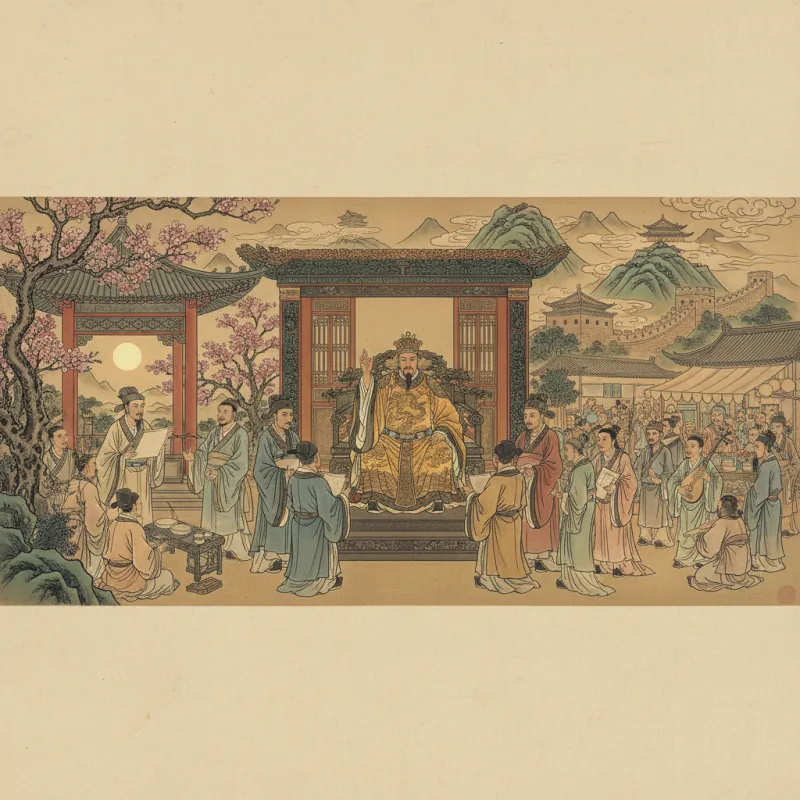
If you could visit any civilization at its absolute peak — not just militarily powerful but culturally radiant, intellectually alive, and genuinely cosmopolitan — the Tang Dynasty (唐朝 Táng Cháo, 618–907 CE) would be a strong candidate. Picture this: you're walking through Chang'an (长安), the world's largest city, home to over a million souls. Persian merchants haggle in the Western Market. Buddhist monks from India debate philosophy in monastery courtyards. Japanese students copy Chinese characters with intense concentration. Arab traders unload exotic goods at caravanserais. Korean diplomats present tribute at the imperial palace. This wasn't just a Chinese city — it was the world's city, and the Tang Dynasty was its beating heart.
The Rise of a Dynasty: From Chaos to Glory
The Tang emerged from the ashes of the short-lived Sui Dynasty, which had bankrupted itself building the Grand Canal and launching disastrous military campaigns against Korea. When the Sui collapsed in 618 CE, a military aristocrat named Li Yuan (李渊) seized the throne and established the Tang, taking the imperial name Emperor Gaozu (高祖). But the real architect of Tang greatness was his son, Li Shimin (李世民), who became Emperor Taizong (太宗, r. 626–649) after forcing his father to abdicate — a bloody succession that involved killing his brothers but ultimately gave China one of its greatest rulers.
Taizong understood something fundamental: great empires aren't built on military conquest alone. He reformed the bureaucracy, strengthened the civil service examination system (科举 kējǔ), reduced taxes, and created a legal code that would influence East Asian law for centuries. He also practiced what he called "using barbarians to control barbarians" — a pragmatic foreign policy that combined military strength with diplomatic finesse. Under his rule, Tang armies pushed into Central Asia, but Taizong also married his daughters to foreign rulers and welcomed foreign envoys with genuine respect rather than condescension.
The Empress Who Broke Every Rule
No discussion of the Tang is complete without Wu Zetian (武则天, 624–705), the only woman in Chinese history to rule as emperor in her own right. Her story reads like fiction: she entered the palace as a low-ranking concubine to Emperor Taizong, became the favorite of his son Emperor Gaozong, systematically eliminated her rivals (including allegedly murdering her own infant daughter to frame the empress), and eventually declared herself emperor of a new dynasty — the Zhou — in 690.
History has been harsh to Wu Zetian, painting her as a ruthless usurper. But the facts tell a more complex story. During her reign, she expanded the civil service examinations to recruit talent from lower social classes, promoted capable officials regardless of aristocratic background, and maintained the empire's prosperity and territorial integrity. She was a patron of Buddhism, commissioning the magnificent Longmen Grottoes (龙门石窟) near Luoyang. Yes, she was ruthless — but so were most successful rulers. The real scandal was that she was a woman who refused to rule from behind a curtain.
Poetry as National Identity
If you ask educated Chinese people what defines the Tang Dynasty, many will answer with one word: poetry (诗 shī). The Tang produced more than 48,000 poems by over 2,000 poets that survive today — and these are just the ones that made it through the centuries. Poetry wasn't a niche interest for intellectuals; it was how educated people communicated, how officials demonstrated their cultivation, how friends said goodbye, and how lovers expressed longing.
The "Big Three" of Tang poetry — Li Bai (李白, 701–762), Du Fu (杜甫, 712–770), and Bai Juyi (白居易, 772–846) — represent different approaches to the art. Li Bai, the "Immortal Poet," wrote with romantic abandon, celebrating wine, nature, and friendship. Legend says he drowned while drunkenly trying to embrace the moon's reflection in a river — probably false, but perfectly in character. Du Fu, the "Sage Poet," wrote with social conscience, documenting the suffering caused by war and corruption. His poetry is technically perfect and emotionally devastating. Bai Juyi wrote in simpler language, believing poetry should be accessible to common people, not just scholars.
What made Tang poetry special wasn't just individual genius but a cultural ecosystem that valued poetic expression. The civil service examinations tested poetry composition. Officials exchanged poems as part of diplomatic protocol. Even Emperor Xuanzong (玄宗, r. 712–756) was an accomplished poet and musician. This wasn't poetry as decoration — it was poetry as the language of power, friendship, and meaning.
Chang'an: The World's First Global City
At its height, Chang'an covered 84 square kilometers, making it six times larger than contemporary Rome. The city was laid out in a perfect grid, with wide avenues, distinct residential wards, and two massive markets — the Eastern Market for domestic goods and the Western Market for foreign luxuries. The imperial palace complex alone covered 3.2 square kilometers.
But what made Chang'an truly remarkable was its diversity. The city hosted communities of Sogdian merchants from Central Asia, Persian Zoroastrians fleeing Arab conquest, Indian Buddhist monks, Japanese students, Korean diplomats, and Arab traders. Foreign religions flourished: Buddhism, Nestorian Christianity, Zoroastrianism, Manichaeism, and Islam all had temples or churches in the city. Foreign music and dance became fashionable at court. Foreign foods — grapes, walnuts, pomegranates — entered Chinese cuisine. Foreign polo became the sport of aristocrats.
This cosmopolitanism wasn't just tolerance — it was active cultural appetite. Tang elites genuinely believed their civilization was strong enough to absorb foreign influences without losing its identity. They were right. The Tang took Persian metalwork techniques, Indian Buddhist philosophy, Central Asian music, and Korean diplomatic protocols, and made them Chinese.
The An Lushan Rebellion: Paradise Lost
Every golden age has its breaking point. For the Tang, it came in 755 CE when An Lushan (安禄山), a general of Sogdian-Turkic descent, rebelled against Emperor Xuanzong. The rebellion lasted eight years, killed millions, and permanently weakened the dynasty. The causes were complex: An Lushan's personal ambition, court factionalism, the emperor's infatuation with his concubine Yang Guifei (杨贵妃), and structural problems in the military system.
The rebellion's impact went beyond immediate destruction. The Tang never fully recovered its control over the provinces. Regional military governors (节度使 jiédùshǐ) became increasingly autonomous, setting the stage for the dynasty's eventual fragmentation. The cosmopolitan confidence of the early Tang gave way to xenophobia — foreign religions faced persecution, and the government became suspicious of foreign merchants and ideas.
Yet even in decline, the Tang remained culturally influential. The late Tang produced brilliant poets like Li Shangyin (李商隐) and Du Mu (杜牧), whose work explored themes of loss, nostalgia, and political disillusionment. The dynasty limped on until 907, when the last emperor was deposed, ushering in the chaotic Five Dynasties and Ten Kingdoms period.
The Tang Legacy: Why It Still Matters
The Tang Dynasty's influence on Chinese civilization is impossible to overstate. The Tang established the template for Chinese imperial government that lasted until 1911. Its poetry remains the gold standard of Chinese literature. Its capital city plan influenced urban design across East Asia. Its cultural confidence — the belief that Chinese civilization could absorb foreign influences and emerge stronger — became a recurring theme in Chinese history.
Beyond China, the Tang shaped East Asian civilization. Japan's Nara and Heian periods were deeply influenced by Tang culture, from architecture to Buddhism to government structure. Korea's Unified Silla period developed in dialogue with Tang power and culture. Vietnam's independence movement defined itself partly in opposition to Tang imperialism, but also absorbed Tang administrative practices.
Today, when Chinese people abroad call themselves "Tang people" (唐人 Tángrén) and their communities "Tang people streets" (唐人街 Tángrénjiē, Chinatowns), they're invoking this dynasty's legacy. The Tang represents a moment when Chinese civilization was not just powerful but genuinely open to the world — a cosmopolitan confidence that later dynasties, including the Ming Dynasty, would struggle to recapture.
What the Tang Teaches Us
The Tang Dynasty offers lessons that transcend its historical moment. It shows that cultural greatness requires more than military power or economic wealth — it requires openness to foreign ideas, investment in arts and education, and confidence in one's own civilization. The Tang's greatest strength wasn't its armies but its ability to make people from across Asia want to participate in Chinese culture.
The dynasty also demonstrates the fragility of golden ages. The same cosmopolitanism that made the Tang great also created vulnerabilities — foreign generals like An Lushan could rise to power, and the empire's vast size made it difficult to control. The Tang's decline reminds us that no civilization, no matter how brilliant, is immune to internal contradictions and external pressures.
Walk through any major museum's Chinese art collection, and you'll find Tang Dynasty pieces: three-color glazed pottery (唐三彩 Táng sāncǎi) depicting camels and foreign merchants, elegant figurines of court ladies, Buddhist sculptures showing Indian and Central Asian influences. These artifacts aren't just beautiful — they're evidence of a civilization at its creative peak, confident enough to borrow from the world and generous enough to share its achievements. That's the Tang Dynasty's real legacy: not just power or poetry, but the possibility of a civilization that's both distinctly itself and genuinely cosmopolitan.
Related Reading
- The Complete Guide to Chinese History: 5,000 Years in One Article
- The Sui Dynasty: Brief Glory, Lasting Legacy
- Exploring Ancient Chinese Dynasties: Emperors, Battles, and Cultural Legacy
- Spring and Autumn to Warring States: China's Age of Philosophy
- Song Dynasty: The World's Most Advanced Civilization
- Ancient Chinese Dynasties and Emperors: Legal Systems, Battles, and Cultural Legacy
- Diplomacy and Cultural Exchange in Chinese Ancient Dynasties
- Exploring Ancient Agricultural Practices in Chinese Dynasties