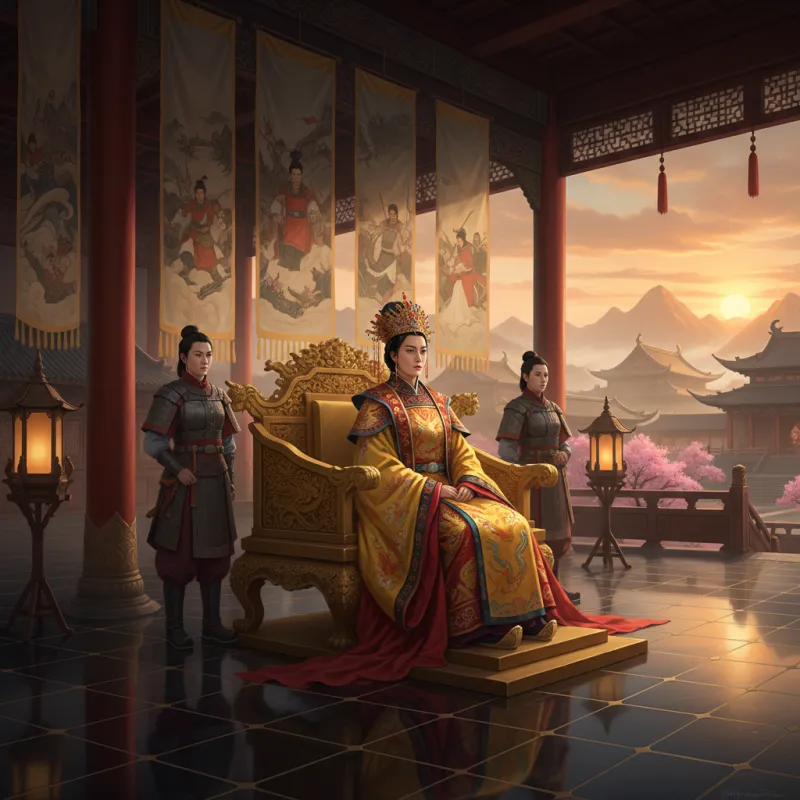
The year is 690 CE. In the grand halls of Luoyang, a 66-year-old woman ascends the Dragon Throne and declares herself Huangdi (皇帝, huángdì) — not empress, but emperor. Wu Zetian (武則天, Wǔ Zétiān) doesn't just break the glass ceiling; she shatters it so completely that no woman in China's subsequent 1,200 years of imperial history would dare attempt what she accomplished. Her reign remains one of the most controversial and fascinating chapters in Chinese history, a story that forces us to reckon with questions about power, gender, and the price of ambition.
From Concubine to Consort: The Early Climb
Wu Zhao, as she was originally known, entered the imperial palace in 637 at age fourteen as a fifth-rank concubine to Emperor Taizong, the legendary second ruler of the Tang Dynasty. Her father, Wu Shihuo, had been a wealthy timber merchant who supported the Tang's founding, which gave the family enough status to catch the emperor's eye. But Taizong, despite Wu's education and beauty, never promoted her beyond the lowest concubine ranks. She spent thirteen years in relative obscurity, learning the brutal mechanics of palace politics.
Here's where the story gets interesting. When Taizong died in 649, Wu should have been sent to Ganye Temple (感業寺, Gǎnyè Sì) to live out her days as a Buddhist nun — the standard fate for childless imperial concubines. She did go to the temple, had her head shaved, and donned the robes. But Wu had already caught the attention of Taizong's son, the crown prince Li Zhi. Whether their relationship began before Taizong's death remains one of history's juiciest scandals. What we know is that by 651, the new Emperor Gaozong had Wu brought back to the palace, initially as a laundress to avoid immediate scandal.
The Ruthless Consolidation of Power
Wu's return to palace life triggered one of the most vicious power struggles in Tang history. Emperor Gaozong's existing empress, Wang, had actually supported bringing Wu back, hoping she would distract the emperor from his favored Consort Xiao. Fatal mistake. Wu systematically destroyed both women through a combination of political maneuvering and, if the historical accounts are accurate, shocking brutality.
The most infamous incident involves Wu's own infant daughter. According to the Old Book of Tang (舊唐書, Jiù Táng Shū), when Empress Wang visited Wu's newborn daughter, Wu allegedly strangled the child and blamed the empress. Whether this actually happened or was later propaganda remains debated, but Gaozong believed it. By 655, both Empress Wang and Consort Xiao were deposed, beaten with rods, had their hands and feet cut off, and were thrown into wine vats to die. Wu became empress, and she wasn't playing games.
Over the next decade, Wu consolidated power as Gaozong's health deteriorated. He suffered from debilitating headaches and vision problems, possibly from a stroke. Wu began attending state meetings behind a screen, then openly beside the emperor. Officials who opposed her met mysterious ends. The Tang court whispered about the "Two Sages" (二聖, Èr Shèng) ruling together, though everyone knew who really held the reins.
The Zhou Dynasty Interlude
When Gaozong died in 683, Wu's son Li Zhe became Emperor Zhongzong. He lasted six weeks before Wu deposed him for trying to appoint his wife's father as chancellor without consulting her. She replaced him with another son, Li Dan (Emperor Ruizong), but kept him as a puppet. For seven years, Wu ruled as empress dowager, but she wanted more than power behind the throne — she wanted the throne itself.
In 690, Wu did the unthinkable. She declared the Tang Dynasty ended and established her own Zhou Dynasty (周, Zhōu), naming herself Shengshen Huangdi (聖神皇帝, Shèngshén Huángdì) — "Holy and Divine Emperor." She changed the name of the imperial capital from Chang'an to Shendu (神都, Shéndū), "Divine Capital," and moved the court to Luoyang. She even invented new Chinese characters, including a new character for her name "Zhao" (曌) — the sun and moon above the sky, symbolizing her illumination of the heavens.
The audacity was breathtaking. Confucian scholars had spent centuries arguing that women were fundamentally unsuited to rule, citing the Book of Changes and other classics. Wu commissioned new Buddhist texts that conveniently prophesied a female Buddha would rule China. She promoted women to positions of authority, reformed the examination system to recruit officials based on merit rather than aristocratic birth, and ruthlessly purged the old Tang nobility who opposed her.
Governance and Legacy
Here's what the traditional histories don't want to admit: Wu Zetian was actually a competent ruler. During her fifteen-year reign as emperor (690-705), the empire remained stable and prosperous. She expanded the imperial examination system, which weakened the hereditary aristocracy and created a more meritocratic bureaucracy. She promoted agricultural development, reduced taxes on farmers, and maintained the Tang's military strength on the frontiers.
Wu also proved to be a shrewd diplomat. She managed relations with the Tibetan Empire and the Turkic Khaganates through a combination of military pressure and strategic marriages. The economy flourished, and Chinese culture reached new heights. The poet Chen Zi'ang and the calligrapher Yan Zhenqing both worked during her reign, contributing to what would become the Tang Dynasty's golden age of arts.
But Wu's methods were undeniably brutal. She established a secret police network and encouraged denunciations. Thousands of officials and aristocrats were executed, exiled, or forced to commit suicide. Her lovers in her later years — the Zhang brothers — became notorious for their corruption and influence. The same ruthlessness that brought her to power eventually made her vulnerable.
The Final Act
In 705, at age 81, Wu Zetian was forced to abdicate. A group of officials, led by Zhang Jianzhi, staged a coup, killed the Zhang brothers, and restored her son Li Xian (Emperor Zhongzong) to the throne. The Tang Dynasty was officially restored. Wu died ten months later, and in a final gesture that speaks volumes, her memorial stele at Qianling Mausoleum bears no inscription. Whether this was her choice or her successors' revenge remains unclear, but the Wordless Stele (無字碑, Wúzì Bēi) has become one of Chinese history's most powerful symbols.
Why Wu Zetian Still Matters
Wu Zetian's story refuses to fit into comfortable narratives. She was undeniably capable, intelligent, and effective as a ruler. She was also ruthless, manipulative, and willing to destroy anyone who threatened her power — including possibly her own daughter. Traditional Confucian historians painted her as a monster, a cautionary tale about what happens when women overstep their natural roles. Modern feminists sometimes celebrate her as a proto-feminist icon, which seems equally reductive.
The truth is more complex. Wu Zetian succeeded in a system designed to exclude her by being more ruthless and politically savvy than the men around her. She proved that women could wield imperial power effectively, yet her reign also reinforced the idea that female rule required exceptional — and exceptionally brutal — measures. No woman would rule China as emperor again, though powerful empress dowagers like Cixi would later wield similar behind-the-scenes power.
What makes Wu Zetian's story endlessly fascinating is how it forces us to separate competence from morality, and to recognize that the same qualities we admire in male rulers — ambition, strategic thinking, ruthlessness — become controversial when embodied by a woman. She remains China's only female emperor not because no other woman was capable, but because the system she briefly broke immediately closed ranks after her death. The Dragon Throne would remain exclusively male for the rest of imperial history, making Wu Zetian's fifteen-year reign an anomaly that still challenges our understanding of power, gender, and historical possibility.
Related Reading
- Kangxi: The Longest-Reigning Emperor
- The Kangxi Emperor: China's Longest-Reigning and Greatest Ruler
- Emperor Wu of Han: The Warrior Emperor Who Shaped Chinese Identity
- China's Most Fascinating Emperors: The Brilliant, the Mad, and the Unexpected
- Qin Shi Huang: The First Emperor Who Created China
- Unveiling the Splendor of Ancient Chinese Architecture Across Dynasties
- Ancient Chinese Medicine: A Look into Dynasties and Healing Practices
- Exploring Ancient Agricultural Practices in Chinese Dynasties