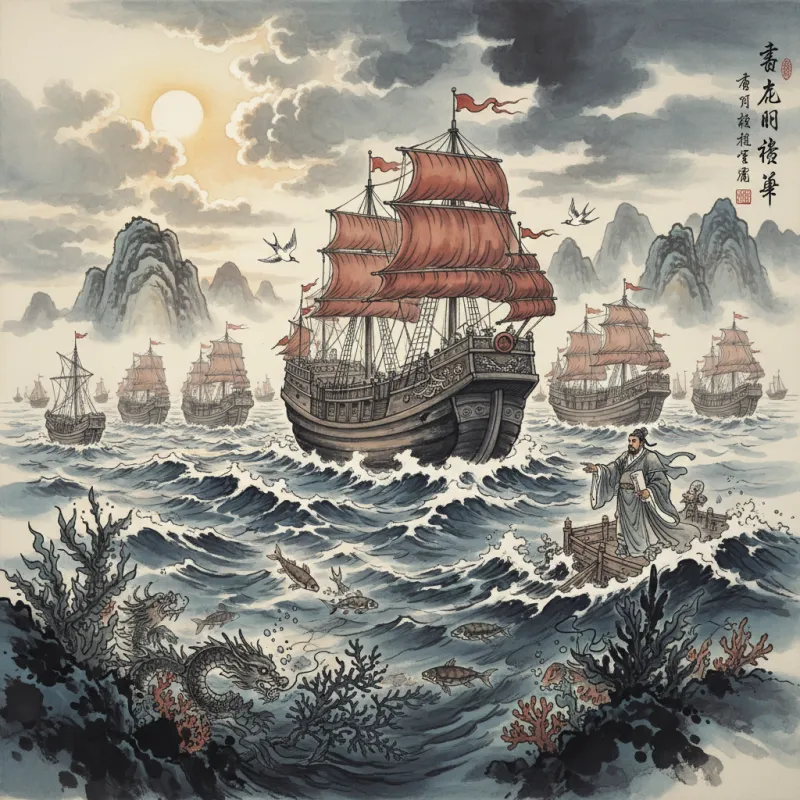
Between 1405 and 1433, Chinese treasure ships the size of football fields crossed the Indian Ocean carrying silk, porcelain, and the authority of the Ming emperor to kingdoms from Java to the coast of Africa. Then, almost overnight, China burned the ships, banned ocean-going vessels, and erased the maritime ambitions of the world's most advanced naval power. What happened?
The Fleet That Made Columbus Look Like a Fisherman
In July 1405, Admiral Zheng He (郑和, Zhèng Hé) commanded a fleet of 317 vessels carrying 27,800 men out of the Yangtze River delta. The flagship — a nine-masted treasure ship called a 宝船 (bǎochuán) — measured over 120 meters long and 50 meters wide. To put this in perspective: Columbus's Santa Maria, which wouldn't sail until 1492, was barely 19 meters long. Zheng He's treasure ships were floating cities with multiple decks, watertight compartments, balanced rudders, and magnetic compasses that made European navigation technology look primitive.
The fleet included warships, supply vessels, water tankers, troop transports, and horse ships. Some carried nothing but gifts: bolts of silk, fine porcelain, lacquerware, and tea. Others were floating armories. The Chinese had gunpowder weapons, including early cannons and fire lances, that could obliterate any naval force they encountered. They never needed to use most of it. The sheer scale of the fleet was the message.
This wasn't exploration in the European sense — stumbling onto continents by accident while searching for spice routes. The Ming Dynasty (明朝, Míng Cháo, 1368-1644) already knew where these places were. Chinese merchants and Arab traders had been crossing the Indian Ocean for centuries. This was a demonstration of power, a projection of imperial authority across the maritime world, and possibly the most expensive diplomatic mission in history.
From Prisoner to Admiral: The Unlikely Rise of Ma He
Zheng He wasn't born with that name, and he wasn't born Chinese in the ethnic sense that mattered to the Ming court. He was born Ma He (马和, Mǎ Hé) in 1371 in Yunnan province, to a Hui Muslim family descended from Persian or Central Asian migrants. His father and grandfather had both made the hajj to Mecca, and the family served the Mongol Yuan Dynasty that the Ming had just overthrown.
When Ming forces conquered Yunnan in 1381, ten-year-old Ma He was captured, castrated, and made a 宦官 (huànguān) — a eunuch servant. This brutal practice was standard for conquered populations, and it marked him for life. But it also gave him access to the imperial court. He was assigned to the household of Zhu Di (朱棣, Zhū Dì), the Prince of Yan, and proved himself in military campaigns. When Zhu Di seized the throne in 1402 through a bloody civil war — becoming the Yongle Emperor (永乐帝, Yǒnglè Dì) — Ma He was one of his most trusted commanders.
The emperor renamed him Zheng He and gave him command of the treasure fleet. It was an extraordinary appointment. Zheng He stood over six feet tall in an era when most Chinese men were barely five feet. He was Muslim in a Confucian court, a eunuch in a society that valued lineage, and a former enemy who became the face of Chinese imperial power across the Indian Ocean. The Yongle Emperor chose well. Zheng He combined military experience, diplomatic skill, linguistic ability (he likely spoke Chinese, Arabic, and possibly Persian), and absolute loyalty to the throne.
Seven Voyages Across the Known World
Between 1405 and 1433, Zheng He led seven major expeditions, each lasting roughly two years. The routes varied, but the pattern was consistent: sail south through the South China Sea, cross to the Strait of Malacca, then fan out across the Indian Ocean to dozens of kingdoms and trading ports.
The third voyage (1409-1411) reached the Malabar Coast of India and Ceylon (Sri Lanka), where Zheng He intervened in a civil war, captured the hostile king, and brought him back to China in chains. The fourth voyage (1413-1415) reached Hormuz in the Persian Gulf, the great entrepôt where goods from the Middle East, Africa, and Asia converged. The seventh and final voyage (1431-1433) sent detachments to Mecca and possibly as far down the African coast as Mozambique.
At each stop, Zheng He delivered gifts, established tributary relationships, and collected exotic goods: giraffes from East Africa (which the Chinese thought were qilin, mythical creatures), lions, leopards, ostriches, zebras, precious stones, spices, and medicinal herbs. He also collected tribute missions — foreign envoys who would travel back to Beijing to acknowledge the Ming emperor's supremacy. More than 30 kingdoms sent missions to the Ming court during this period, from Siam and Java to Bengal and Aden.
The fleet also dealt with pirates and hostile rulers. In 1407, Zheng He's forces destroyed the pirate Chen Zuyi's fleet near Palembang in Sumatra, killing over 5,000 pirates. In 1411, as mentioned, he captured the king of Ceylon. These weren't voyages of conquest — China didn't establish colonies — but they made clear that Chinese naval power was unmatched.
The Technology That Made It Possible
Chinese shipbuilding in the early 15th century was centuries ahead of Europe. The treasure ships used watertight bulkhead compartments — if one section flooded, the others remained sealed. European ships wouldn't adopt this technology until the 18th century. They had balanced rudders mounted on the sternpost, allowing precise steering of massive vessels. They used multiple masts with lug sails that could be adjusted for different wind conditions.
Navigation relied on detailed charts, compass bearings, and astronomical observations. Chinese sailors used a technique called 牵星术 (qiānxīngshù) — "star-pulling navigation" — measuring the altitude of stars above the horizon with their fingers to determine latitude. They had rutters (航海指南, hánghǎi zhǐnán) — detailed sailing directions noting landmarks, depths, currents, and safe anchorages for every route.
The ships themselves were built using camphor wood and tung oil, making them resistant to rot and marine borers. The largest treasure ships may have been somewhat smaller than the 120-meter estimates — some modern scholars suggest 60-80 meters is more realistic given the structural limitations of wooden ships — but even at the conservative estimate, they dwarfed anything else on the water.
Compare this to the maritime technology of the Silk Road era, and the advancement is staggering. Within a few generations, China had gone from coastal trading junks to ocean-going super-ships that could carry thousands of tons of cargo across open water.
Why China Turned Its Back on the Sea
Here's the mystery that haunts historians: after 1433, China stopped. The treasure voyages ended with Zheng He's death. The Yongle Emperor had died in 1424, and his successors had different priorities. The Confucian bureaucracy, which had always opposed the voyages as wasteful, gained influence. In 1436, the court ordered the construction of ocean-going ships to cease. In 1500, it became a capital offense to build a ship with more than two masts. In 1525, coastal authorities were ordered to destroy all ocean-going ships and arrest their owners.
The reasons were complex. The voyages were phenomenally expensive — some estimates suggest they consumed a significant portion of the imperial budget. They didn't generate profit in the way European voyages would; they were about prestige, not trade. The Confucian elite viewed merchants and maritime trade as vulgar, beneath the dignity of a great civilization. They believed China was the 中国 (Zhōngguó) — the "Middle Kingdom" — and the world should come to China, not the other way around.
There were also practical concerns. The Mongols were threatening the northern borders. The Grand Canal needed constant maintenance. The capital had moved from Nanjing to Beijing, shifting focus inland. Maritime trade continued through private merchants and smugglers, but the state withdrew from the sea.
This decision had world-historical consequences. When Portuguese ships reached the Indian Ocean in 1498, they found a power vacuum. The trading networks were still there — Arab, Indian, and Chinese merchants still crossed these waters — but there was no dominant naval power. Within decades, European nations would establish colonial empires across Asia. China, which had possessed the technology and resources to dominate the Indian Ocean, had voluntarily retreated.
The Legacy of the Treasure Fleet
Zheng He became a folk hero, especially among Chinese Muslims and overseas Chinese communities in Southeast Asia. Temples dedicated to him dot the coasts of Malaysia, Indonesia, and Thailand. In China, he's remembered as a symbol of Chinese maritime achievement and, more recently, as a counterpoint to Western colonialism — proof that China could project power without conquest.
The treasure voyages also left a genetic legacy. Chinese communities throughout Southeast Asia trace their origins partly to this period of intensive contact. The tribute system that Zheng He reinforced shaped East Asian international relations for centuries.
But the most significant legacy might be the road not taken. Imagine if China had continued building its navy, establishing trading posts, and projecting power across the Indian Ocean. The age of European colonialism might never have happened, or at least not in the form we know. The decision to abandon the sea was rational from the perspective of Confucian bureaucrats in Beijing, but it changed the course of world history.
Today, as China builds a modern blue-water navy and promotes the Belt and Road Initiative, officials explicitly invoke Zheng He's voyages as historical precedent — peaceful trade and diplomacy, not conquest. Whether that comparison holds up is debatable, but it shows how a eunuch admiral from Yunnan, commanding wooden ships six centuries ago, still shapes how China sees itself and its place in the world.
The treasure ships are gone, burned or rotted away. But the memory of when China ruled the seas remains, a reminder that history's trajectories are never inevitable, and that the choices of emperors and bureaucrats can echo for centuries.
Related Reading
- The Silk Road: A Complete Beginner's Guide
- The Silk Road Was Not About Silk: What Actually Traveled Between China and the West
- The Silk Road Was Not a Road (And Other Things You Got Wrong)
- How Buddhism, Islam, and Christianity Traveled the Silk Road
- Unveiling the Role of Women in Ancient Chinese Dynasties
- Ancient Chinese Dynasties and Emperors: Legal Systems, Battles, and Cultural Legacy
- The Yuan Dynasty: When Mongols Ruled China