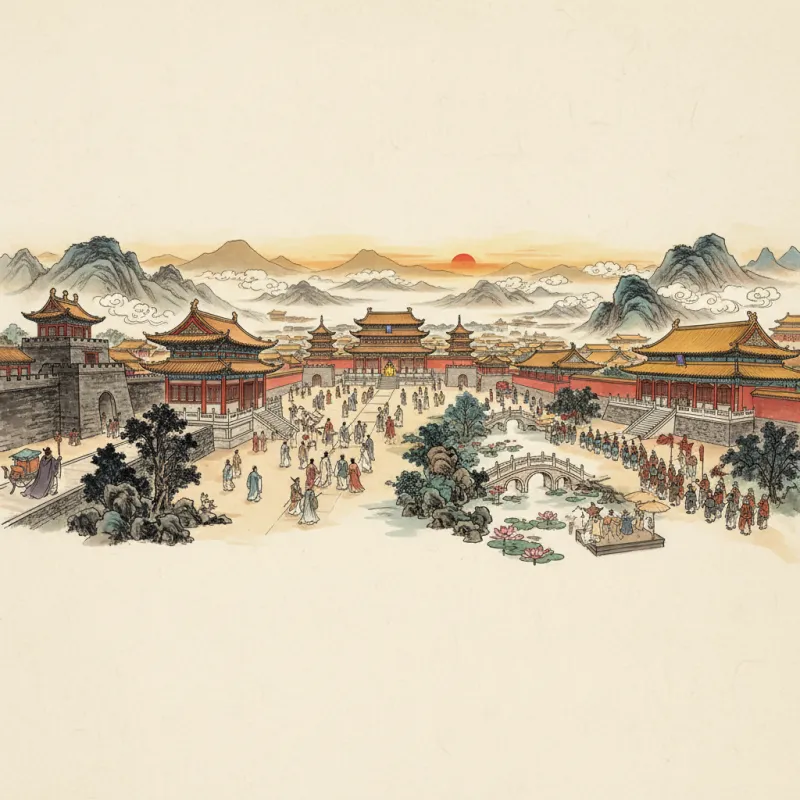
The Forbidden City's vermillion walls rise 10 meters high, enclosing 980 buildings that took 14 years and over a million workers to complete. Yet this Ming dynasty masterpiece represents just one chapter in a 4,000-year architectural saga where every roof tile, every carved beam, and every courtyard layout encoded the cosmic order itself. Ancient Chinese architecture wasn't merely about shelter—it was philosophy made tangible, power rendered in wood and stone.
The Timber Frame Revolution: China's Architectural DNA
While Mediterranean civilizations built with stone and Rome perfected the arch, Chinese architects chose a radically different path: the timber frame system known as dougong (斗拱, dǒugǒng). These interlocking wooden brackets, visible beneath the eaves of nearly every significant Chinese building, distributed weight without a single nail. The earliest confirmed dougong appears in a tomb mural from the Warring States period (475-221 BCE), but the system reached its zenith during the Song dynasty (960-1279).
The genius of timber construction lay in its flexibility. When earthquakes struck—and they struck often across China's seismically active regions—wooden buildings swayed rather than crumbled. The Yingxian Wooden Pagoda in Shanxi, built in 1056, has survived multiple earthquakes that registered above 6.0 on the Richter scale. At 67 meters tall, it remains the world's oldest wooden pagoda, a testament to Song engineering that modern architects still study.
This construction method also enabled rapid assembly and disassembly. The Qing dynasty's Gongcheng Zuofa (工程做法, "Structural Regulations"), published in 1734, standardized building components so thoroughly that carpenters could prefabricate entire structures. It's no coincidence that Chinese armies could erect fortified camps overnight—their architectural system was modular by design.
The Cosmological Blueprint: Feng Shui and Axial Planning
Every significant Chinese building faced south. This wasn't arbitrary preference but cosmic necessity. The emperor, as the Son of Heaven, positioned himself facing south to receive the yang energy of the sun while his back remained to the yin darkness of the north. This north-south axis, called zhongzhouxian (中轴线, zhōngzhóuxiàn), organized not just individual buildings but entire cities.
Beijing's central axis, established during the Yuan dynasty (1271-1368) and perfected under the Ming, stretches 7.8 kilometers from the Bell Tower through the Forbidden City to the Temple of Heaven. Every gate, every hall, every courtyard aligns with mathematical precision. The emperor's throne in the Hall of Supreme Harmony sits at the exact center of this axis—the literal middle of the Middle Kingdom.
But feng shui (风水, fēngshuǐ) demanded more than cardinal alignment. Buildings required protection from malevolent spirits that traveled in straight lines, hence the ubiquitous spirit walls (yingbi, 影壁) that blocked direct entry into courtyards. Water features had to flow from west to east, mimicking the cosmic flow of qi. Mountains should rise behind structures, providing the protective embrace of the Black Tortoise, while open spaces before them allowed the Azure Dragon and White Tiger to guard the flanks.
The Tang dynasty capital of Chang'an (modern Xi'an) embodied these principles on an unprecedented scale. With a population exceeding one million, it was the world's largest city in the 8th century, laid out in a perfect grid that divided the city into 108 wards. Each ward was a walled mini-city, and the entire metropolis oriented itself around the imperial palace complex at its northern end. When Japanese envoys visited Chang'an, they were so impressed they modeled their own capitals—Nara and Kyoto—directly on its design.
Dynastic Signatures: From Han Simplicity to Qing Extravagance
The Han dynasty (206 BCE-220 CE) favored austere elegance. Archaeological evidence from tomb models reveals single-story buildings with simple hip-and-gable roofs. The Han aesthetic prioritized function and cosmic harmony over ornamentation. Their watchtowers, like those preserved along the Silk Road, used rammed earth construction that could withstand desert winds for centuries.
Everything changed with the Tang dynasty (618-907). Tang architecture exploded with color and confidence, reflecting an empire at its zenith. Roof ridges curved upward in the distinctive yangjiao (仰角) style that would become synonymous with Chinese architecture worldwide. The Giant Wild Goose Pagoda in Xi'an, built in 652 to house Buddhist scriptures brought from India, showcases Tang proportions: bold, vertical, and unapologetically grand. Tang builders also perfected the diantang (殿堂) style, where massive halls sat atop raised platforms, their roofs supported by forests of columns that created vast interior spaces without walls.
The Song dynasty brought intellectual refinement. Song architects codified building standards in the Yingzao Fashi (营造法式, "Treatise on Architectural Methods"), completed in 1103 by Li Jie. This 34-volume masterwork documented everything from dougong ratios to paint formulas, establishing proportional systems that governed Chinese architecture for centuries. Song buildings favored subtlety over spectacle—notice how the Longxing Temple's main hall in Hebei uses gentle roof curves and restrained decoration to achieve monumentality through proportion rather than ornament.
The Ming dynasty (1368-1644) returned to bold statements. Ming builders loved yellow glazed tiles, which only imperial structures could use, and they weren't shy about deploying them. The Forbidden City's golden roofs consumed so much glaze that dedicated kilns operated solely to supply the palace. Ming architecture also embraced defensive thinking—the Great Wall's most iconic sections, with their crenellated watchtowers and beacon platforms, date from this period. The Ming rebuilt the wall using brick and stone rather than rammed earth, creating the structure tourists photograph today.
The Qing dynasty (1644-1912) added Manchu and Tibetan influences to the Han architectural vocabulary. The Summer Palace's Tibetan-style pagoda and the Putuo Zongcheng Temple in Chengde, which mimics Lhasa's Potala Palace, reflect the Qing emperors' multi-ethnic empire. Qing architecture also went baroque—more decoration, more color, more everything. Compare the restrained Song-era halls with the Qing's Hall of Prayer for Good Harvests at the Temple of Heaven, where blue tiles, red columns, and gold details create an almost overwhelming visual symphony.
Sacred Spaces: Temples, Pagodas, and the Architecture of Belief
Buddhism's arrival during the Han dynasty revolutionized Chinese architecture by introducing the pagoda. Adapted from Indian stupas, Chinese pagodas evolved into distinctly native forms. The earliest surviving example, the Songyue Pagoda in Henan (523 CE), uses brick to create a 12-sided tower that tapers elegantly skyward. By the Tang dynasty, pagodas had become calling cards for Buddhist temples, their multiple eaves creating rhythmic vertical compositions that punctuated city skylines.
Daoist temples followed different principles. Rather than announcing themselves with vertical towers, Daoist complexes nestled into mountainsides, their buildings ascending in terraces that followed natural topography. The Hanging Temple (Xuankong Si, 悬空寺) in Shanxi, built in 491, clings to a cliff face 75 meters above the ground, its wooden halls supported by oak crossbeams driven into the rock. This isn't just architectural bravado—it's Daoist philosophy made manifest, demonstrating harmony with nature rather than dominance over it.
Confucian temples, by contrast, emphasized earthbound order. The Temple of Confucius in Qufu, the sage's hometown, sprawls across 16,000 square meters in a layout that mirrors imperial palaces. Its courtyards progress from outer to inner, public to sacred, each transition marked by gates and walls that enforce hierarchical progression. The main hall, Dacheng Hall, rebuilt in 1724, uses 28 stone columns carved with dragons—two more than the Forbidden City's Hall of Supreme Harmony, a rare exception to strict hierarchical rules justified by Confucius's supreme cultural status.
The Courtyard House: Architecture of Daily Life
While palaces and temples impressed, the siheyuan (四合院, sìhéyuàn)—the courtyard house—shaped how millions lived. This residential form, perfected during the Yuan and Ming dynasties, organized family life around a central courtyard open to the sky. The main hall faced south, housing the family patriarch. Side wings accommodated younger generations, with strict rules governing who occupied which rooms based on age, gender, and status.
Beijing's hutong neighborhoods consisted of thousands of these courtyard houses arranged along narrow alleys. Each siheyuan turned inward, presenting blank walls to the street while reserving beauty and light for family members. This architectural introversion reflected Confucian values: privacy, hierarchy, and the primacy of family over public life. The courtyard itself functioned as an outdoor room where children played, elders conversed, and seasonal changes marked time's passage.
Southern China developed variations suited to different climates. Fujian's tulou (土楼, tǔlóu)—massive circular earthen buildings—housed entire clans in fortress-like structures that could shelter hundreds. Built between the 12th and 20th centuries, these communal dwellings used rammed earth walls up to 1.8 meters thick, creating defensible compounds during periods of banditry and unrest. The largest, Chengqi Lou, contains 400 rooms arranged in concentric circles, a village within a building.
Anhui's huizhou (徽州) merchants built courtyard houses with distinctive white walls and black tiles, their interiors featuring elaborate wood carvings that displayed wealth earned from salt and tea trades. These houses incorporated tianjing (天井, tiānjǐng)—small interior courtyards that brought light deep into narrow urban plots while collecting rainwater in central pools. The Huizhou saying "fat water doesn't flow to outsiders' fields" referred to this practice of capturing every drop within family walls, but it equally described their architectural philosophy of self-containment.
Gardens: Landscape as Architecture
Chinese gardens weren't landscaping—they were architecture without roofs. The classical gardens of Suzhou, developed primarily during the Ming and Qing dynasties, compressed entire landscapes into walled compounds where every rock, pond, and pavilion was positioned with painterly precision. The Humble Administrator's Garden, created in 1509 by a retired official, uses water to occupy three-fifths of its space, creating the illusion of vastness within 5.2 hectares.
Garden designers followed principles articulated in Yuanye (园冶, "The Craft of Gardens"), written by Ji Cheng in 1631. The goal wasn't naturalism but rather capturing nature's essence through artful arrangement. Rocks from Lake Tai, prized for their grotesque perforations, represented mountains. Winding paths prevented visitors from seeing the entire garden at once, creating the experience of youyuan (游园)—garden wandering—where each turn revealed new compositions.
Pavilions, bridges, and covered walkways structured these spaces while framing views like three-dimensional paintings. The Lingering Garden's Celestial Hall of Five Peaks uses windows shaped like fans, flowers, and gourds to frame specific garden scenes, transforming landscape into living scrolls. This wasn't accidental—many garden owners were literati painters who designed their gardens as inhabitable artworks, places where poetry, painting, and architecture merged.
Legacy in Wood and Stone
When the Yingxian Wooden Pagoda sways in earthquakes, when the Forbidden City's drainage system handles Beijing's summer downpours without flooding, when Fujian's tulou maintain comfortable interior temperatures without air conditioning, ancient Chinese architecture proves its sophistication. These weren't primitive structures awaiting Western improvement—they represented alternative solutions to universal problems, solutions that often surpassed their contemporaries elsewhere.
Modern Chinese architecture grapples with this inheritance. Should it preserve, adapt, or transcend these traditions? The debate continues in every new building that rises in Chinese cities, each one negotiating between a 4,000-year architectural legacy and the demands of contemporary life. But walk through any surviving hutong, any temple courtyard, any classical garden, and the old principles still resonate: harmony with nature, cosmic order made visible, and the belief that how we build shapes how we live.
The vermillion walls still stand, though now they're surrounded by glass towers rather than tile-roofed neighborhoods. Yet those walls remember when architecture encoded the universe itself, when every beam and bracket connected earth to heaven, when building wasn't just construction but cosmology. That memory, preserved in wood and stone, remains ancient China's gift to world architecture—not just beautiful buildings, but a complete philosophy of space, order, and human dwelling.
Related Reading
- Women Who Changed Chinese History: Warriors, Empresses, and Rebels
- The Three Kingdoms: Why China's Favorite Story Is About Failure
- The Porcelain Trade: How Chinese Pottery Conquered the World