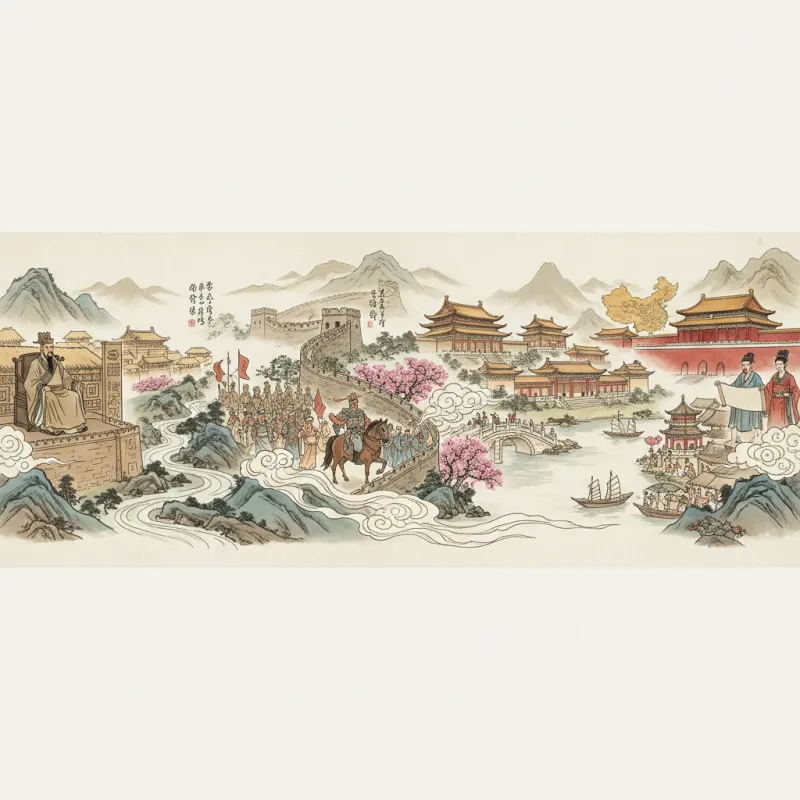
The peasant rebel Zhu Yuanzhang stood in the ruins of the Mongol palace in 1368, surrounded by the ashes of the Yuan dynasty. Within a generation, he would transform China from Mongol occupation into the Ming dynasty — one of history's most prosperous civilizations. This wasn't unusual. For four millennia, Chinese history has moved in cycles: dynasties rise with vigor, consolidate power, grow corrupt, collapse, and are replaced. Understanding these cycles isn't just academic — it's the key to understanding how 1.4 billion people conceptualize their past, present, and future.
The Dynasty System: More Than Just Rulers
Chinese history is organized by 朝代 (cháodài) — dynasties — a framework so fundamental that educated Chinese can recite the major dynasty names in order the way Westerners might recite their ABCs. The sequence — Xia, Shang, Zhou, Qin, Han, Three Kingdoms, Jin, Sui, Tang, Song, Yuan, Ming, Qing — isn't merely a timeline. It's a conceptual framework that shapes how Chinese civilization understands itself.
Each dynasty represents a ruling family that held the 天命 (Tiānmìng) — the Mandate of Heaven. This wasn't metaphorical. Chinese political philosophy held that legitimate rulers governed by divine sanction, which could be revoked if the ruler became corrupt, incompetent, or lost the people's trust. Natural disasters, famines, and rebellions were interpreted as Heaven's warning signs. When a dynasty fell, it meant Heaven had withdrawn its mandate. When a new dynasty rose, Heaven had granted a fresh start.
This created a remarkably stable yet flexible political system. Unlike European monarchies that claimed divine right regardless of performance, Chinese dynasties had to justify their rule continuously. A peasant rebel could overthrow an emperor and establish a new dynasty — and be considered legitimate if he succeeded. Zhu Yuanzhang, the Ming founder, was a former Buddhist monk and beggar. Liu Bang, who founded the Han dynasty, was a village official. The system was theoretically meritocratic, even if the reality was bloodier.
The Ancient Foundations: Xia, Shang, and Zhou
The Xia dynasty (c. 2070-1600 BCE) exists in that murky zone between legend and history. Traditional accounts describe Yu the Great taming floods and establishing the first hereditary dynasty, but archaeological evidence remains inconclusive. Most historians treat it as semi-mythical, though recent excavations at Erlitou suggest a sophisticated Bronze Age culture that might correspond to Xia.
The Shang dynasty (c. 1600-1046 BCE) is where Chinese history becomes verifiable. Oracle bones — turtle shells and ox scapulae inscribed with early Chinese characters — provide direct evidence of Shang rulers, their concerns, and their worldview. They were obsessed with divination, ancestor worship, and human sacrifice. Shang tombs contain hundreds of sacrificial victims, along with bronze vessels of stunning artistry. The Shang established patterns that would persist: a king ruling from a capital, supported by a nobility, governing through ritual and military force.
The Zhou dynasty (1046-256 BCE) lasted longer than any other — nearly 800 years — though its later centuries dissolved into chaos. The Zhou introduced the Mandate of Heaven concept to justify their overthrow of the Shang. They also developed the fengjian system, often compared to European feudalism, where the king granted lands to relatives and allies who ruled semi-autonomously. This worked until it didn't. By the Spring and Autumn period (770-476 BCE) and the subsequent Warring States period (475-221 BCE), Zhou authority was fiction. Dozens of states fought for supremacy, but this chaos produced China's greatest philosophical flowering: Confucius, Laozi, Mozi, Mencius, Zhuangzi, and the other "Hundred Schools of Thought" all emerged during this period of crisis.
The Imperial Template: Qin and Han
The Qin dynasty (221-206 BCE) lasted only 15 years but transformed China permanently. Qin Shi Huang, the First Emperor, unified the warring states through brutal military conquest and even more brutal standardization. He standardized writing, currency, weights, measures, and even axle widths so carts could use the same roads. He built the early Great Wall, burned books, buried scholars alive, and created a centralized bureaucratic state that replaced feudalism. His tomb, guarded by the famous Terracotta Army, reflects his megalomania. The Qin collapsed almost immediately after his death, but its administrative template persisted.
The Han dynasty (206 BCE - 220 CE) refined what the Qin created. Liu Bang, the peasant-turned-emperor, established a dynasty that would last four centuries and give the Chinese people their ethnic name — the Han. The Han adopted Confucianism as state ideology, created the civil service examination system (in embryonic form), expanded Chinese territory dramatically, and opened the Silk Road. The historian Sima Qian wrote his monumental Records of the Grand Historian during the Han, establishing the biographical-annalistic format that would define Chinese historiography. When Chinese people today speak of "Han culture" or "Han Chinese," they're referencing this dynasty's enduring influence.
The Han split into Western Han (206 BCE - 9 CE) and Eastern Han (25-220 CE), interrupted by Wang Mang's brief Xin dynasty. Its collapse led to the Three Kingdoms period — immortalized in the Romance of the Three Kingdoms novel — where warlords Cao Cao, Liu Bei, and Sun Quan fought for supremacy. This period of division lasted until the Sui dynasty reunified China in 589 CE.
The Golden Age: Tang and Song
The Tang dynasty (618-907 CE) represents Chinese civilization at its most cosmopolitan and confident. Chang'an, the Tang capital, was the world's largest city, home to over a million people including merchants, monks, and diplomats from across Asia. Tang poetry — by Li Bai, Du Fu, Wang Wei, and others — remains the pinnacle of Chinese literature. The Tang was militarily powerful, culturally sophisticated, and religiously tolerant. Buddhism flourished alongside Daoism and Confucianism. Women enjoyed relatively high status; Wu Zetian even became China's only female emperor.
The Tang's decline began with the An Lushan Rebellion (755-763 CE), a catastrophic civil war that killed millions and shattered the dynasty's confidence. It limped along for another century and a half before collapsing into the Five Dynasties and Ten Kingdoms period — another era of fragmentation.
The Song dynasty (960-1279 CE) reunified most of China but never matched the Tang's military power. What it lacked in martial prowess, it compensated with economic and cultural sophistication. The Song experienced what historians call a "medieval economic revolution" — paper money, credit systems, urbanization, and technological innovation. Movable type printing, gunpowder weapons, and the magnetic compass all developed or matured during the Song. Neo-Confucianism, synthesized by Zhu Xi, became the dominant philosophy. Song landscape painting and ceramics remain unsurpassed.
The Song split into Northern Song (960-1127) and Southern Song (1127-1279) after losing northern China to the Jurchen Jin dynasty. Eventually, both fell to the Mongols, who established the Yuan dynasty — China's first conquest by foreign invaders.
Foreign Rule and Restoration: Yuan, Ming, and Qing
The Yuan dynasty (1271-1368 CE), established by Kublai Khan, ruled China as part of the vast Mongol Empire. The Mongols maintained ethnic hierarchies, with Mongols at the top, followed by Central Asians, northern Chinese, and southern Chinese at the bottom. They employed foreigners like Marco Polo in administration to avoid relying on Chinese officials. Despite this, Chinese culture influenced the Mongols more than vice versa. The Yuan adopted Chinese administrative practices, patronized Chinese arts, and gradually sinicized. Still, Chinese resentment simmered, erupting in rebellions that eventually brought Zhu Yuanzhang to power.
The Ming dynasty (1368-1644 CE) began as a restoration of native Chinese rule. Zhu Yuanzhang, now the Hongwu Emperor, was paranoid and ruthless, purging tens of thousands of officials in anti-corruption campaigns. His son, the Yongle Emperor, moved the capital to Beijing, built the Forbidden City, and sponsored Zheng He's massive maritime expeditions — fleets of hundreds of ships that reached Africa decades before European exploration began. Then, inexplicably, China turned inward. The treasure voyages stopped, maritime trade was restricted, and China focused on internal stability rather than external expansion. This decision would have profound consequences when European powers arrived centuries later.
The Ming fell to a combination of internal rebellion and external invasion. Li Zicheng's peasant rebellion captured Beijing in 1644, causing the last Ming emperor to hang himself. The Manchus, a semi-nomadic people from the northeast, seized the opportunity to invade, claiming they were restoring order and establishing the Qing dynasty (1644-1912 CE).
The Qing was China's last dynasty and its second period of foreign rule. The Manchus were even more successful than the Mongols at maintaining their identity while ruling China. They required Chinese men to wear the queue hairstyle as a sign of submission, maintained the banner system for Manchu military organization, and prohibited intermarriage. Yet they also adopted Confucian governance, patronized Chinese culture, and expanded China to its greatest territorial extent, incorporating Xinjiang, Tibet, and Mongolia.
The Qing's early emperors — particularly Kangxi, Yongzheng, and Qianlong — presided over a prosperous, stable empire. But by the 19th century, the dynasty faced crises it couldn't solve: population pressure, administrative corruption, and most devastatingly, Western imperialism. The Opium Wars, Taiping Rebellion, and subsequent "century of humiliation" shattered the traditional order. The Qing finally collapsed in 1912, ending not just a dynasty but the entire imperial system that had structured Chinese civilization for millennia.
The Dynasty Cycle: Pattern and Reality
Chinese historians identified a recurring pattern: a dynasty begins with a vigorous founder who unifies the country and establishes good governance. His successors consolidate power and preside over prosperity. Eventually, later emperors grow weak or corrupt, officials become self-serving, taxes increase, infrastructure decays, and natural disasters strike. Rebellions erupt, the dynasty fragments, and a new founder emerges to restart the cycle.
This 治乱循环 (zhì luàn xúnhuán) — "cycle of order and chaos" — shaped how Chinese understood history as cyclical rather than progressive. Unlike Western historical narratives that emphasize linear progress, Chinese historiography saw patterns repeating. This wasn't fatalism but rather a framework for understanding political legitimacy and social change.
Modern historians debate how accurately this model reflects reality. Some dynasties don't fit neatly — the Zhou lasted 800 years but was barely functional for most of it. The Tang's decline was gradual, not sudden. The Qing fell to foreign imperialism, not internal rebellion alone. Yet the dynasty cycle remains useful for understanding how Chinese civilization maintained continuity despite repeated political upheavals. The bureaucracy, the examination system, Confucian ideology, and cultural practices persisted across dynasties, creating a civilization that was remarkably stable at its core even as ruling families changed.
Why This Still Matters
Understanding Chinese dynasties isn't just historical trivia. When Xi Jinping references the "Chinese Dream" or the "great rejuvenation of the Chinese nation," he's invoking a narrative where China's current rise represents recovery from the Qing collapse and the century of humiliation. When Chinese officials discuss Taiwan, they reference the Qing's territorial extent. When they emphasize stability and order, they're drawing on millennia of political philosophy about good governance and the Mandate of Heaven.
The dynasty system also explains why Chinese civilization has such strong continuity. Unlike Rome, which fell and fragmented, or Egypt, which was absorbed by other empires, China repeatedly unified after periods of division. The dynasty framework provided a template for reunification: a new founder claims the Mandate of Heaven, establishes a capital, adopts Confucian governance, and restores order. This happened over and over, creating a civilization that's simultaneously ancient and continuously renewed.
For anyone trying to understand modern China — its politics, its self-conception, its historical grievances and ambitions — the dynasties aren't background. They're the foundation. Four thousand years of history don't disappear just because the last emperor abdicated in 1912. They shape how 1.4 billion people understand who they are and where they're going.
Related Reading
- Spring and Autumn to Warring States: China's Age of Philosophy
- The Tang Dynasty: China's Golden Age of Poetry, Power, and Culture
- The Ming Dynasty: Zheng He and China's Age of Exploration
- The Complete Guide to Chinese History: 5,000 Years in One Article
- Exploring the Dynastic Era: A Journey Through Ancient Chinese History
- The Battle of Changping: 400,000 Buried Alive
- Chinese Architecture: Forbidden Cities, Pagodas, and Garden Design
- The Silk Road Was Not a Road (And Other Things You Got Wrong)