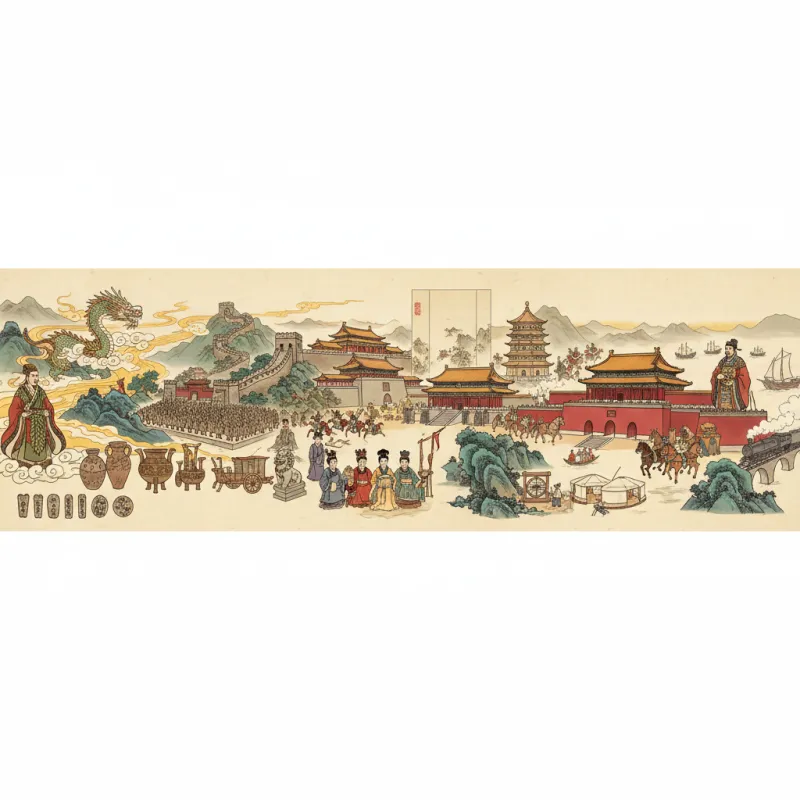
Picture this: a single family ruling for nearly 800 years, longer than the entire history of the United States. That's the Zhou Dynasty. Now imagine that dynasty is just one chapter in a story that spans fifty centuries. China's dynastic timeline isn't just a list of rulers—it's a continuous thread of civilization that survived invasions, revolutions, and the rise and fall of empires across the globe. While Rome crumbled and Europe fragmented into feuding kingdoms, Chinese dynasties kept meticulous records, built on each other's innovations, and created a cultural continuity unmatched in human history.
The Legendary Foundations (c. 2852-1600 BCE)
Before history became history, there was myth—but Chinese myth with a peculiar characteristic: it gradually solidifies into archaeological fact. The Three Sovereigns and Five Emperors (三皇五帝, Sānhuáng Wǔdì) weren't just creation myths. The Yellow Emperor (黄帝, Huángdì), traditionally dated to around 2697 BCE, is credited with inventing everything from the compass to traditional Chinese medicine. Exaggeration? Certainly. But recent archaeological discoveries keep pushing China's civilizational origins earlier and earlier.
The Xia Dynasty (夏朝, Xià Cháo, c. 2070-1600 BCE) was long dismissed as pure legend until excavations at Erlitou revealed a sophisticated Bronze Age culture that matches the traditional dates almost perfectly. Yu the Great (大禹, Dà Yǔ) supposedly founded the dynasty after taming catastrophic floods—and geological evidence now confirms massive flooding in the Yellow River valley around 1920 BCE. The line between myth and history in China is thinner than we thought.
The Bronze Age Powerhouses (1600-256 BCE)
The Shang Dynasty (商朝, Shāng Cháo, c. 1600-1046 BCE) is where Chinese history becomes undeniable. Oracle bones—turtle shells and ox scapulae inscribed with divination questions—provide the earliest confirmed Chinese writing. These weren't primitive scratchings; the script was already sophisticated, suggesting centuries of prior development. Shang bronze work remains unsurpassed in technical mastery, with ritual vessels so intricate they seem impossible without modern tools.
Then came the Zhou Dynasty (周朝, Zhōu Cháo, 1046-256 BCE), and here's where it gets interesting. The Zhou didn't just conquer the Shang—they invented political philosophy to justify it. The Mandate of Heaven (天命, Tiānmìng) became the cornerstone of Chinese political thought: rulers govern by divine approval, but lose that mandate through corruption or incompetence. This wasn't just propaganda; it created a framework where rebellion against bad rulers became morally justified, even necessary.
The Zhou split into Western Zhou (西周, Xī Zhōu, 1046-771 BCE) and Eastern Zhou (东周, Dōng Zhōu, 770-256 BCE), with the Eastern period subdividing into the Spring and Autumn Period (春秋, Chūnqiū, 770-476 BCE) and the Warring States Period (战国, Zhànguó, 475-221 BCE). These weren't peaceful transitions. The Warring States period was exactly what it sounds like—seven major kingdoms locked in total war, developing military technology, bureaucratic systems, and philosophical schools at a breakneck pace. Confucius, Laozi, Sunzi, Mozi, Zhuangzi—all emerged from this crucible of chaos. War, it turns out, is excellent for innovation.
The First Empire and Its Immediate Collapse (221 BCE-220 CE)
Qin Shi Huang (秦始皇, Qín Shǐhuáng) of the Qin Dynasty (秦朝, Qín Cháo, 221-206 BCE) unified China through sheer brutality and organizational genius. He standardized writing, currency, weights, and measures—creating a unified state from warring kingdoms. He built the first version of the Great Wall. He buried scholars alive and burned books. He died searching for immortality elixirs, probably poisoned by mercury. His dynasty collapsed within years of his death, but the template was set: China would be an empire, not a collection of states.
The Han Dynasty (汉朝, Hàn Cháo, 206 BCE-220 CE) that followed became the golden standard. So influential that ethnic Chinese still call themselves "Han people" (汉人, Hànrén). The Han established the Silk Road, invented paper, created the civil service examination system, and expanded Chinese territory to its greatest extent yet. Emperor Wu (汉武帝, Hàn Wǔdì, r. 141-87 BCE) made Confucianism the state ideology—a decision that would shape Chinese governance for two millennia. The Han lasted over 400 years, briefly interrupted by Wang Mang's Xin Dynasty (新朝, Xīn Cháo, 9-23 CE), creating the Western Han and Eastern Han periods.
The Age of Division (220-589 CE)
After the Han collapsed, China fragmented into the Three Kingdoms (三国, Sānguó, 220-280 CE)—Wei, Shu, and Wu—immortalized in the Romance of the Three Kingdoms, one of China's greatest novels. This period of division continued through the Jin Dynasty (晋朝, Jìn Cháo, 266-420 CE) and the Northern and Southern Dynasties (南北朝, Nánběi Cháo, 420-589 CE).
Don't let the chaos fool you—this was a period of incredible cultural development. Buddhism flooded into China, transforming Chinese philosophy and art. The Sixteen Kingdoms period in the north saw non-Han peoples establishing dynasties, enriching Chinese culture with new perspectives. Poetry flourished. Calligraphy became high art. Sometimes civilization advances fastest when political unity breaks down.
The Second Golden Age (581-907 CE)
The Sui Dynasty (隋朝, Suí Cháo, 581-618 CE) reunified China but burned itself out in a generation through overambitious projects—particularly the Grand Canal, which remains the world's longest canal. The Sui's collapse gave birth to the Tang Dynasty (唐朝, Táng Cháo, 618-907 CE), often considered China's greatest dynasty.
The Tang was cosmopolitan, confident, and culturally explosive. Chang'an (modern Xi'an) became the world's largest city, filled with merchants from Persia, India, and beyond. Women enjoyed unprecedented freedom—Empress Wu Zetian (武则天, Wǔ Zétiān) became China's only female emperor. Poetry reached heights never matched since; Li Bai and Du Fu wrote verses that every educated Chinese person still memorizes. The Tang invented woodblock printing, perfected porcelain, and created a bureaucratic system so efficient that later dynasties barely modified it. Learn more about this golden age in The Tang Dynasty: China's Golden Age of Poetry and Power.
The Commercial Revolution (907-1279 CE)
After the Tang fell, China split again during the Five Dynasties and Ten Kingdoms period (五代十国, Wǔdài Shíguó, 907-960 CE). The Song Dynasty (宋朝, Sòng Cháo, 960-1279 CE) reunified most of China, though it never matched the Tang's military power. What the Song lacked in martial prowess, it made up for in economic and technological innovation.
The Song invented or perfected: movable type printing, gunpowder weapons, the compass for navigation, paper money, and advanced shipbuilding. Song China was the world's first society to experience an industrial revolution—coal and iron production reached levels not seen in Europe until the 18th century. The population exploded. Cities grew massive. A merchant class emerged. Neo-Confucianism developed as a philosophical response to Buddhism's challenge.
The Song split into Northern Song (北宋, Běi Sòng, 960-1127 CE) and Southern Song (南宋, Nán Sòng, 1127-1279 CE) after losing northern China to the Jurchen Jin Dynasty (金朝, Jīn Cháo, 1115-1234 CE). But even diminished, the Southern Song remained the world's most advanced economy.
The Mongol Conquest (1271-1368 CE)
The Yuan Dynasty (元朝, Yuán Cháo, 1271-1368 CE) was different—China's first conquest by foreign nomads who ruled the entire country. Kublai Khan established a dynasty that connected China to a Mongol empire stretching from Korea to Hungary. Marco Polo visited. The Silk Road reached its peak. Chinese drama flourished, perhaps because traditional Confucian scholars refused to serve the Mongol court, leaving creative space for popular entertainment.
But the Yuan never fully sinicized. They maintained ethnic hierarchies, with Mongols on top and Han Chinese near the bottom. When the dynasty weakened, rebellion came swiftly.
The Ming Restoration (1368-1644 CE)
The Ming Dynasty (明朝, Míng Cháo, 1368-1644 CE) was a Han Chinese restoration with a chip on its shoulder. The Hongwu Emperor, a former peasant and Buddhist monk, expelled the Mongols and established one of history's most autocratic governments. The Ming rebuilt the Great Wall in its current form, moved the capital to Beijing, and created the Forbidden City.
Early Ming China was outward-looking. Admiral Zheng He (郑和, Zhèng Hé) led massive treasure fleets to Southeast Asia, India, Arabia, and East Africa between 1405 and 1433—ships that dwarfed anything Europe would build for another century. Then, abruptly, China turned inward. The voyages stopped. Maritime trade was restricted. This decision would have profound consequences when European ships arrived centuries later.
The Last Dynasty (1644-1912 CE)
The Qing Dynasty (清朝, Qīng Cháo, 1644-1912 CE) was China's second conquest dynasty, established by the Manchus from northeast of the Great Wall. The Qing expanded China to its greatest territorial extent, incorporating Tibet, Xinjiang, Mongolia, and Taiwan. The Kangxi, Yongzheng, and Qianlong emperors presided over a prosperous 18th century when China was arguably the world's largest economy.
But the 19th century brought catastrophe. The Opium Wars, the Taiping Rebellion (which killed more people than World War I), and repeated military defeats by Western powers and Japan exposed the dynasty's weakness. The Qing attempted reforms—too little, too late. The dynasty fell in 1912, ending not just a dynasty but the entire imperial system that had governed China for over two millennia.
Understanding the Pattern
Chinese dynasties follow a recognizable cycle: a strong founder unifies the country, his successors consolidate power, the dynasty reaches a cultural and economic peak, then gradually declines through corruption, natural disasters, and rebellion until a new dynasty emerges. Historians call this the dynastic cycle (朝代循环, Cháodài Xúnhuán), and it's remarkably consistent across 3,000 years.
But the cycle isn't just repetition—each dynasty built on its predecessors' achievements. The civil service examination system, Confucian ideology, bureaucratic structures, and cultural continuity meant that even when dynasties fell, Chinese civilization persisted. This is what makes China unique: not that it never fell, but that it kept rebuilding itself on the same foundation, maintaining cultural continuity while empires around it rose and vanished without trace.
Related Reading
- The Complete Guide to Chinese History: 5,000 Years in One Article
- The Sui Dynasty: Brief Glory, Lasting Legacy
- The Ming Dynasty: Zheng He and China's Age of Exploration
- Song Dynasty: The World's Most Advanced Civilization
- Ancient Chinese Fashion: What People Really Wore Through the Dynasties
- Ancient Chinese Inventions the West Forgot to Credit
- Ancient Chinese Law: When Justice Was Personal and Punishment Was Public