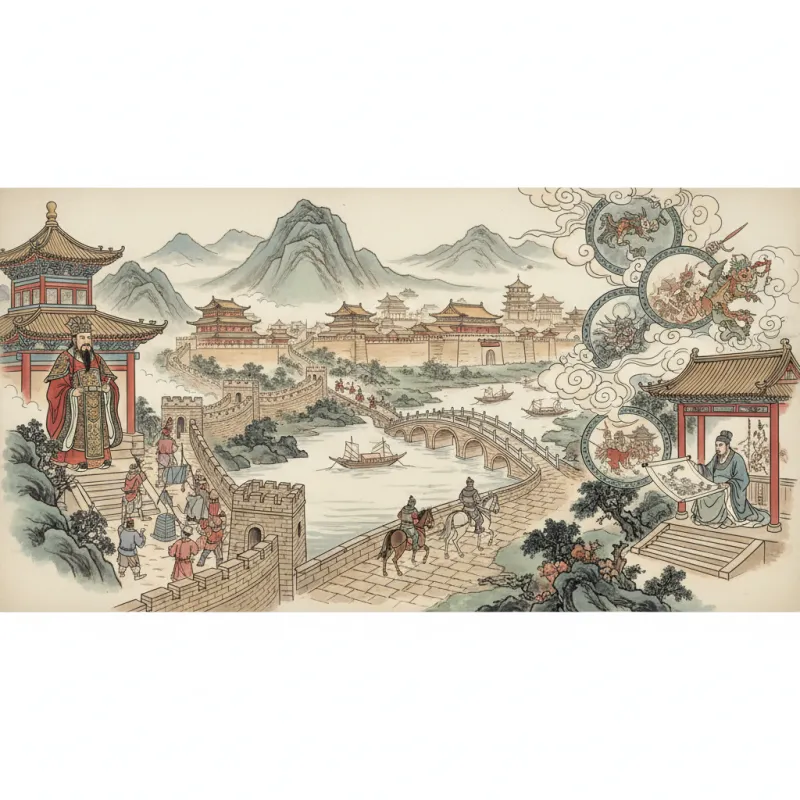
Five thousand years of history compressed into one article? Impossible, you might think. But here's the thing: Chinese civilization doesn't just have length — it has continuity. While Rome fell and Europe fragmented into feuding kingdoms, while the Maya abandoned their cities and the Indus Valley civilization vanished into mystery, China kept going. Dynasties collapsed, sure. Invaders swept in from the steppes. Civil wars tore the country apart. But the cultural thread — the writing system, the philosophical traditions, the bureaucratic structures — never completely broke. That's what makes this story worth telling, and what makes it possible to tell at all.
The Mythical Beginning: When Gods Walked Among Men
Every civilization needs an origin story, and China's is spectacular. The traditional narrative begins with the Three Sovereigns and Five Emperors (三皇五帝, Sān Huáng Wǔ Dì) — semi-divine culture heroes who supposedly ruled before recorded history. Fuxi taught humans to fish and hunt. Shennong, the Divine Farmer, introduced agriculture and herbal medicine (allegedly by tasting hundreds of plants, some poisonous, to determine their properties). The Yellow Emperor, Huangdi, invented writing, the compass, and traditional Chinese medicine.
Pure mythology? Mostly. But here's where it gets interesting: archaeology keeps finding kernels of truth in these legends. The Xia Dynasty (夏朝, Xià Cháo, c. 2070-1600 BCE), long dismissed as mythical, now has archaeological support from the Erlitou culture sites in Henan Province. We've found palace foundations, bronze workshops, and evidence of a stratified society that matches the traditional descriptions. Not proof of the Xia, exactly, but proof that something was happening in that time and place that looked a lot like early state formation.
The Shang Dynasty (商朝, Shāng Cháo, c. 1600-1046 BCE) is where we hit solid ground. Oracle bones — turtle shells and ox scapulae inscribed with early Chinese characters — provide direct written evidence. These weren't literary texts; they were divination records, questions posed to ancestors about everything from military campaigns to toothaches. The Shang kings were obsessed with ancestor worship, human sacrifice, and bronze casting. Their ritual vessels, decorated with taotie monster masks, remain some of the most sophisticated bronze work ever produced.
The Classical Age: Philosophy and Warfare
The Zhou Dynasty (周朝, Zhōu Cháo, 1046-256 BCE) lasted longer than any other Chinese dynasty, but calling it unified is generous. After the Western Zhou capital fell to invaders in 771 BCE, the Eastern Zhou period devolved into the Spring and Autumn period (春秋, Chūn Qiū, 770-476 BCE) and then the Warring States period (战国, Zhàn Guó, 475-221 BCE). China fragmented into dozens of competing kingdoms, each developing its own military innovations, administrative systems, and philosophical schools.
This chaos produced China's golden age of philosophy. Confucius (孔子, Kǒng Zǐ, 551-479 BCE) wandered from court to court, trying to convince rulers to embrace ritual propriety and benevolent governance. He mostly failed during his lifetime, but his disciples compiled his teachings into the Analects (论语, Lúnyǔ), which would shape Chinese thought for millennia. Laozi, the possibly-mythical founder of Daoism, advocated for wu wei (无为, wú wéi) — effortless action in harmony with the natural way. Mozi preached universal love and condemned wasteful rituals. The Legalists, led by thinkers like Han Feizi, argued for strict laws and harsh punishments as the only way to create order.
The Warring States period was also an arms race. Iron weapons replaced bronze. Crossbows became standard infantry weapons. Cavalry tactics evolved. The state of Qin, tucked away in the western mountains, adopted Legalist policies wholesale: standardized laws, meritocratic promotion, collective punishment for crimes, and total mobilization for war. It worked. Between 230 and 221 BCE, Qin conquered all six rival kingdoms and unified China for the first time.
The First Empire: Qin and Han
Qin Shi Huang (秦始皇, Qín Shǐ Huáng, 259-210 BCE), the First Emperor, is one of history's most polarizing figures. He standardized weights, measures, currency, and even the axle width of carts (so they'd fit in the same ruts). He connected and extended defensive walls into what would become the Great Wall. He burned books and buried scholars alive to suppress dissent. He built a tomb guarded by thousands of terracotta warriors, each with unique facial features.
He also created a template for Chinese imperial government that lasted two thousand years: a centralized bureaucracy, divided into provinces and counties, staffed by appointed officials rather than hereditary nobles. The Qin Dynasty collapsed almost immediately after his death — turns out brutal Legalism doesn't inspire loyalty — but the structure survived.
The Han Dynasty (汉朝, Hàn Cháo, 206 BCE-220 CE) refined the Qin model. Emperor Wu (汉武帝, Hàn Wǔ Dì, r. 141-87 BCE) made Confucianism the official state ideology, creating a synthesis of Legalist methods and Confucian values that defined Chinese governance. He also expanded the empire dramatically, pushing into Central Asia, Korea, and Vietnam. The Silk Road opened, connecting China to Rome through a chain of oasis cities and nomadic middlemen.
This was China's first golden age. Paper was invented. Historical writing flourished — Sima Qian's Records of the Grand Historian (史记, Shǐjì) set the standard for all later dynastic histories. The civil service examination system began to take shape, creating a meritocratic path to power (in theory, anyway — in practice, only wealthy families could afford the education required). The Han Dynasty lasted so long and was so successful that "Han" became the ethnic label for the Chinese majority.
Division and Reunification: The Medieval Period
The Han Dynasty's collapse in 220 CE kicked off four centuries of division. The Three Kingdoms period (三国, Sān Guó, 220-280 CE) — immortalized in the Romance of the Three Kingdoms novel — saw China split between Wei, Shu, and Wu. Then came the Jin Dynasty, which briefly reunified the country before collapsing into the Sixteen Kingdoms period, when non-Chinese peoples from the northern steppes established kingdoms across northern China.
This sounds like pure chaos, and it was. But it was also transformative. Buddhism, which had trickled into China during the Han, exploded in popularity. Why? Because traditional Confucianism had no good answers for the suffering and instability people were experiencing. Buddhism offered karma, reincarnation, and the promise of escape from the cycle of suffering. Monasteries became centers of learning, art, and social welfare. The Mogao Caves near Dunhuang, carved and painted over centuries, preserve some of the most stunning Buddhist art ever created.
The Sui Dynasty (隋朝, Suí Cháo, 581-618 CE) reunified China through military conquest and massive infrastructure projects, most notably the Grand Canal, which connected the Yellow River and Yangtze River systems. The dynasty burned out quickly — the second emperor's disastrous Korean campaigns and extravagant building projects sparked rebellions — but it set the stage for the Tang.
The Golden Age: Tang and Song
The Tang Dynasty (唐朝, Táng Cháo, 618-907 CE) is when China became the most advanced civilization on Earth. Chang'an, the capital, was the world's largest city, with over a million residents. The civil service examinations became the primary path to office, creating a genuine meritocracy (though still biased toward the wealthy). Poetry reached heights it would never match again — Li Bai, Du Fu, and Wang Wei wrote verses that every educated Chinese person still memorizes. The only female emperor in Chinese history, Wu Zetian (武则天, Wǔ Zétiān, r. 690-705), proved as capable as any man despite Confucian prejudices.
The Tang was cosmopolitan in a way China wouldn't be again until the modern era. Persian merchants, Arab traders, Indian monks, and Korean scholars filled Chang'an's streets. Foreign religions — Zoroastrianism, Manichaeism, Nestorian Christianity, Islam — all found followers. Chinese culture spread throughout East Asia; Japan and Korea modeled their governments on Tang institutions.
The An Lushan Rebellion (755-763) nearly destroyed the dynasty. A general of Sogdian-Turkic descent, An Lushan commanded the empire's best troops on the northern frontier. When he rebelled, he captured both capitals and declared himself emperor. The Tang survived, but barely, and never fully recovered its earlier glory. Regional military governors became increasingly independent, and the dynasty finally collapsed in 907.
The Song Dynasty (宋朝, Sòng Cháo, 960-1279) never matched the Tang's military power — it lost control of northern China to the Jurchen Jin Dynasty in 1127 — but it was an economic and cultural powerhouse. This was China's commercial revolution: paper money, joint-stock companies, maritime trade networks stretching to East Africa. Movable type printing made books affordable. Neo-Confucianism, synthesized by scholars like Zhu Xi, created a new philosophical orthodoxy that would dominate until the 20th century.
Song China was also an inventor's paradise. Gunpowder weapons evolved from fireworks to bombs to primitive guns. The magnetic compass enabled long-distance navigation. Advances in agriculture — new rice varieties, better irrigation — supported a population boom. Some historians argue that Song China was on the verge of an industrial revolution, centuries before Europe. Then the Mongols arrived.
The Mongol Conquest and Ming Restoration
Genghis Khan and his descendants conquered the largest contiguous land empire in history, and China was their greatest prize. The Mongol conquest was brutal — entire cities were massacred, the population dropped by millions — but the Yuan Dynasty (元朝, Yuán Cháo, 1271-1368) that emerged was surprisingly sophisticated. Kublai Khan employed Chinese advisors, patronized the arts, and maintained the civil service system (though Mongols and other non-Chinese got preferential treatment). Marco Polo's travels, whatever their historical accuracy, introduced Europe to the wealth and sophistication of Mongol China.
The Yuan Dynasty never fully legitimized itself in Chinese eyes. Mongol rulers kept their own language and customs, and ethnic discrimination was official policy. When the dynasty weakened in the 1350s, rebellions erupted across China. A former Buddhist monk and peasant rebel leader, Zhu Yuanzhang, emerged victorious and founded the Ming Dynasty (明朝, Míng Cháo, 1368-1644).
The Ming was a restoration dynasty, consciously modeling itself on the Tang and Song. The Hongwu Emperor, as Zhu Yuanzhang became known, was paranoid and ruthless, purging tens of thousands of officials in anti-corruption campaigns. But he also rebuilt the country's infrastructure, reformed the tax system, and reestablished Chinese cultural pride after a century of foreign rule.
The Yongle Emperor (永乐帝, Yǒnglè Dì, r. 1402-1424) moved the capital to Beijing and launched the famous treasure voyages under Admiral Zheng He (郑和, Zhèng Hé). Between 1405 and 1433, Zheng He's massive fleets — some ships over 400 feet long — sailed to Southeast Asia, India, the Persian Gulf, and East Africa. These weren't military conquests but diplomatic missions, demonstrating Chinese power and collecting tribute. Then, abruptly, the voyages stopped. The Confucian bureaucracy, which viewed commerce and foreign contact with suspicion, convinced the emperor to cancel the program and destroy the ships.
This decision symbolizes the Ming's eventual trajectory: inward-looking, conservative, resistant to change. The Great Wall was rebuilt and extended to its current form, a massive defensive project that consumed enormous resources. The civil service examinations became increasingly rigid, focused on memorizing Neo-Confucian orthodoxy rather than practical governance. When Manchu invaders from the northeast attacked in the 1640s, the Ming Dynasty was too weak and divided to resist effectively.
The Last Dynasty: Qing and the Century of Humiliation
The Qing Dynasty (清朝, Qīng Cháo, 1644-1912) was China's last imperial dynasty and its most territorially expansive. The Manchus, like the Mongols before them, were foreign conquerors, but they learned from the Yuan's mistakes. They adopted Chinese governmental structures wholesale, patronized Chinese culture, and presented themselves as legitimate heirs to the Confucian tradition. They also maintained their distinct Manchu identity, requiring Chinese men to wear the queue hairstyle as a sign of submission.
The early Qing emperors — Kangxi, Yongzheng, Qianlong — were capable rulers who presided over a prosperous, stable empire. The population exploded, reaching 300 million by 1800. New World crops like corn, sweet potatoes, and peanuts enabled farming in marginal lands. Chinese porcelain, silk, and tea were luxury goods throughout the world.
But the Qing faced challenges no previous dynasty had encountered: European imperialism backed by industrial technology. The Opium Wars (1839-1842, 1856-1860) were humiliating defeats. Britain forced China to legalize opium imports, cede Hong Kong, and open treaty ports where foreigners lived under their own laws. The Taiping Rebellion (1850-1864), led by a failed civil service candidate who claimed to be Jesus Christ's younger brother, killed 20-30 million people and nearly toppled the dynasty.
The late Qing attempted reforms — the Self-Strengthening Movement tried to adopt Western technology while preserving Chinese values — but it was too little, too late. The Boxer Rebellion (1900), an anti-foreign uprising, ended with eight foreign armies occupying Beijing. The Qing Dynasty finally collapsed in 1912, ending not just a dynasty but the entire imperial system that had governed China for over two thousand years.
The Modern Era: Revolution and Transformation
The 20th century was China's most turbulent period since the Warring States. The Republic of China (1912-1949) never achieved stable governance. Warlords carved up the country. The May Fourth Movement (1919) rejected traditional culture and embraced science and democracy. The Chinese Communist Party, founded in 1921, fought the Nationalist government in a civil war interrupted by Japanese invasion (1937-1945). When the civil war resumed, the Communists won, and Mao Zedong proclaimed the People's Republic of China in 1949.
Mao's era (1949-1976) was revolutionary in every sense. Land reform, collectivization, the Great Leap Forward (which caused a famine killing tens of millions), the Cultural Revolution (which destroyed countless cultural artifacts and persecuted intellectuals) — Mao tried to remake Chinese society from the ground up. He succeeded in some ways: literacy rates soared, women gained legal equality, life expectancy increased. But the human cost was staggering.
After Mao's death, Deng Xiaoping launched economic reforms that transformed China into a market economy while maintaining Communist Party control. The results have been extraordinary: hundreds of millions lifted out of poverty, massive infrastructure development, and China's emergence as a global economic power. The inventions and innovations that once made China the world's most advanced civilization — paper, printing, gunpowder, the compass — have been joined by modern achievements in technology, manufacturing, and infrastructure.
The Thread That Never Broke
So what holds this five-thousand-year story together? Not political continuity — dynasties rose and fell, borders shifted constantly, foreign conquerors ruled for centuries. Not ethnic unity — China has always been multi-ethnic, and the definition of "Chinese" has changed repeatedly. Not even linguistic unity — spoken Chinese has always been divided into mutually unintelligible dialects.
The answer is cultural continuity. The Chinese writing system, despite reforms, remains recognizable to anyone who learned classical Chinese. Confucian values — filial piety, respect for education, emphasis on social harmony — still shape behavior. The concept of the Mandate of Heaven (天命, Tiānmìng), which justified rebellion against unjust rulers, provided a framework for political legitimacy that transcended individual dynasties. The examination system, despite its flaws, created a shared elite culture across vast distances and centuries.
This continuity is both China's greatest strength and its greatest burden. It provides stability, identity, and pride in a civilization that has survived everything history could throw at it. But it also creates resistance to change, reverence for tradition over innovation, and a tendency to look backward rather than forward. Modern China is still negotiating this tension, trying to honor its past while building its future.
Five thousand years in one article? We've barely scratched the surface. Every paragraph here could be a book, every dynasty a library. But if you understand the basic arc — the early kingdoms, the classical age of philosophy, the imperial system's creation and refinement, the cycles of unity and division, the challenges of modernity — you understand the framework. The rest is details, and China has five thousand years of fascinating details waiting to be explored.
Related Reading
- Exploring Ancient Chinese Dynasties: Emperors, Battles, and Cultural Legacy
- The Tang Dynasty: China's Golden Age of Poetry, Power, and Culture
- Spring and Autumn to Warring States: China's Age of Philosophy
- The Ming Dynasty: Zheng He and China's Age of Exploration
- The Dynasties of China: A Quick Guide to 4,000 Years of History
- Chinese Philosophy in Five Minutes: Confucius, Laozi, and the Arguments That Shaped a Civilization
- Unraveling the Economic Tapestry of Ancient Chinese Dynasties
- The Silk Road Was Not a Road (And Other Things You Got Wrong)