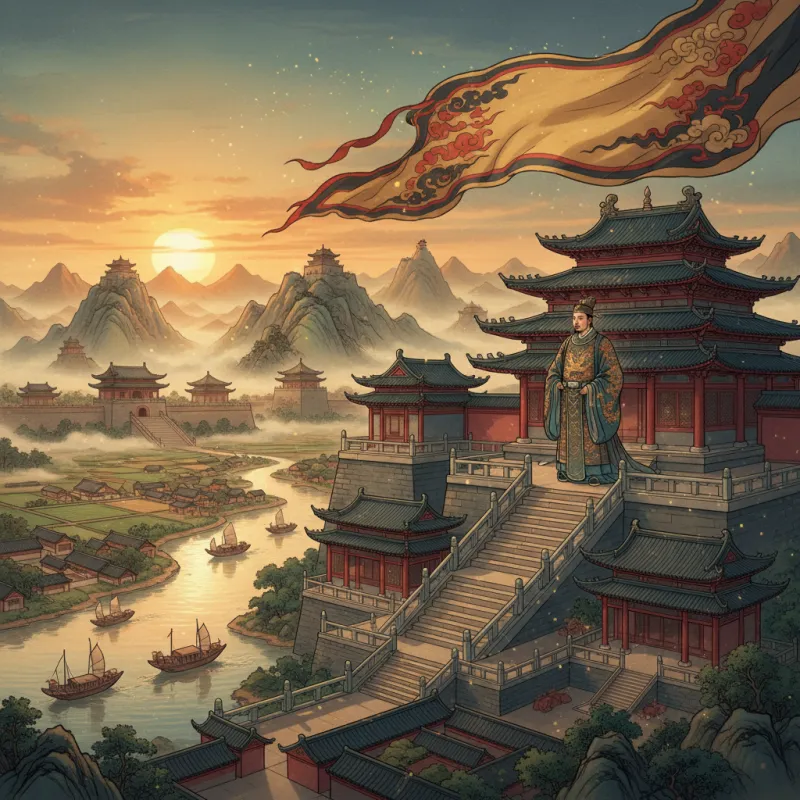
Imagine standing on the banks of the Grand Canal in 609 AD, watching an imperial flotilla stretch for sixty miles—dragon boats, supply vessels, and pleasure barges carrying Emperor Yang and his court southward in a display of power so extravagant it would bankrupt an empire. This is the Sui Dynasty in microcosm: brilliant, ambitious, and utterly unsustainable. In just 37 years, from 581 to 618 AD, the Sui reunified China after three centuries of division, built infrastructure that would serve the nation for a millennium, and then collapsed so spectacularly that its name became synonymous with imperial overreach.
The Reunification Nobody Saw Coming
Yang Jian (楊堅, Yáng Jiān) didn't look like a dynasty founder. He was a military official in the Northern Zhou court, married to a formidable woman named Dugu Qieluo who would become one of history's most influential empresses. When the Northern Zhou emperor died in 580 AD, leaving a child on the throne, Yang Jian made his move. Within a year, he'd forced the boy emperor to abdicate, declared himself Emperor Wen of Sui (隋文帝, Suí Wéndì), and set about conquering the south.
What made Yang Jian different from the dozens of warlords who'd tried and failed to reunify China since the fall of the Han Dynasty? Three things: patience, administrative genius, and the ability to sell himself as a legitimate heir to both northern and southern traditions. He didn't just conquer—he absorbed. Southern aristocrats were given positions in his government. Buddhist monasteries, which had proliferated during the division, were brought under state control but not destroyed. By 589 AD, when Sui forces captured Jiankang (modern Nanjing) and ended the Chen Dynasty, Yang Jian had accomplished what seemed impossible: a unified China under a single emperor.
The Government That Actually Worked
Here's what most people miss about the Sui: before the megaprojects and the military disasters, Emperor Wen built one of the most efficient governments China had ever seen. He revived and refined the equal-field system (均田制, jūntián zhì), which redistributed land to peasant families and tied tax collection to household registration rather than corrupt local officials. He standardized weights, measures, and coinage across the empire. Most importantly, he reformed the civil service examination system, making it more meritocratic and less dependent on aristocratic birth.
The Sui legal code, completed in 583 AD, became the template for Tang Dynasty law and influenced legal systems across East Asia for centuries. It was remarkably humane for its time—reducing the number of capital offenses, requiring multiple reviews for death sentences, and establishing clear procedures for appeals. Emperor Wen personally reviewed capital cases, sometimes staying up all night to ensure justice was served. His wife, Empress Dugu, was known to sit behind a screen during court sessions, occasionally sending notes to correct her husband's decisions.
This wasn't just good governance—it was revolutionary. The Sui created the administrative framework that would allow the Tang to flourish. Without Emperor Wen's reforms, there would be no Tang golden age, no Song Dynasty innovations, no stable imperial system lasting into the twentieth century.
The Grand Canal: Ambition in Concrete Form
Emperor Yang (楊廣, Yáng Guǎng), who succeeded his father in 604 AD after possibly murdering him (the historical record is conveniently unclear), had a vision problem. Not a lack of vision—too much of it. His signature project, the Grand Canal (大運河, Dà Yùnhé), remains one of humanity's greatest engineering achievements and one of history's most expensive mistakes.
The canal system, when completed, stretched over 1,100 miles, connecting the Yellow River to the Yangtze River and linking the agricultural south with the political north. Millions of laborers were conscripted—some sources claim up to five million workers, though that's likely an exaggeration. What's not exaggerated: the human cost was staggering. Workers died by the thousands from exhaustion, accidents, and disease. Entire villages were emptied to meet labor quotas.
But here's the thing—it worked. The Grand Canal transformed Chinese economics and logistics. Grain from the fertile Yangtze valley could now feed northern armies and cities. Trade goods moved efficiently across the empire. The canal remained China's primary north-south transportation artery until the twentieth century. Even today, modernized sections carry more cargo than the Panama Canal. Emperor Yang's megaproject was simultaneously a humanitarian disaster and an infrastructure triumph that justified itself over centuries.
When Ambition Becomes Madness
If Emperor Yang had stopped with the canal, he might be remembered as a great builder rather than a cautionary tale. He didn't stop. He rebuilt the eastern capital at Luoyang on a massive scale. He constructed a network of imperial roads. He built granaries to store surplus grain—a genuinely good idea that required more forced labor. And then he decided to conquer Korea.
The Goguryeo campaigns (598, 612, 613, and 614 AD) were disasters that make Napoleon's Russian campaign look well-planned. The 612 expedition allegedly involved over a million soldiers—the largest military force assembled in Chinese history to that point. They marched into Korea, got bogged down in sieges, ran out of supplies, and retreated with catastrophic losses. Contemporary sources claim that only 2,700 soldiers returned from an army of 300,000 in one campaign, though such numbers are probably propagandistic.
Emperor Yang kept trying. Each failure required more conscripts, more taxes, more resources extracted from an increasingly desperate population. Peasants began cutting off their own fingers and toes to avoid military service. Rebellions erupted across the empire. The emperor, isolated in his pleasure palaces, seemed oblivious to the collapse happening around him.
The Fall and the Phoenix
By 617 AD, the Sui Dynasty was effectively over, though Emperor Yang wouldn't die until 618, strangled by his own officials while hiding in Yangzhou. The empire fragmented into competing warlords, and for a brief moment, it looked like China would return to centuries of division.
Enter Li Yuan (李淵, Lǐ Yuān), a Sui general with aristocratic connections to both the northern and southern elite—and, conveniently, related by marriage to the Sui imperial family. In 618 AD, he declared himself Emperor Gaozu of Tang and began the process of reunification. But here's the crucial point: Li Yuan didn't reject the Sui system. He embraced it. The Tang Dynasty was essentially Sui 2.0—same administrative structure, same legal code, same examination system, same canal network, just with better PR and more sustainable policies.
The Sui's real legacy isn't its brief existence but its lasting institutions. The Grand Canal. The examination system. The legal code. The administrative divisions. The Tang took credit for the golden age, but they were building on Sui foundations. It's like how everyone remembers the iPhone but forgets that most of its technology came from earlier, less successful devices.
Lessons from a Dynasty That Burned Too Bright
What do we learn from the Sui? That good governance and megalomania can coexist in the same regime. That infrastructure projects can be both humanitarian disasters and long-term successes. That the difference between a great emperor and a terrible one sometimes comes down to knowing when to stop.
Emperor Wen built wisely and governed well, creating systems that would last a thousand years. Emperor Yang inherited those systems and drove them to destruction through sheer ambition. The Sui Dynasty proved that you can do everything right administratively and still fail catastrophically if you lose touch with the human cost of your decisions.
The dynasty's brevity makes it easy to overlook, sandwiched between the chaos of the Northern and Southern Dynasties and the glory of the Tang. But that's a mistake. The Sui was the crucible where medieval China was forged. Its failures taught the Tang what not to do. Its successes gave them the tools to build an empire that would dominate East Asia for centuries.
Stand on the banks of the Grand Canal today, watching barges carry goods between north and south, and you're witnessing the Sui Dynasty's real monument—not the brief glory of imperial power, but the lasting legacy of infrastructure and institutions that outlived the emperors who built them. That's the paradox of the Sui: a dynasty that failed spectacularly but succeeded in ways its founders never imagined, creating the foundation for China's greatest age while destroying itself in the process.
Related Reading
- Spring and Autumn to Warring States: China's Age of Philosophy
- Exploring Ancient Chinese Dynasties: Emperors, Battles, and Cultural Legacy
- Song Dynasty: The World's Most Advanced Civilization
- The Yuan Dynasty: When Mongols Ruled China
- The Military Strategies and Key Battles of Ancient Chinese Dynasties
- Chinese Science and Technology: Inventions That Changed the World (Before Europe Noticed)
- Diplomacy and Cultural Exchange in Chinese Ancient Dynasties