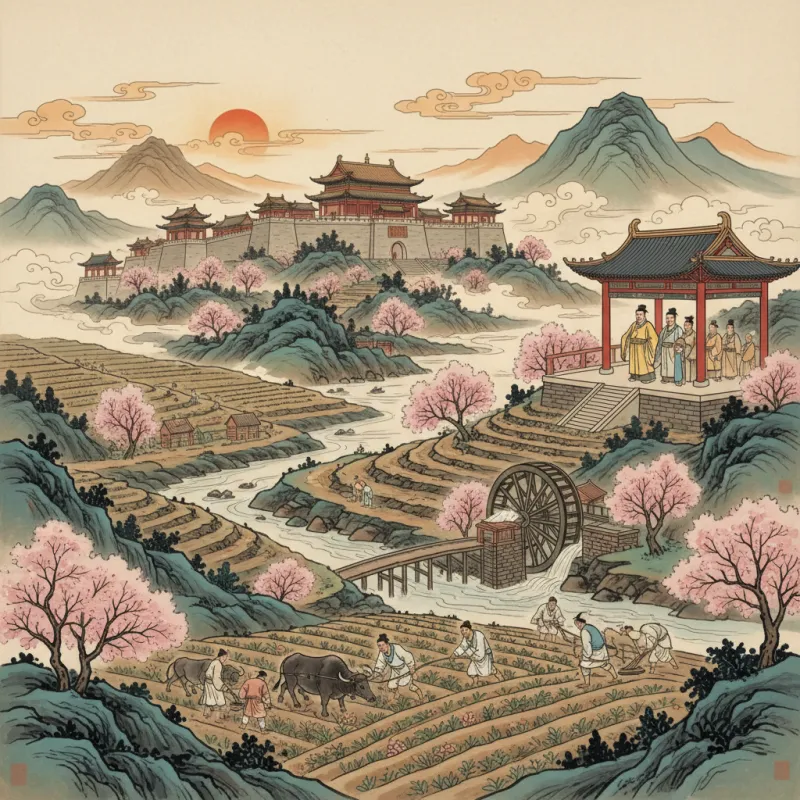
Picture a farmer in 1100 BCE, standing knee-deep in flooded rice paddies under the scorching sun of the Yellow River valley. He's not just planting seeds—he's performing an act that will feed empires, topple dynasties, and shape the destiny of a quarter of humanity for the next three millennia. Ancient Chinese agriculture wasn't merely about survival; it was a sophisticated science that modern agronomists still study with reverence.
The Shang Dynasty: When Oracle Bones Met the Plow
The Shang Dynasty (商朝, Shāng Cháo, circa 1600-1046 BCE) gave us something extraordinary: written records of agricultural practices etched onto oracle bones. These weren't simple farming logs—they were divinations asking the gods about rainfall, harvest timing, and pest control. The Shang farmers developed the lei si (耒耜) system, a sophisticated wooden plow that could break the hard loess soil of northern China. What's remarkable is that they understood crop rotation centuries before European farmers stumbled onto the concept. Millet, wheat, and rice weren't just planted randomly; they were rotated based on soil depletion patterns that wouldn't be scientifically explained until the 19th century.
The Shang also pioneered the well-field system (井田制, jǐngtián zhì), dividing land into nine squares like the Chinese character for "well" (井). Eight families farmed the outer squares for themselves, while collectively working the central square for the lord. This wasn't just taxation—it was social engineering through agriculture, creating interdependence that stabilized early Chinese society.
Zhou Dynasty Innovations: The Birth of Agricultural Philosophy
When the Zhou Dynasty (周朝, Zhōu Cháo, 1046-256 BCE) overthrew the Shang, they brought something revolutionary: the idea that farming was a moral act. The concept of the Mandate of Heaven (天命, tiānmìng) directly linked agricultural success to political legitimacy. A failed harvest wasn't just bad luck—it was cosmic judgment on the emperor's virtue. This belief drove Zhou rulers to obsess over agricultural improvement in ways that would seem bizarre to modern politicians.
The Zhou period saw the introduction of iron farming tools around 600 BCE, transforming agriculture from backbreaking labor to something approaching efficiency. The iron plow could cut deeper, turn soil faster, and last longer than bronze or wooden predecessors. But the real genius was in water management. Zhou engineers developed the first large-scale irrigation systems, including the Dujiangyan (都江堰) project started in 256 BCE, which still irrigates over 5,000 square kilometers of Sichuan Province today. That's 2,200 years of continuous operation—try finding a modern infrastructure project with that track record.
Han Dynasty: The Golden Age of Agricultural Texts
The Han Dynasty (汉朝, Hàn Cháo, 206 BCE-220 CE) produced what might be history's first agricultural bestseller: the "Fan Shengzhi Shu" (氾胜之书), written around 40 BCE. Fan Shengzhi wasn't some armchair theorist—he was a government agricultural officer who tested everything he wrote about. His manual covered seed selection, soil preparation, pest control, and even early greenhouse techniques using heated walls to extend growing seasons. The Han took agriculture so seriously that they established the position of Da Si Nong (大司农, Grand Minister of Agriculture), making farming policy a cabinet-level concern.
Han farmers perfected the alternating field system (代田法, dàitián fǎ), where fields were divided into ridges and furrows that switched positions each year. This wasn't just about crop rotation—it was about soil structure, moisture retention, and nutrient distribution. Modern soil scientists have confirmed that this method reduces erosion and maintains soil fertility better than continuous flat planting. The Han also developed the seed drill, a device that wouldn't appear in Europe until the 16th century, allowing precise seed placement and spacing that dramatically improved yields.
The Han's obsession with agricultural improvement wasn't purely altruistic. They understood what modern economists call the agricultural surplus theory—that civilization advances only when farmers produce more than they consume, freeing others to become artisans, scholars, and soldiers. This surplus funded the Silk Road, built the Great Wall, and supported the bureaucracy that held the empire together.
Tang and Song Dynasties: The Rice Revolution
The Tang (唐朝, Táng Cháo, 618-907 CE) and Song (宋朝, Sòng Cháo, 960-1279 CE) dynasties witnessed what historians call the medieval agricultural revolution, centered on a humble grain: rice. The introduction of Champa rice from Vietnam during the Song Dynasty changed everything. This early-ripening variety allowed double-cropping—two harvests per year instead of one. The population of China doubled during the Song Dynasty, not because of conquest or immigration, but because farmers could suddenly feed twice as many mouths from the same land.
The Song government distributed illustrated agricultural manuals like the "Nong Shu" (农书) by Chen Fu, complete with diagrams showing proper planting techniques, tool designs, and seasonal calendars. These weren't optional reading—local officials were evaluated partly on agricultural productivity in their districts, creating a bureaucratic incentive structure that pushed innovation down to the village level. The Song also perfected terrace farming in southern China, transforming steep hillsides into productive paddies through engineering feats that rival anything built by the Romans.
What's often overlooked is the Song Dynasty's development of agricultural credit systems. Farmers could borrow seeds and tools in spring, repaying after harvest—an early form of agricultural finance that prevented the cycle of debt and land loss that plagued other civilizations. This system, combined with improved rice varieties and better irrigation, created the economic foundation for Song China to become the world's most advanced economy, producing more iron than all of Europe combined.
Ming and Qing Dynasties: Global Exchange and Intensification
The Ming (明朝, Míng Cháo, 1368-1644 CE) and Qing (清朝, Qīng Cháo, 1644-1912 CE) dynasties saw Chinese agriculture transform through contact with the Americas. New World crops—maize, sweet potatoes, peanuts, and potatoes—arrived via Spanish and Portuguese traders, allowing cultivation of marginal lands previously considered unsuitable for farming. Sweet potatoes, in particular, could grow in sandy, poor soil where rice failed, effectively expanding China's agricultural land by millions of acres without clearing a single forest.
The Qing Dynasty's "Shou Shi Tong Kao" (授时通考), an agricultural encyclopedia compiled in 1742, synthesized centuries of farming knowledge into a comprehensive guide covering everything from astronomy for planting calendars to veterinary medicine for draft animals. This wasn't just preservation of tradition—it was active innovation, incorporating new crops and techniques while maintaining proven methods. The Qing also developed sophisticated fertilization techniques, including the use of night soil (human waste), bean cakes, and green manure crops that modern organic farmers would recognize.
The Philosophy Behind the Practice
What distinguished Chinese agriculture from other ancient civilizations wasn't just technical sophistication—it was the philosophical framework. Confucian thought elevated farming to a noble profession, with scholars regularly praising the virtue of agricultural labor. The concept of tian ren he yi (天人合一, harmony between heaven and humanity) meant that farming wasn't domination of nature but cooperation with it. This philosophy led to sustainable practices that maintained soil fertility for millennia, while other civilizations exhausted their land and collapsed.
The ancient Chinese understood something that modern industrial agriculture is only now relearning: that soil is alive, that diversity strengthens ecosystems, and that short-term yields matter less than long-term sustainability. Their multi-cropping systems, integration of aquaculture with agriculture (rice paddies with fish), and careful attention to soil health created agricultural systems that supported the world's largest population for most of recorded history.
Legacy in Modern Fields
Walk through rural China today, and you'll still see echoes of these ancient practices. Terraced rice paddies follow Song Dynasty engineering principles. Farmers still consult lunar calendars descended from Han Dynasty astronomy. The Dujiangyan irrigation system still waters Sichuan's fields. These aren't museum pieces—they're living traditions that have proven their worth across centuries.
The genius of ancient Chinese agriculture lies not in any single innovation but in the systematic, philosophical approach to farming as both science and art. While European agriculture remained largely stagnant from Roman times until the 18th century, Chinese farmers continuously experimented, documented, and improved their methods. They created an agricultural tradition so robust that it supported the world's largest population, weathered countless wars and natural disasters, and continues to feed 1.4 billion people today. That's not just history—that's a masterclass in sustainable civilization.
Related Reading
- Delving into Ancient China: A Journey Through Dynasties, Emperors, and Cultural Treasures
- Ancient Chinese Medicine: A Look into Dynasties and Healing Practices
- What Did Ancient Chinese People Eat? A Dynasty-by-Dynasty Food History