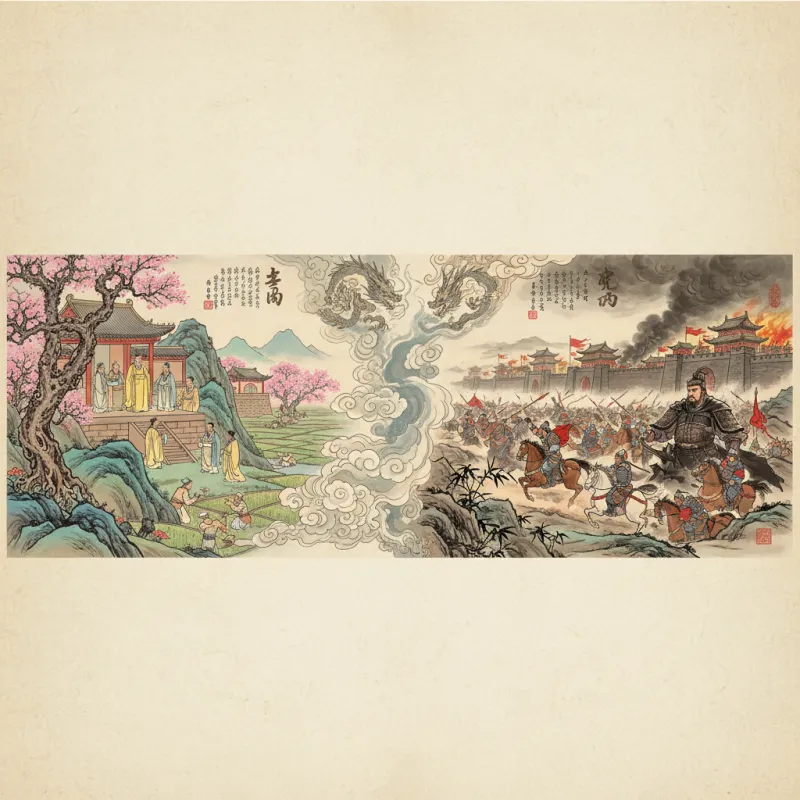
The year is 479 BCE. In the state of Lu, an elderly teacher named Kong Qiu (孔丘, Kǒng Qiū)—better known as Confucius—has just died, his dream of restoring Zhou ritual order seemingly unfulfilled. Meanwhile, in the southern state of Chu, a young aristocrat named Zhuang Zhou (莊周, Zhuāng Zhōu) hasn't even been born yet, but he'll grow up to write about butterflies and dreams in ways that make Confucius's earnest moralizing look quaint. Between these two figures lies the most intellectually explosive period in Chinese history: the transition from Spring and Autumn to Warring States, when China didn't just tolerate philosophical diversity—it demanded it.
When Heaven's Mandate Shattered
The Zhou Dynasty had promised that virtuous rulers would receive the Mandate of Heaven (天命, tiānmìng), but by 770 BCE, that promise rang hollow. When barbarian tribes sacked the Zhou capital and forced the royal house eastward to Luoyi, the emperor became little more than a ceremonial figurehead. Real power belonged to the regional lords—the dukes, marquises, and counts who'd once sworn fealty to Zhou but now fought each other with increasing brutality.
The Spring and Autumn Period (春秋時代, Chūnqiū Shídài, 770-476 BCE) takes its name from the Spring and Autumn Annals, a terse chronicle of Lu state that Confucius supposedly edited. During these three centuries, over 140 states were gradually absorbed through conquest and alliance until only seven major powers remained. The Warring States Period (戰國時代, Zhànguó Shídài, 475-221 BCE) that followed wasn't just more of the same—it was warfare industrialized, with armies numbering in the hundreds of thousands and entire populations relocated as strategic pawns.
This chaos created an intellectual marketplace. Rulers desperate for advantage would hire anyone with a workable theory of governance. Philosophers became consultants, traveling from court to court pitching their ideas. The Chinese call them the Hundred Schools of Thought (諸子百家, zhūzǐ bǎijiā), though "hundred" is poetic license—there were probably dozens of distinct philosophical traditions, most now lost to history.
The Confucian Gambit: Ritual as Social Technology
Confucius (孔子, Kǒngzǐ, 551-479 BCE) looked at the carnage around him and concluded that China's problem was amnesia. People had forgotten the ritual propriety (禮, lǐ) that made the early Zhou Dynasty great. His solution? Education. If you could train a class of morally cultivated gentlemen (君子, jūnzǐ) who embodied humaneness (仁, rén) and righteousness (義, yì), they'd naturally create good government.
This sounds naive until you realize Confucius was proposing something radical: that moral authority trumps hereditary privilege. A peasant who cultivated virtue could become a gentleman; a nobleman who lacked it was just a well-dressed thug. His student Mencius (孟子, Mèngzǐ, 372-289 BCE) pushed this further, arguing that human nature was inherently good and that rulers who oppressed their people forfeited legitimacy. The people could justly overthrow them.
Xunzi (荀子, Xúnzǐ, 310-235 BCE), the third great Confucian, disagreed sharply. Human nature was evil, he insisted—selfish and chaotic without rigorous training. This darker view made him more pragmatic about power, and two of his students, Li Si and Han Feizi, would take his pessimism in directions he never intended.
The Daoist Counterculture: Doing Nothing, Accomplishing Everything
While Confucians were busy trying to fix society, the Daoists asked: what if society itself is the problem? Laozi (老子, Lǎozǐ), the semi-mythical author of the Daodejing (道德經), proposed that the universe operates according to a natural Way (道, dào) that human cleverness only disrupts. The best government governs least. The best action is non-action (無為, wúwéi)—not passivity, but effortless alignment with natural patterns.
Zhuangzi (莊子, Zhuāngzǐ, 369-286 BCE) took this mysticism and made it literary. His book is full of talking skulls, giant fish that transform into birds, and the famous butterfly dream: did Zhuangzi dream he was a butterfly, or is a butterfly now dreaming it's Zhuangzi? These aren't just pretty stories—they're philosophical arguments against the Confucian obsession with categories and distinctions. What if "life" and "death," "self" and "other," "right" and "wrong" are just perspectives, not absolutes?
The Daoist critique of Confucianism was devastating: all your ritual propriety and moral cultivation just creates more artificial distinctions, more reasons for conflict. Return to simplicity. Embrace the uncarved block (樸, pǔ). Stop trying so hard.
Legalism: When Philosophy Gets Dangerous
The Qin Dynasty that eventually unified China in 221 BCE didn't do it with Confucian virtue or Daoist spontaneity. It did it with Legalism (法家, fǎjiā), a philosophy so ruthlessly effective that it's still controversial today.
Han Feizi (韓非子, Hán Fēizǐ, 280-233 BCE), that student of Xunzi, synthesized earlier Legalist thought into a comprehensive theory of authoritarian governance. His core insight: people respond to incentives, not moral exhortation. Create clear laws with harsh punishments and generous rewards, then enforce them uniformly regardless of social status. The ruler should be inscrutable, revealing nothing, trusting no one—not even his most loyal ministers.
Shang Yang (商鞅, Shāng Yāng, 390-338 BCE), who'd implemented Legalist reforms in Qin a century earlier, proved the system worked. He organized the population into mutual surveillance units, standardized weights and measures, and rewarded military success with social mobility. Qin became a war machine. Shang Yang himself was eventually executed by the system he created—a fact that Han Feizi noted with grim approval. The law must apply to everyone, even its architects.
Li Si (李斯, Lǐ Sī, 280-208 BCE), the other student of Xunzi, became Qin's prime minister and put Legalist theory into practice on a national scale. He's the one who convinced the First Emperor to burn books and bury scholars alive—not from sadism, but from Legalist logic. Diverse philosophies create confusion; confusion undermines law; therefore, eliminate diversity. The fact that Li Si also died horribly, cut in half in the marketplace, suggests that Legalism's problem wasn't just moral but practical: systems that trust no one eventually trust no one.
The Also-Rans: Mohism, Logicians, and Military Strategists
Mozi (墨子, Mòzǐ, 470-391 BCE) deserves more attention than he gets. His philosophy of universal love (兼愛, jiān'ài) argued that people should care equally for everyone, not just their families—a direct challenge to Confucian filial piety. Mohists were also serious about defensive warfare, developing sophisticated siege equipment and fortification techniques. They'd hire themselves out to defend small states against aggression, a kind of philosophical mercenary corps. The movement died out, possibly because its egalitarian ideals couldn't compete with Confucianism's appeal to hierarchy.
The School of Names (名家, míngjiā), or Logicians, explored paradoxes that would make Zeno proud. Gongsun Long (公孫龍, Gōngsūn Lóng) famously argued that "a white horse is not a horse"—not sophistry, but serious investigation into how language relates to reality. These debates seem abstract until you realize that legal systems depend on precise definitions. What counts as "murder" versus "justifiable killing"? The Logicians were doing the conceptual groundwork.
And then there's Sunzi (孫子, Sūnzǐ), whose Art of War (孫子兵法, Sūnzǐ Bīngfǎ) remains the most influential military treatise ever written. His philosophy of warfare—win without fighting, know yourself and your enemy, adapt to circumstances—is really a philosophy of strategic thinking applicable far beyond battlefields. Silicon Valley executives quote him more than generals do now.
The Synthesis That Never Happened
Here's what's fascinating: these schools were in genuine dialogue. Mencius debated Mohists. Zhuangzi mocked Logicians. Han Feizi critiqued everyone. They weren't talking past each other—they were building on and responding to each other's arguments. The Warring States period was a genuine philosophical ecosystem.
The Han Dynasty that followed Qin tried to synthesize these traditions, officially adopting Confucianism while quietly incorporating Legalist administrative techniques and Daoist cosmology. But something was lost. The creative tension, the sense that fundamental questions remained open—that ended when the empire stabilized. Philosophy became commentary on classics rather than fresh engagement with reality.
Why This Still Matters
Walk through any Chinese city today and you'll see these ancient arguments playing out. The government's emphasis on social harmony (和諧, héxié) echoes Confucian ideals, while its surveillance state owes more to Han Feizi than anyone wants to admit. The Daoist temples tucked into mountains offer escape from urban intensity. Even the gaokao exam system, with its promise of meritocratic advancement, reflects Confucius's belief that education can transform society.
But the deeper legacy is methodological. The Hundred Schools proved that a civilization could sustain radical philosophical diversity without collapsing—at least for a while. They showed that abstract ideas have concrete consequences, that how you think about human nature determines how you structure government. And they demonstrated that philosophy at its best isn't academic—it's urgent, practical, and literally a matter of life and death.
The Spring and Autumn and Warring States periods ended when Qin unified China through force. Whether that unification was tragedy or triumph depends on which philosopher you ask. Confucians mourned the loss of Zhou ritual order. Legalists celebrated efficient administration. Daoists probably just laughed at the whole thing. That we can still argue about it 2,300 years later suggests these ancient thinkers succeeded in their real goal: not solving China's problems, but teaching us how to think about them.
Related Reading
- The Complete Guide to Chinese History: 5,000 Years in One Article
- Exploring Ancient Chinese Dynasties: Emperors, Battles, and Cultural Legacy
- Complete Chinese Dynasty Timeline: 5,000 Years in One Guide
- The Yuan Dynasty: When Mongols Ruled China
- The Dynasties of China: A Quick Guide to 4,000 Years of History
- Chinese Science and Technology: Inventions That Changed the World (Before Europe Noticed)
- China's Most Fascinating Emperors: The Brilliant, the Mad, and the Unexpected
- Exploring the Rich Tapestry of Ancient Chinese History and Culture