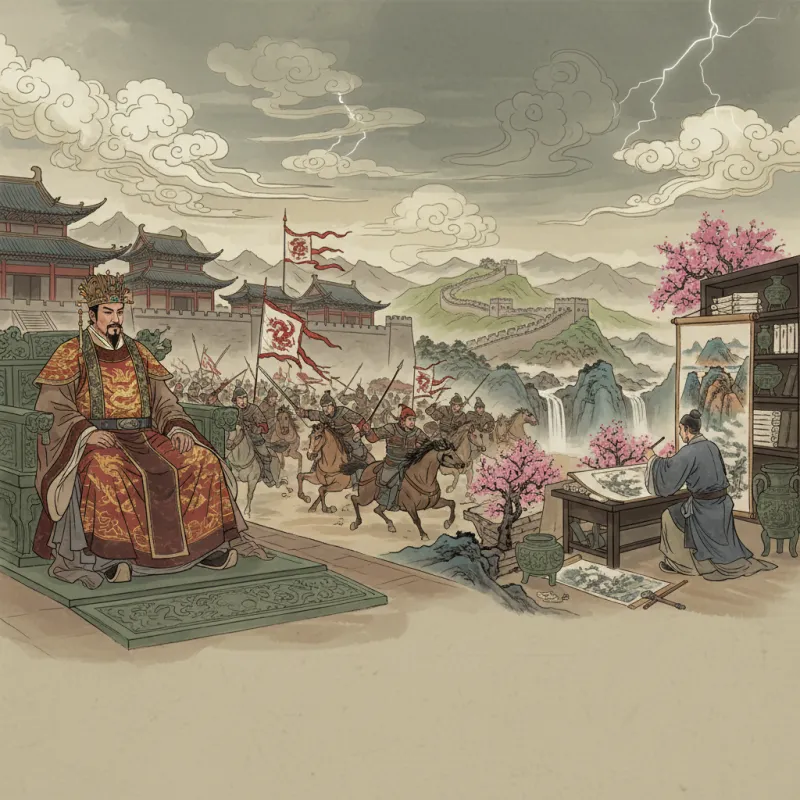
The oracle bone cracked under the heated bronze rod, its fracture lines spelling doom for the Shang king's military campaign. In 1046 BCE, King Wu of Zhou didn't need divination to know his moment had arrived—he had 800 allied lords, a restless population tired of Shang excess, and a brilliant strategist named Jiang Ziya. The Battle of Muye lasted a single morning, and by noon, three millennia of dynastic cycles had begun in earnest. This pattern of rise, prosperity, decline, and collapse would repeat itself across Chinese history with almost mathematical precision, each dynasty leaving behind emperors who became legends, battles that redrew maps, and cultural achievements that outlasted their empires.
The Mandate of Heaven: How Dynasties Justified Power
Every Chinese dynasty needed more than military might—it needed cosmic approval. The concept of Tianming (天命, tiānmìng), or the Mandate of Heaven, emerged during the Zhou Dynasty as brilliant political propaganda. When the Zhou overthrew the Shang, they couldn't simply claim "might makes right." Instead, they argued that Heaven itself had withdrawn its mandate from the corrupt Shang and bestowed it upon the virtuous Zhou. This wasn't just philosophy; it was a revolutionary idea that made rebellion legitimate.
The genius of the Mandate lay in its flexibility. Natural disasters, famines, floods—these became signs that Heaven had grown displeased with the current ruler. Peasant uprisings weren't just rebellions; they were Heaven's judgment made manifest. This created a fascinating paradox: emperors claimed absolute divine authority, yet that same authority could be revoked if they failed to govern well. The Tang Dynasty's golden age demonstrated this principle perfectly—emperors like Taizong actively sought criticism from officials, believing that good governance maintained Heaven's favor.
The Qin: Brutal Efficiency and the Birth of Imperial China
Ying Zheng didn't just conquer the Warring States—he obliterated them. By 221 BCE, the king of Qin had unified China and declared himself Qin Shi Huang (秦始皇, Qín Shǐhuáng), the First Emperor. His 11-year reign was a masterclass in authoritarian efficiency that still makes historians uncomfortable. He standardized writing, currency, weights, and measures. He built the early Great Wall. He created a centralized bureaucracy that replaced feudal aristocracy. And he buried scholars alive and burned books that contradicted his Legalist philosophy.
The Qin Dynasty lasted only 15 years after his death, collapsing into civil war by 206 BCE. Yet its impact was permanent. Every subsequent dynasty used the Qin's administrative blueprint. The title "emperor" (皇帝, huángdì) that Qin Shi Huang invented would be used for the next 2,000 years. His terracotta army—8,000 life-sized warriors buried to protect him in death—reveals the scale of his ambition and paranoia. The Qin proved that you could conquer China through ruthless efficiency, but you couldn't hold it without winning hearts.
Han Dynasty: Confucian Scholars Meet Imperial Power
Liu Bang, a peasant-turned-rebel-leader, founded the Han Dynasty in 206 BCE with a crucial insight: the Qin's Legalist harshness had alienated everyone. The Han would rule differently, blending Confucian ethics with practical statecraft. Emperor Wu (汉武帝, Hàn Wǔdì, r. 141-87 BCE) made Confucianism the state ideology, establishing an examination system that would, in later dynasties, allow talented commoners to become officials.
The Han expanded China's borders dramatically, pushing into Central Asia and establishing the Silk Road trade networks. General Ban Chao led 70,000 troops across the Tarim Basin, securing Chinese influence as far as the Caspian Sea. The Han also perfected the art of historical record-keeping—Sima Qian's Shiji (史记, Shǐjì), or Records of the Grand Historian, set the standard for all future dynastic histories. When the Han finally collapsed in 220 CE after four centuries, it had so thoroughly defined Chinese civilization that ethnic Chinese still call themselves "Han people" (汉人, Hànrén).
The Three Kingdoms: When China Fractured Into Legend
The fall of the Han unleashed chaos. For nearly a century, three kingdoms—Wei, Shu, and Wu—battled for supremacy in a period so dramatic that it inspired China's greatest historical novel, Romance of the Three Kingdoms. The Battle of Red Cliffs in 208 CE saw the southern kingdoms of Shu and Wu unite to defeat the numerically superior northern Wei forces through fire ships and strategic brilliance. Generals like Cao Cao, Liu Bei, and Sun Quan became household names, their exploits embellished but rooted in real military genius.
This era matters because it showed that Chinese unity wasn't inevitable. The cultural developments during periods of division often proved as significant as those during unified empires. Buddhism spread rapidly during this fractured period, filling the spiritual vacuum left by Confucianism's association with the failed Han state. The Three Kingdoms period also established the narrative template for Chinese historical drama: loyal ministers, cunning strategists, tragic heroes, and the eternal question of whether unity or virtue matters more.
Tang and Song: The Twin Peaks of Chinese Civilization
If you could visit only two Chinese dynasties, choose the Tang (618-907 CE) and Song (960-1279 CE). The Tang represented cosmopolitan confidence—Chang'an, its capital, was the world's largest city with over a million residents, including Persian merchants, Arab traders, and Japanese monks. Empress Wu Zetian, China's only female emperor, ruled during the dynasty's height, patronizing Buddhism and expanding the bureaucracy. Tang poetry reached heights never surpassed; Li Bai's wine-soaked verses and Du Fu's social commentary remain required reading.
The Song Dynasty traded military power for economic and cultural sophistication. Song China invented paper money, gunpowder weapons, and movable type printing. Its cities were commercial powerhouses—Kaifeng and later Hangzhou dwarfed European capitals. Neo-Confucian philosophers like Zhu Xi created synthesis of Buddhist and Daoist ideas with Confucian ethics that would dominate East Asian thought for centuries. The Song's weakness was military—they paid tribute to northern "barbarian" states and eventually fell to the Mongols. But their cultural legacy? Unmatched.
The Mongol Yuan and the Question of Chinese Identity
When Kublai Khan established the Yuan Dynasty in 1271, he created an identity crisis that still resonates. Were the Mongols a Chinese dynasty or foreign conquerors? Kublai claimed the Mandate of Heaven and adopted Chinese administrative practices, but he also maintained Mongol military supremacy and ethnic hierarchies that placed Han Chinese at the bottom. Marco Polo's accounts of Yuan China introduced Europe to a civilization that seemed impossibly advanced—paper money, coal heating, efficient postal systems.
The Yuan's century of rule (1271-1368) proved that military conquest alone couldn't sustain a dynasty. The Mongols never fully sinicized, maintaining their separate identity while ruling Chinese subjects. This created resentment that exploded in the Red Turban Rebellion. Yet the Yuan also demonstrated China's cultural gravitational pull—even conquerors had to adopt Chinese governance models to rule effectively. This pattern would repeat with the Qing Dynasty centuries later.
Ming and Qing: The Final Imperial Chapters
The Ming Dynasty (1368-1644) began with Zhu Yuanzhang, a peasant rebel who became the Hongwu Emperor and established one of history's most paranoid regimes. He executed tens of thousands of officials in purges, yet also rebuilt China after Mongol rule. The Ming built the Forbidden City, reconstructed the Great Wall in its current form, and sent Admiral Zheng He on seven massive naval expeditions that reached Africa decades before European exploration began.
The Qing Dynasty (1644-1912), founded by Manchu invaders, became China's last imperial dynasty. The Kangxi and Qianlong emperors presided over territorial expansion that created modern China's borders, incorporating Tibet, Xinjiang, and Mongolia. But the Qing's final century was catastrophic—the Opium Wars, Taiping Rebellion, and foreign concessions revealed that China's traditional dynastic system couldn't compete with industrialized Western powers. When the last emperor, Puyi, abdicated in 1912, he ended not just the Qing but 2,000 years of imperial history.
The Enduring Legacy: Why Dynasties Still Matter
Chinese dynasties weren't just political entities—they were civilizational experiments in governance, culture, and identity. Each dynasty's rise and fall taught lessons about power, legitimacy, and the relationship between rulers and ruled. The examination system created social mobility unknown in feudal Europe. The concept of the Mandate of Heaven made governance conditional on performance, not just heredity. The bureaucratic structures developed over millennia influenced governments across East Asia.
Today, understanding these dynasties helps decode modern China's worldview. The emphasis on stability over chaos, unity over division, and long-term planning over short-term gains all have roots in dynastic experiences. The great inventions that emerged from imperial China—paper, printing, gunpowder, the compass—came from this system. When Chinese leaders speak of "national rejuvenation," they're referencing the Tang and Song peaks, not just the recent past. The dynasties ended, but their cultural DNA persists, shaping how 1.4 billion people understand their place in history and the world.
Related Reading
- The Sui Dynasty: Brief Glory, Lasting Legacy
- Song Dynasty: The World's Most Advanced Civilization
- Exploring the Dynastic Era: A Journey Through Ancient Chinese History
- Complete Chinese Dynasty Timeline: 5,000 Years in One Guide
- Spring and Autumn to Warring States: China's Age of Philosophy
- Daily Life in Ancient China: What Ordinary People Actually Did All Day
- Liu Bei vs. Cao Cao: The Ultimate Rivalry in Chinese History
- Traditional Chinese Medicine: 3,000 Years of Healing Philosophy