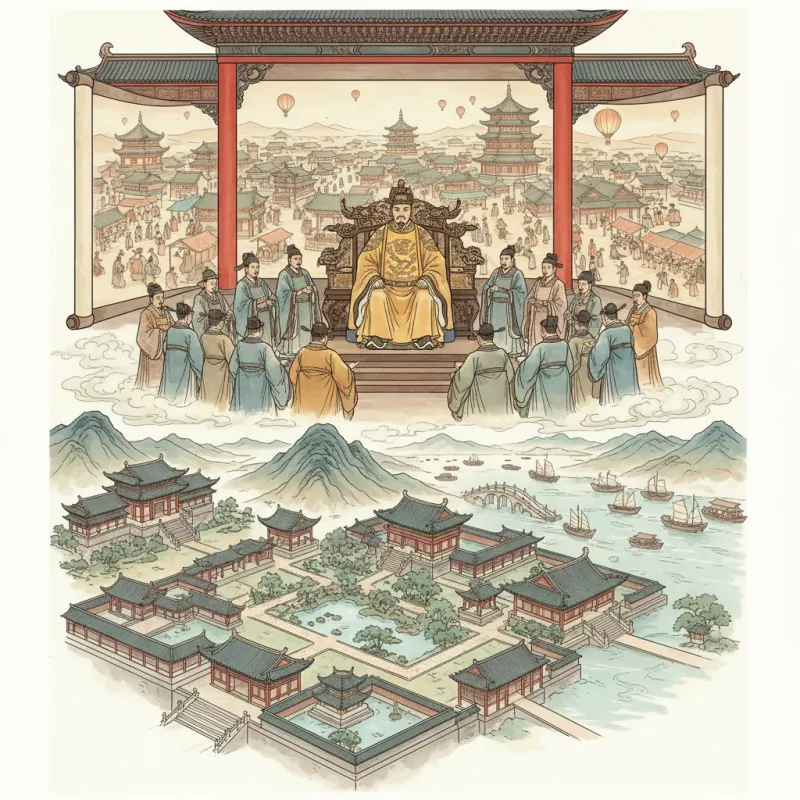
A merchant in 11th-century Kaifeng pulls out a piece of paper to buy silk. Not a receipt, not a contract — actual money. Paper money. While European lords were still hacking coins in half to make change, Song Dynasty China had invented government-backed currency, complete with anti-counterfeiting measures. This wasn't some primitive experiment. The jiaozi (交子 jiāozǐ) featured multiple colors, intricate designs, and official seals. Counterfeiters faced death. The Song Dynasty (宋朝 Sòng Cháo, 960–1279) didn't just stumble into modernity — it sprinted there while the rest of the world was still tying its shoes.
The Economic Revolution Nobody Talks About
The Song economy was absurdly advanced. We're talking about a GDP that constituted 25-30% of the entire world's economic output with only 15% of the global population. Let that sink in. The Song government collected more tax revenue than any European state would manage until the 19th century. How? A sophisticated tax system that moved beyond simple land taxes to include commercial taxes, monopolies on salt and tea, and yes, revenue from that paper money.
But the real story is what happened in the cities. Kaifeng, the Northern Song capital, housed over one million people — making it the world's largest city. Hangzhou, the Southern Song capital after the Jurchen invasions forced the court south in 1127, might have reached 1.5 million. These weren't just population centers. They were economic engines running 24/7. The night markets stayed open past midnight. Restaurants specialized in regional cuisines. Shops sold everything from exotic spices to printed books to mechanical clocks.
The Song invented the world's first shopping malls — multi-story commercial complexes where you could buy furniture, commission a painting, grab dinner, and catch a theatrical performance. The Qingming Scroll, that famous panoramic painting of Kaifeng life, shows a society that looks shockingly modern: bustling commerce, diverse entertainment, complex urban infrastructure. This wasn't the "timeless, unchanging East" of Western imagination. This was capitalism before we had a word for it.
The Four Great Inventions (And Why That Label Undersells It)
Yes, the Song Dynasty perfected or invented printing, gunpowder, and the compass. (Paper came earlier, during the Han Dynasty.) But calling them the "Four Great Inventions" makes them sound like isolated achievements rather than symptoms of a society-wide commitment to innovation.
Take movable type. Bi Sheng (毕昇 Bì Shēng) invented ceramic movable type around 1040. This wasn't just a technical achievement — it was a revolution in information distribution. The Song government printed paper money, official documents, and Confucian classics. Private publishers printed encyclopedias, medical texts, agricultural manuals, and entertainment literature. Book prices dropped. Literacy spread beyond the elite. Ideas circulated faster than ever before in human history.
Gunpowder weapons evolved from simple fire lances to sophisticated bombs, rockets, and early cannons. The Song military used gunpowder grenades called zhentianlei (震天雷 zhèntiānléi, "heaven-shaking thunder") that could shatter iron armor. They deployed fire lances — bamboo tubes packed with gunpowder that shot flames and shrapnel. By the late Song, they had developed true guns with metal barrels. These weren't ceremonial weapons. They were deployed in actual warfare, particularly against the Jurchen Jin Dynasty and later the Mongols.
The magnetic compass transformed maritime trade. Song ships, some of the largest wooden vessels ever built, sailed to Southeast Asia, India, and East Africa. The compass enabled navigation far from coastlines, opening up direct ocean routes. Combined with advanced shipbuilding techniques — watertight compartments, multiple masts, stern-mounted rudders — Song vessels were the most sophisticated in the world.
The Civil Service Examination: Meritocracy's First Real Test
Here's what made the Song truly revolutionary: they took the civil service examination system and made it actually matter. Earlier dynasties had exams, but the Song expanded them dramatically. By the late Song, roughly 400,000 men were taking the exams every three years. Only about 200 would pass the highest level, the jinshi (进士 jìnshì).
This created something unprecedented: a government bureaucracy selected primarily by merit rather than birth. Sure, wealthy families had advantages — they could afford tutors and years of study. But in theory and often in practice, a poor farmer's son could study the Confucian classics, pass the exams, and become a high-ranking official. Some did.
The exams tested knowledge of Confucian texts, poetry composition, and policy analysis. They were brutally difficult. Candidates spent decades preparing. The failure rate was astronomical. But the system created a shared elite culture based on literary and philosophical education rather than military prowess or aristocratic lineage. This had profound effects on Song society: it elevated civilian over military authority, promoted education as a social value, and created a government staffed by people who could actually read and write policy documents.
The downside? The examination system also created a conservative intellectual culture obsessed with classical texts. Innovation in governance was harder when everyone was trained to revere ancient precedents. And the system's emphasis on literary skills over practical administration sometimes produced officials better at writing poetry than managing provinces.
The Military Problem: Why Song China Couldn't Defend Itself
Here's the paradox that defines the Song Dynasty: economically dominant, technologically advanced, culturally sophisticated — and militarily weak. The Song faced constant pressure from northern nomadic peoples: the Khitan Liao Dynasty, the Jurchen Jin Dynasty, and finally the Mongols who conquered them entirely.
The Song military wasn't incompetent. They had gunpowder weapons, sophisticated fortifications, and large armies (sometimes exceeding one million men). But they faced structural problems. The Song founders, remembering how the Tang Dynasty fell partly due to powerful regional military governors, deliberately weakened military authority. They rotated generals frequently, divided command structures, and subordinated military decisions to civilian officials. This prevented military coups but also prevented effective military campaigns.
The Song also faced a cavalry problem. The northern steppes produced excellent horses and riders. The Song heartland in central and southern China didn't. The Song tried to buy horses, breed them, and train cavalry forces, but they never matched the nomadic peoples' mounted warfare capabilities. In open field battles, Song armies often lost.
So the Song adapted. They paid tribute — massive annual payments of silver and silk — to avoid warfare. They built extensive fortification networks. They developed gunpowder weapons to compensate for cavalry weakness. They used their economic strength to fund large standing armies. It worked, sort of. The Song survived for over three centuries, longer than many dynasties. But they survived by accommodating military weakness rather than overcoming it.
Neo-Confucianism: The Intellectual Revolution
While Song armies struggled, Song philosophers were revolutionizing Chinese thought. Neo-Confucianism, synthesized primarily by Zhu Xi (朱熹 Zhū Xī, 1130–1200), became the dominant intellectual framework for the next 800 years.
Neo-Confucianism took classical Confucian ethics and combined them with Buddhist and Daoist metaphysics. It addressed questions the original Confucian texts largely ignored: What is the nature of reality? How does the cosmos work? What is the relationship between human nature and universal principles? Zhu Xi's answer involved li (理 lǐ, "principle" or "pattern") and qi (气 qì, "vital energy" or "matter"). Everything in the universe, from rocks to humans to social relationships, embodied both li and qi. Understanding li meant understanding the fundamental patterns underlying reality.
This sounds abstract, but it had practical implications. Neo-Confucianism emphasized self-cultivation through study and moral practice. It promoted education as the path to understanding both oneself and the cosmos. It reinforced social hierarchies — the "five relationships" between ruler and subject, father and son, husband and wife, elder and younger, friend and friend — as reflections of cosmic order. It became the ideological foundation for the civil service examinations and thus for the entire government bureaucracy.
Neo-Confucianism also had a conservative streak. It emphasized maintaining proper social roles and relationships. It was suspicious of Buddhism's otherworldly focus and Daoism's mysticism. It promoted a vision of society based on hierarchy, education, and moral cultivation — a vision that shaped Chinese culture for centuries.
Urban Life: The Birth of Consumer Culture
Walk through a Song Dynasty city and you'd recognize it. Not the architecture or clothing, but the vibe. People shopping for pleasure, not just necessity. Restaurants competing for customers. Entertainment districts. Advertising. Status-conscious consumers buying luxury goods to display their wealth and taste.
The Song middle class — merchants, shopkeepers, successful artisans, lower-level officials — had disposable income and wanted to spend it. They bought silk clothing, porcelain dishes, lacquerware, paintings, calligraphy, books, and exotic imports. They ate at restaurants serving regional specialties. They attended theatrical performances, storytelling sessions, and variety shows. They visited teahouses to socialize and conduct business.
Song cities had specialized commercial districts. Kaifeng had a district for silk merchants, another for jewelers, another for booksellers. Shops stayed open late. Street vendors sold snacks. Performers entertained crowds. The government tried to regulate all this activity — setting market hours, licensing businesses, collecting taxes — but the commercial energy was unstoppable.
This urban consumer culture produced new art forms. Vernacular literature — stories and novels written in everyday language rather than classical Chinese — flourished. Professional storytellers performed in markets and teahouses, and their stories were eventually written down and published. Drama and opera developed into sophisticated art forms. Painting shifted from primarily religious and court subjects to include landscapes, everyday scenes, and personal expression.
The Fall: Mongols and the End of an Era
The Mongols ended it. Kublai Khan's armies conquered the Southern Song in 1279 after decades of warfare. The last Song emperor, an eight-year-old boy, drowned when his officials jumped into the sea rather than surrender. The Song Dynasty was over.
Why did the Song fall? Military weakness, yes, but also bad luck. The Mongols were the most effective military force in world history. They conquered everyone from Korea to Hungary. The Song held out longer than most. They used their wealth to fund resistance, their technology to develop new weapons, their fortifications to slow Mongol advances. But ultimately, the Mongol combination of cavalry mobility, siege expertise, and sheer ruthlessness overwhelmed them.
The Song legacy survived. The Mongol Yuan Dynasty adopted Song administrative practices, continued the civil service examinations, and preserved Song cultural achievements. When the Ming Dynasty overthrew the Mongols in 1368, they explicitly claimed to restore Song traditions. Neo-Confucianism remained dominant. The examination system continued. The economic and technological foundations the Song built shaped Chinese civilization for centuries.
Why the Song Dynasty Matters
The Song Dynasty matters because it shows what Chinese civilization could achieve when it prioritized commerce, technology, and culture over military expansion. It was a society that valued education, rewarded merit, promoted innovation, and created space for a vibrant urban culture. It was also a society that struggled to defend itself, paid tribute to militarily stronger neighbors, and eventually fell to conquest.
There's a counterfactual question historians love to debate: What if the Song had survived? What if they'd developed their technological advantages further? Would they have triggered an industrial revolution centuries before Europe? Would Chinese ships have "discovered" Europe rather than the reverse? We'll never know. The Mongol conquest redirected Chinese history.
But for three centuries, the Song Dynasty proved that a civilization could be economically dynamic, technologically innovative, and culturally sophisticated all at once. They created a model of society based on merit, education, and commerce rather than military might and aristocratic privilege. That model had flaws — it couldn't defend itself, it reinforced social hierarchies, it sometimes valued classical learning over practical innovation. But it was a remarkable achievement nonetheless.
A thousand years later, we're still trying to figure out how they did it.
Related Reading
- The Sui Dynasty: Brief Glory, Lasting Legacy
- Complete Chinese Dynasty Timeline: 5,000 Years in One Guide
- The Tang Dynasty: China's Golden Age of Poetry, Power, and Culture
- The Dynasties of China: A Quick Guide to 4,000 Years of History
- Exploring Ancient Chinese Dynasties: Emperors, Battles, and Cultural Legacy
- The Silk Road Was Not a Road (And Other Things You Got Wrong)
- The Role of Trade in Shaping Ancient Chinese Dynasties and Culture
- Delving into Ancient China: A Journey Through Dynasties, Emperors, and Cultural Treasures