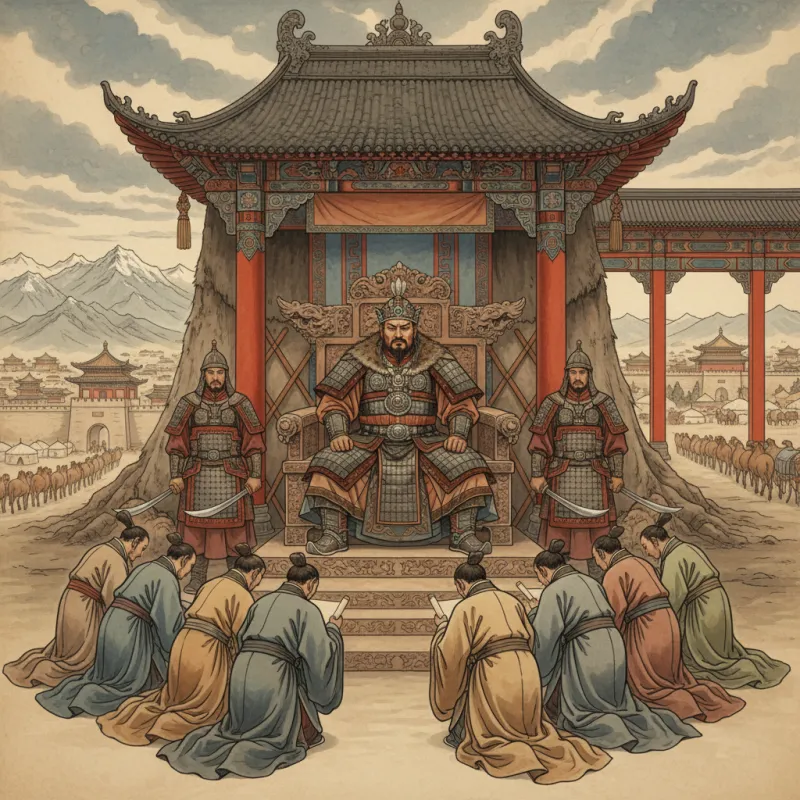
When Kublai Khan declared himself Emperor of China in 1271, he faced an impossible paradox: how do you rule the world's most sophisticated civilization when your people are nomadic warriors who can't read Chinese? The answer would reshape both Mongol and Chinese identity, creating a century of cultural collision that still echoes through China's history today.
The Conquest That Changed Everything
The Mongol conquest of China wasn't a single dramatic battle—it was a grinding, multi-generational campaign that began with Genghis Khan and wouldn't conclude until his grandson Kublai finally subdued the Southern Song in 1279. By the time the last Song emperor drowned himself in the sea off Guangdong, the Mongols had been fighting in China for nearly seventy years.
What made this conquest different from previous "barbarian" invasions was its scale and permanence. The Mongols didn't just want tribute or border territory—they wanted everything. Kublai Khan (忽必烈, Hūbìliè) moved his capital from Karakorum in Mongolia to Dadu (大都, literally "Great Capital"), modern-day Beijing, signaling that this wasn't a temporary occupation. The Ming Dynasty would later inherit this northern capital, cementing Beijing's role as China's political center for the next seven centuries.
A Government Built on Distrust
Kublai Khan faced a dilemma that would define Yuan governance: he needed Chinese bureaucrats to run the empire, but he couldn't trust them. His solution was brutal in its simplicity—create a rigid four-tier social hierarchy that placed Mongols at the top, followed by non-Chinese allies (Semu people, including Central Asians and Europeans), then northern Chinese, and finally the conquered southern Chinese at the bottom.
This wasn't just social prejudice; it was encoded into law. Mongols and Semu people received lighter punishments for the same crimes. They dominated the highest government positions. Chinese scholars, who had spent centuries believing that mastery of Confucian classics guaranteed political power, suddenly found themselves shut out of their own government. The civil service examination system—the backbone of Chinese meritocracy since the Tang Dynasty—was suspended for most of the Yuan period.
The irony? This very exclusion pushed Chinese intellectuals toward the arts. Denied political careers, they poured their talents into drama, painting, and poetry. The Yuan Dynasty produced some of China's greatest playwrights, including Guan Hanqing (關漢卿) and his masterpiece "The Injustice to Dou E" (竇娥冤, Dòu É Yuān), a tragedy that used historical allegory to critique Mongol rule right under the censors' noses.
The Silk Road's Golden Age
If the Yuan Dynasty failed at cultural integration, it succeeded spectacularly at international trade. The Mongol Empire's vast reach—stretching from Korea to Hungary—created the largest contiguous land empire in history, and the Yuan Dynasty sat at its eastern terminus. For the first time in centuries, merchants could travel from the Mediterranean to the Pacific without crossing hostile borders.
This was the world that brought Marco Polo to Kublai Khan's court in the 1270s. Whether you believe all of Polo's tales or not (and historians remain divided), his account captures something real: the Yuan capital was genuinely cosmopolitan in a way previous Chinese dynasties had never been. Persian astronomers worked in the imperial observatory. Muslim merchants dominated the finance industry. Christian Nestorians built churches in Chinese cities.
The Yuan government actively encouraged this diversity, not out of tolerance but pragmatism. Foreign merchants and administrators had no local power base, making them more reliable than Chinese officials. The result was an economic boom. Chinese porcelain, silk, and tea flowed west in unprecedented quantities, while silver, spices, and new technologies flowed east.
Paper Money and Economic Disaster
The Mongols brought one innovation that would prove both revolutionary and catastrophic: a fully paper-based currency system. The Yuan Dynasty issued paper money (交鈔, jiāochāo) backed by silver reserves, and for a while, it worked brilliantly. Marco Polo marveled at how the Khan could "make people take pieces of paper for money."
But here's where nomadic warriors proved they didn't understand Chinese economics. When the government needed funds—for military campaigns, for palace construction, for disaster relief—they simply printed more money. By the 1350s, hyperinflation had destroyed the currency's value. A string of cash that could buy a horse in 1300 couldn't buy a chicken by 1350. The economic collapse fueled the rebellions that would ultimately topple the dynasty.
This wasn't just bad policy; it revealed a fundamental disconnect. The Mongols never fully grasped the sophisticated economic systems they'd inherited. They saw China's wealth as something to extract, not cultivate. When the Yellow River flooded repeatedly in the 1340s—a disaster requiring massive infrastructure investment—the Yuan government's response was inadequate, further eroding their legitimacy.
Cultural Fusion and Resistance
Despite the political tensions, Yuan China witnessed remarkable cultural synthesis. The Mongols brought their own traditions—wrestling, archery, and a preference for meat and dairy that baffled Chinese observers—while gradually adopting Chinese customs. Kublai Khan himself wore Chinese imperial robes and performed Confucian rituals, even as he maintained Mongol identity.
The period saw the rise of zaju (雜劇, zájù), a form of musical drama that combined Mongol, Central Asian, and Chinese theatrical traditions. These plays, performed in vernacular Chinese rather than classical literary language, reached broader audiences than earlier elite art forms. They tackled themes of injustice, corruption, and moral courage—coded critiques of Mongol rule that audiences understood perfectly.
Chinese landscape painting also flourished, particularly among the "Four Great Masters" of the Yuan. Artists like Zhao Mengfu (趙孟頫) developed styles that emphasized personal expression over realistic representation, creating works that felt both traditional and revolutionary. Some scholars argue this inward turn—toward personal cultivation rather than public service—was a direct response to political exclusion.
The Collapse
By the 1350s, the Yuan Dynasty was unraveling. The Red Turban Rebellion, led by Han Chinese rebels claiming to restore native rule, gained momentum across southern China. Natural disasters—floods, droughts, locusts—struck repeatedly, and the government's response was paralyzed by corruption and incompetence.
The final Yuan emperor, Toghon Temür (妥懽帖睦爾), fled north to Mongolia in 1368 as rebel leader Zhu Yuanzhang's armies approached Dadu. Zhu would establish the Ming Dynasty and spend decades purging Mongol influence from Chinese culture. But the Mongols never accepted their defeat—they continued calling themselves the "Northern Yuan" and raided Chinese borders for another century.
The Yuan Legacy
The Yuan Dynasty lasted less than a century of effective rule over all China—remarkably short compared to the Han's four centuries or the Tang's three. Yet its impact was profound. It permanently moved China's political center northward. It demonstrated that China could be conquered and ruled by outsiders, a precedent that would haunt the Qing Dynasty centuries later. It opened China to the world in ways that would never be fully reversed.
Most importantly, the Yuan Dynasty forced Chinese intellectuals to grapple with a disturbing question: what happens when cultural superiority doesn't guarantee political power? The answers they developed—emphasizing cultural preservation, artistic expression, and moral resistance—would shape Chinese identity through subsequent foreign conquests.
The Mongols proved you could conquer China with superior military force. But they also proved that conquest alone wasn't enough. Without genuine cultural integration or economic wisdom, even the world's greatest military empire couldn't hold China indefinitely. That lesson, written in the Yuan Dynasty's rise and fall, remains relevant today.
Related Reading
- Exploring Ancient Chinese Dynasties: Emperors, Battles, and Cultural Legacy
- Song Dynasty: The World's Most Advanced Civilization
- Exploring the Dynastic Era: A Journey Through Ancient Chinese History
- The Tang Dynasty: China's Golden Age of Poetry, Power, and Culture
- The Ming Dynasty: Zheng He and China's Age of Exploration
- The Silk Road Was Not About Silk: What Actually Traveled Between China and the West
- Exploring the Rich Tapestry of Ancient Chinese History and Culture
- Crime and Punishment in Imperial China