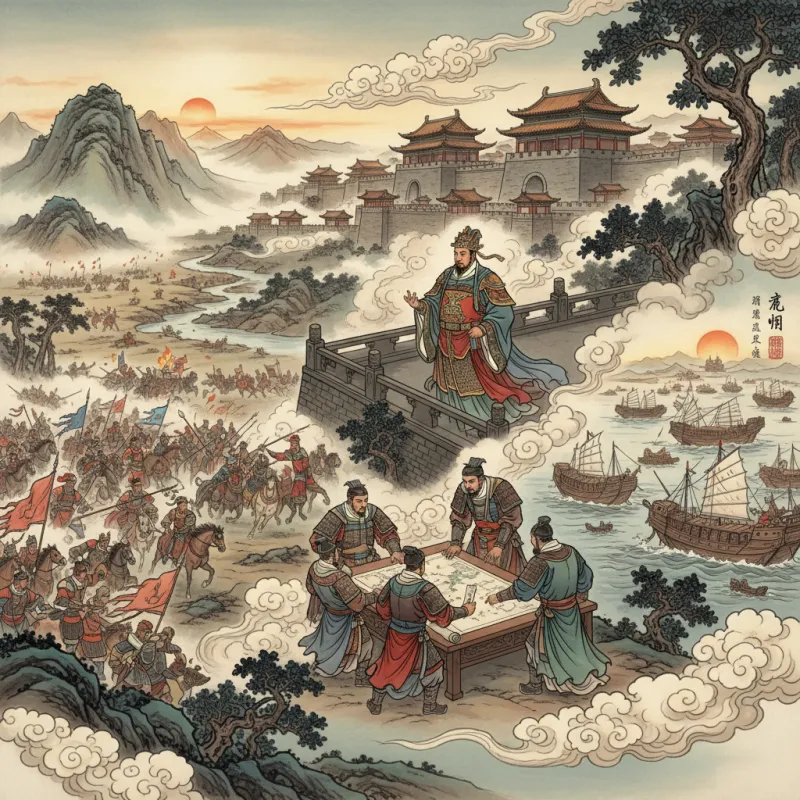
The chariot wheels had barely stopped turning when Sun Wu presented his radical manuscript to King Helü of Wu. The year was 512 BCE, and what this former Qi state general carried would revolutionize warfare for the next two millennia. His Sunzi Bingfa (孙子兵法, The Art of War) didn't just describe how to fight—it explained how to win without fighting at all. This philosophical approach to military strategy would become the backbone of Chinese warfare, distinguishing it from the brute-force tactics that dominated other ancient civilizations.
The Warring States Laboratory of War
The Warring States period (475-221 BCE) wasn't just chaotic—it was the crucible that forged Chinese military thought into something unprecedented. Seven major states clawed at each other's throats for survival, and this existential pressure produced innovations that would echo through history. The state of Qin, eventually victorious, didn't win through superior numbers alone. They won because they systematized warfare in ways their rivals couldn't match.
Consider the Battle of Changping in 260 BCE, where Qin general Bai Qi (白起) faced off against Zhao forces. The numbers were staggering—450,000 Zhao soldiers trapped and ultimately buried alive after their surrender. But the real story isn't the brutality; it's how Bai Qi used deception to lure the Zhao army into an untenable position, cutting their supply lines and forcing capitulation. This wasn't mindless slaughter—it was calculated psychological warfare combined with logistical mastery, principles straight from Sun Tzu's playbook.
The period also saw the rise of professional military treatises beyond Sun Tzu. Wu Qi's Wuzi (吴子) emphasized the moral dimension of warfare, arguing that soldiers fight hardest when they believe in their cause. The Liutao (六韬, Six Secret Teachings) attributed to Jiang Ziya provided practical advice on everything from troop formations to espionage networks. These weren't abstract philosophies—they were operational manuals tested in the blood-soaked fields of constant warfare.
Han Dynasty: Cavalry and the Xiongnu Challenge
When the Han Dynasty consolidated power after 206 BCE, they inherited a unified empire but faced an immediate existential threat from the north. The Xiongnu confederation of nomadic tribes had mastered mounted archery to a degree that made them nearly invincible on open terrain. Early Han emperors tried appeasement, sending princesses and tribute in the heqin (和亲, peace through kinship) policy. It bought time, nothing more.
Emperor Wu of Han (汉武帝, r. 141-87 BCE) changed everything. He didn't just want to defend against the Xiongnu—he wanted to break them. His general Wei Qing (卫青) and the legendary Huo Qubing (霍去病) launched deep-penetration cavalry raids that turned the tables on nomadic warfare. The Battle of Mobei in 119 BCE saw Huo Qubing lead 50,000 cavalry over 1,000 miles into Xiongnu territory, destroying their royal court and forcing them into permanent retreat.
What made this possible? The Han had finally developed their own cavalry traditions, breeding programs for war horses, and—crucially—the logistical infrastructure to support extended campaigns in hostile territory. They also employed Xiongnu defectors who understood steppe warfare intimately. This wasn't just military innovation; it was strategic adaptation at the civilizational level. The military innovations of the Han Dynasty would influence Chinese warfare for centuries.
Three Kingdoms: The Romance and Reality of Strategic Genius
The collapse of the Han Dynasty in 220 CE ushered in the Three Kingdoms period, which has been romanticized beyond recognition by the 14th-century novel Romance of the Three Kingdoms. But strip away the embellishments, and you find genuine strategic brilliance that still merits study.
The Battle of Red Cliffs in 208-209 CE remains one of history's most analyzed engagements. Cao Cao (曹操) commanded perhaps 220,000 troops (the novel claims 800,000, which is absurd) against the allied forces of Sun Quan and Liu Bei, who fielded maybe 50,000 combined. The southern alliance won through a fire attack that exploited Cao Cao's decision to chain his ships together to reduce seasickness among his northern troops. Zhuge Liang (诸葛亮) and Zhou Yu (周瑜) didn't just get lucky with the wind—they understood their enemy's weaknesses and the environmental conditions of the Yangtze River.
What's often overlooked is how this battle demonstrated the importance of naval warfare in Chinese military strategy. The Yangtze River wasn't just a geographic feature; it was a strategic barrier that required specialized knowledge to cross or defend. The southern kingdoms of Wu and later Shu understood riverine warfare in ways the northern Wei never fully mastered.
Zhuge Liang's later Northern Expeditions (228-234 CE) show both the brilliance and limitations of Chinese strategic thought. His use of the bagua zhen (八卦阵, Eight Trigrams Formation) and innovative logistics like the "wooden ox" supply carts demonstrated tactical creativity. But he never achieved his goal of conquering Wei, partly because strategic genius can't overcome fundamental resource disparities. Shu was simply too small and too poor to sustain prolonged offensive operations against a larger, wealthier opponent.
Tang Dynasty: The Apex of Imperial Military Power
The Tang Dynasty (618-907 CE) represents Chinese military power at its zenith. At its height under Emperor Taizong (唐太宗, r. 626-649 CE), Tang armies projected power from Korea to Central Asia, creating a cosmopolitan empire that absorbed and adapted military techniques from across Eurasia.
Taizong himself was a military genius who had fought in the wars that established the dynasty. His campaigns against the Eastern Turks in 629-630 CE demonstrated sophisticated combined-arms tactics, using infantry, cavalry, and even camel corps in coordinated operations. The Tang military system, based on the fubing (府兵, militia system), created a self-sustaining military force that didn't drain the treasury—at least initially.
But the Tang's greatest military achievement might be their defeat of the Göktürk Khaganate, which had threatened China for generations. By 657 CE, Tang forces had pushed their frontier to the Aral Sea, an unprecedented expansion that required not just military might but also diplomatic finesse in managing dozens of tributary states and allied tribes.
The Battle of Talas in 751 CE, where Tang forces clashed with the Abbasid Caliphate, marked the limit of Chinese westward expansion. Though the Tang lost, the battle's significance is often overstated—it didn't collapse the empire, but it did signal that Tang power had reached its natural limits. The real disaster came four years later with the An Lushan Rebellion (755-763 CE), which revealed how dependent the Tang had become on non-Chinese generals and troops. The military structure of the Tang Dynasty would never fully recover.
Song Dynasty: Wealth Without Military Dominance
The Song Dynasty (960-1279 CE) presents a paradox: economically and culturally, it was perhaps China's most advanced civilization, yet militarily it was consistently outmatched by "barbarian" neighbors. This wasn't due to lack of innovation—the Song pioneered gunpowder weapons, developed sophisticated naval forces, and maintained armies exceeding one million men. The problem was structural and philosophical.
Song Taizu (宋太祖), the dynasty's founder, deliberately weakened military authority to prevent the kind of military coup that had brought him to power. He rotated generals frequently, divided military commands, and elevated civilian officials over military ones. This created stability at home but weakness abroad. The Song paid tribute to the Liao Dynasty, then the Jin Dynasty, and finally fell to the Mongols despite having superior resources.
The Song did excel in defensive warfare and siege technology. Their use of gunpowder weapons—fire lances, primitive grenades, and eventually true guns—represented a revolution in military technology. The naval Battle of Caishi in 1161 CE, where Song forces destroyed a Jin invasion fleet using paddle-wheel warships and incendiary weapons, showed what Song military innovation could achieve when properly deployed.
Yet the Song's ultimate failure against the Mongols revealed the limits of technological advantage without strategic coherence.襄阳 (Xiangyang), the fortress city that held out against Mongol siege from 1268 to 1273, demonstrated Song defensive capabilities. But once it fell, the dynasty's fate was sealed. No amount of gunpowder could compensate for divided command, political infighting, and the lack of a coherent strategic vision.
The Enduring Legacy of Chinese Military Thought
What distinguishes Chinese military strategy from other traditions isn't just the emphasis on deception and indirect approaches—it's the integration of military thought with broader philosophical and political frameworks. Sun Tzu's dictum that "the supreme art of war is to subdue the enemy without fighting" reflects Daoist principles of wuwei (无为, effortless action) and Confucian concerns about the moral costs of warfare.
This philosophical grounding meant Chinese military thought remained remarkably consistent across dynasties, even as tactics and technology evolved. The emphasis on intelligence gathering, understanding terrain, maintaining morale, and achieving political objectives rather than mere battlefield victory—these principles appear in texts separated by centuries because they reflected deeper cultural values.
Modern military theorists from Mao Zedong to contemporary strategists continue to mine ancient Chinese military texts for insights. The concept of "unrestricted warfare" proposed by PLA colonels Qiao Liang and Wang Xiangsui in 1999 explicitly draws on Sun Tzu's holistic approach to conflict. Whether discussing cyber warfare, economic competition, or traditional military operations, the ancient Chinese understanding that war is fundamentally about achieving political goals through the most efficient means possible remains relevant.
The battles and strategies of ancient Chinese dynasties weren't just historical events—they were laboratories that tested and refined ideas about power, conflict, and human nature that continue to resonate today.
Related Reading
- The Terracotta Army: 8,000 Soldiers Guarding an Emperor's Tomb
- Chinese Military Strategy: Sun Tzu and the Art of Winning Without Fighting
- Sun Tzu in Action: 5 Real Battles That Used Art of War Strategy
- The Great Wall of China: The Complete History Beyond the Myth
- The Art of War Is Not About War (It Is About Avoiding It)
- Unveiling the Splendor of Ancient Chinese Architecture Across Dynasties
- Unraveling the Economic Tapestry of Ancient Chinese Dynasties
- Unveiling the Role of Women in Ancient Chinese Dynasties