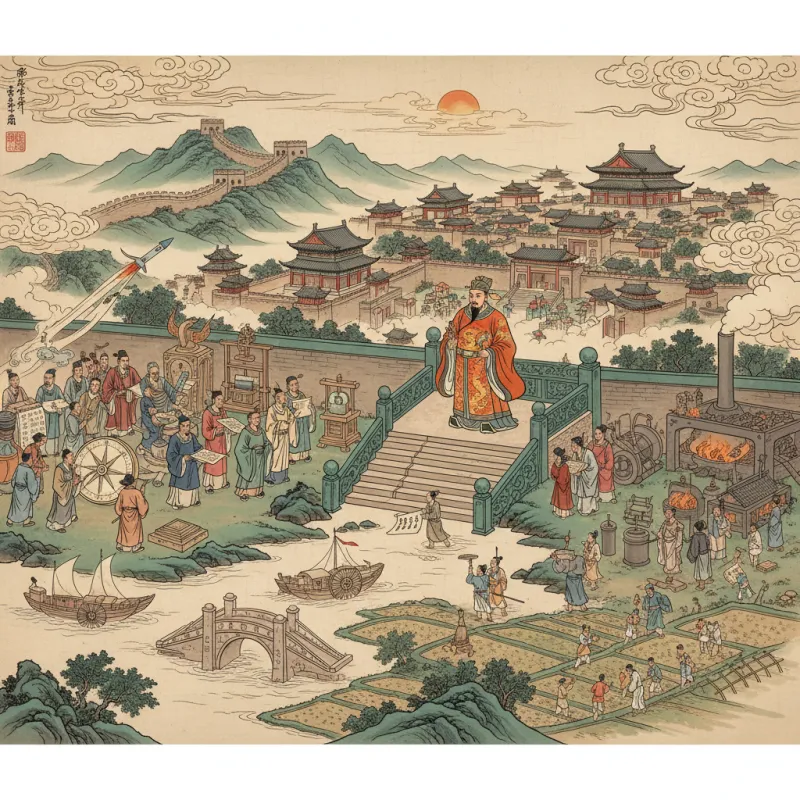
When a Chinese eunuch named Cai Lun (蔡伦) presented his paper-making technique to Emperor He in 105 CE, he probably didn't realize he was handing humanity one of its most transformative tools. But here's what really gets me: Europe wouldn't figure out papermaking for another thousand years. A millennium. That's not a head start — that's a different civilization timeline altogether.
The Paper Revolution Nobody Talks About
Sure, everyone knows Cai Lun invented paper. What they don't know is that he was essentially recycling trash. His formula used tree bark, hemp scraps, old fishing nets, and worn-out rags — the kind of materials people threw away. He pulped them, spread the mixture thin, and let it dry into sheets. Brilliant in its simplicity.
But the real genius wasn't the invention itself. It was what paper replaced. Before Cai Lun, Chinese scholars wrote on bamboo strips or silk. Bamboo was heavy — a single book could weigh dozens of pounds. Silk was expensive — only the wealthy could afford it. Paper democratized knowledge. Suddenly, a merchant could own books. A student could take notes. A government could maintain records without building warehouses for bamboo.
The ripple effects were staggering. The imperial examination system, which would shape Chinese governance for centuries, only became practical because of cheap paper. Buddhist sutras spread across Asia on paper scrolls. Poetry flourished because poets could actually afford to write. When paper reached the Islamic world around 750 CE (after Chinese papermakers were captured in the Battle of Talas), it triggered an intellectual golden age in Baghdad. Europe finally got paper in the 12th century, and within 300 years, they had the printing press and the Renaissance.
Printing: The Technology Europe Gets Credit For
Here's an uncomfortable truth for Western history books: Johannes Gutenberg's printing press in 1440 was impressive, but China had been printing books for six centuries by then.
The Diamond Sutra, printed in 868 CE during the Tang Dynasty, is the world's oldest surviving printed book. It's not a fragment or a curiosity — it's a complete, sophisticated scroll with intricate illustrations. The woodblock printing technique that created it was already mature technology by then, suggesting Chinese printers had been refining their craft for generations.
But woodblock printing had limitations. Each page required carving an entire block of wood in reverse. Want to print a different book? Carve new blocks. The Song Dynasty inventor Bi Sheng (毕昇) solved this around 1040 CE with movable type made from clay. Individual characters could be arranged, printed, then rearranged for the next page. It was modular, reusable, and conceptually identical to what Gutenberg would "invent" 400 years later.
Why didn't movable type revolutionize China the way it did Europe? The Chinese writing system has thousands of characters, making typesetting more complex than alphabetic languages. Woodblock printing remained more practical for Chinese texts. But the technology existed, was documented, and even spread to Korea, where metal movable type appeared in the 13th century — still two centuries before Gutenberg.
Gunpowder: From Immortality Elixirs to Imperial Warfare
Taoist alchemists in the 9th century were trying to create an elixir of immortality when they accidentally invented the opposite: a substance that could end life spectacularly. They mixed saltpeter, sulfur, and charcoal, and discovered that heating this combination produced an explosive reaction. One Tang Dynasty text warns alchemists that certain formulas "caused smoke and flames, burning hands and faces, and even burning down the building."
By the 10th century, the Song Dynasty military had weaponized gunpowder into fire lances (火枪, huǒqiāng) — bamboo tubes packed with gunpowder that shot flames and projectiles. These evolved into true guns and cannons by the 13th century. The Mongols, always quick to adopt useful military technology, spread gunpowder weapons across their empire, which is how the formula reached the Middle East and eventually Europe.
What fascinates me is how differently China and Europe used gunpowder. Chinese military doctrine emphasized defensive warfare and siege weapons. European powers, locked in constant territorial conflicts, optimized gunpowder for field artillery and handheld firearms. By the 16th century, European gun technology had surpassed Chinese designs — not because Europeans were more innovative, but because their endless wars created stronger evolutionary pressure for weapons development.
The Compass: Navigation Technology That Stayed Home
Chinese fortune-tellers during the Han Dynasty used lodestones (naturally magnetic rocks) to align their divination boards. By the Song Dynasty, someone realized that a magnetized needle floating in water always pointed north-south. This became the compass (指南针, zhǐnánzhēn — literally "south-pointing needle").
The maritime compass appeared in Chinese texts by the 11th century, giving sailors a reliable navigation tool that worked even when stars were obscured. Arab traders learned the technology from Chinese merchants, and it reached Europe by the 12th century. Within a few generations, European explorers were using Chinese compass technology to circumnavigate the globe.
Here's the irony: China invented the compass but never used it for the kind of aggressive maritime exploration that defined the European Age of Discovery. Admiral Zheng He's treasure fleets in the early 15th century were massive — ships far larger than anything Columbus would sail — but they were diplomatic missions, not conquest expeditions. After Zheng He, China turned inward, and the compass that could have made them a global maritime power instead helped Europeans colonize the world.
The Inventions Nobody Mentions
Focusing only on the Four Great Inventions is like judging a restaurant by four dishes while ignoring the rest of the menu. Chinese innovation was far broader.
Porcelain (瓷器, cíqì): Europeans called it "china" because they couldn't figure out how to make it. The secret was kaolin clay fired at extremely high temperatures — technology China mastered during the Tang Dynasty. Europe didn't crack the formula until the 18th century.
The Seismoscope: Zhang Heng (张衡) invented a device in 132 CE that could detect earthquakes hundreds of miles away. It used a pendulum mechanism that would drop a ball from a dragon's mouth into a frog's mouth below, indicating the direction of the seismic waves. Europe wouldn't have comparable seismological instruments until the 19th century.
The Mechanical Clock: Su Song (苏颂) built an astronomical clock tower in 1088 CE that used an escapement mechanism — the same principle that makes mechanical clocks work. It was 200 years before similar technology appeared in Europe.
Cast Iron: China was casting iron by the 5th century BCE. Europe didn't figure it out until the 14th century CE — a 1,800-year gap. This gave China superior agricultural tools, weapons, and construction materials for nearly two millennia.
The Stirrup: This seems simple, but stirrups revolutionized cavalry warfare by giving riders stability. Chinese cavalry used stirrups by the 4th century CE. European knights didn't adopt them until the 8th century, which is partly why mounted warriors became so dominant in medieval warfare.
Why Europe "Caught Up" (And What That Means)
By the 18th century, European technology had clearly surpassed Chinese innovation in many fields. Why? The answer isn't about intelligence or culture — it's about incentives and systems.
China's imperial system valued stability. Innovation was welcome if it supported existing structures, but disruptive change was often suppressed. The civil service examination system rewarded mastery of classical texts, not experimental science. Merchants had lower social status than scholars, limiting the commercial incentives for technological development.
Europe's fragmented political landscape created different pressures. Competing kingdoms meant constant warfare, driving military innovation. The rise of merchant classes created economic incentives for efficiency and productivity. The scientific revolution established institutions (universities, scientific societies) dedicated to systematic inquiry.
China invented the technologies that made the modern world possible, but Europe created the systems that accelerated technological change itself. It's not that Chinese innovation stopped — it's that European innovation accelerated dramatically.
The Legacy We're Still Living
When you write on paper, navigate with GPS (a descendant of compass technology), or use anything involving explosives or propellants, you're using Chinese inventions. The scientific achievements of ancient China laid groundwork that the entire world built upon.
What strikes me most isn't just that China invented these technologies first. It's how long they maintained that technological lead. We're talking about centuries, sometimes a full millennium, where Chinese innovation was simply operating on a different level than the rest of the world.
The question isn't why China invented so much. The question is why it took everyone else so long to catch up — and what we lost during those centuries when knowledge flowed in one direction but rarely back. The Four Great Inventions were just the beginning of a much larger story about how Chinese ingenuity shaped the world we inhabit today.
Related Reading
- Chinese Astronomy: Mapping the Stars for 4000 Years
- Traditional Chinese Medicine: 2,500 Years of Healing
- Chinese Astronomy: Mapping the Stars for 4,000 Years
- Unveiling the Role of Women in Ancient Chinese Dynasties
- The Three Kingdoms: History, Fiction, and Why Everyone's Obsessed
- The Art of War Is Not About War (It Is About Avoiding It)